
Study One-page note
Working Memory: Why You Can't Hold Much
Ever lose track halfway through a maths problem? Your working memory only holds about 4 things. Save this page.
Good to know
Capacity varies between people. Figures come from lab memory tasks.
What's on the page
The note as text, so you can read it, copy it or use a screen reader.
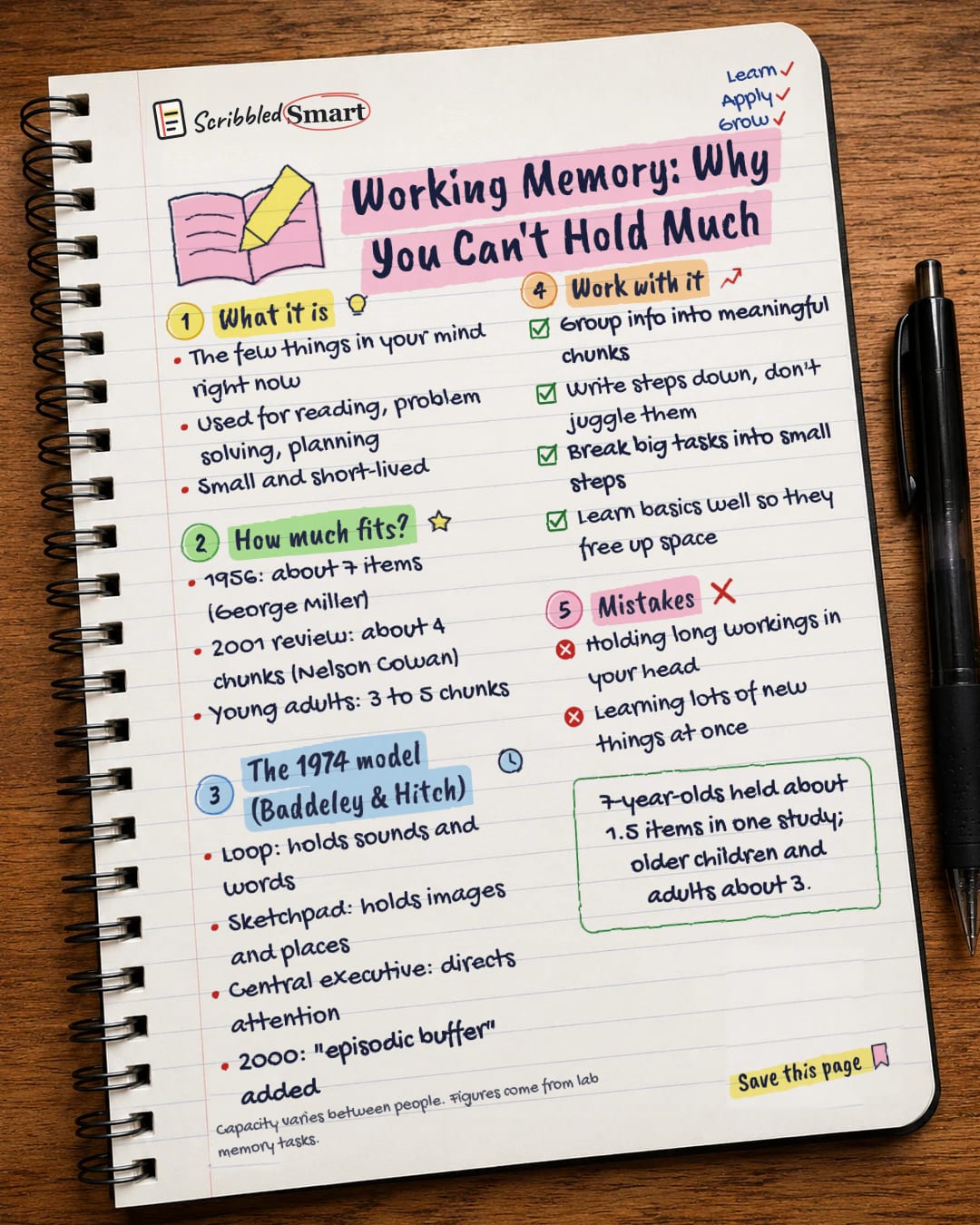
What it is
- The few things in your mind right now
- Used for reading, problem solving, planning
- Small and short-lived
How much fits?
- 1956: about 7 items (George Miller)
- 2001 review: about 4 chunks (Nelson Cowan)
- Young adults: 3 to 5 chunks
The 1974 model (Baddeley & Hitch)
- Loop: holds sounds and words
- Sketchpad: holds images and places
- Central executive: directs attention
- 2000: "episodic buffer" added
Work with it
- Group info into meaningful chunks
- Write steps down, don't juggle them
- Break big tasks into small steps
- Learn basics well so they free up space
Mistakes
- Holding long workings in your head
- Learning lots of new things at once
Sources
- Cowan (2001), Behavioral and Brain Sciences 24(1)
- Cowan (2010), The Magical Mystery Four, Current Directions in Psychological Science 19(1) (PMC)
- Baddeley (2000), Trends in Cognitive Sciences 4(11)
- Baddeley & Hitch (1974), Working memory, Psychology of Learning and Motivation 8
- Perry et al. (2021), Cognitive Science in the Classroom, EEF (PDF copy)
- EEF: Metacognition and Self-regulated Learning, summary of recommendations
How we checked this
Every fact on this note comes from the 6 sources listed here, checked against official or peer-reviewed sources where possible. AI tools help with drafting; a person checks every fact against the sources. How we research
Spotted a mistake? Tell us and we'll fix it and log it on the corrections page.


