
Study One-page note
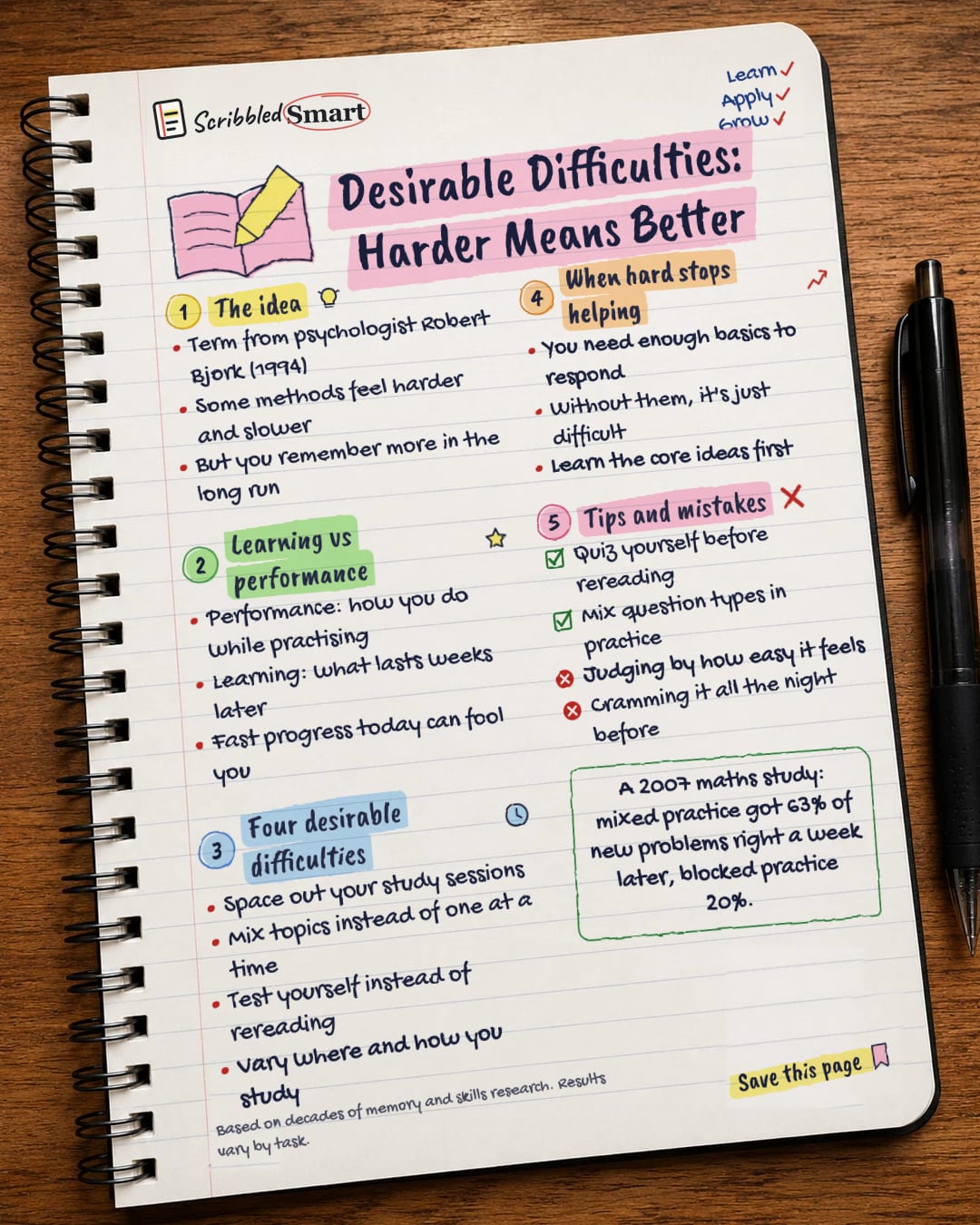
Desirable Difficulties: Harder Means Better
If studying feels easy, you might not be learning much. Here's why harder can be better. Save this page.
Good to know
Based on decades of memory and skills research. Results vary by task.
What's on the page
The note as text, so you can read it, copy it or use a screen reader.
The idea
- Term from psychologist Robert Bjork (1994)
- Some methods feel harder and slower
- But you remember more in the long run
Learning vs performance
- Performance: how you do while practising
- Learning: what lasts weeks later
- Fast progress today can fool you
Four desirable difficulties
- Space out your study sessions
- Mix topics instead of one at a time
- Test yourself instead of rereading
- Vary where and how you study
When hard stops helping
- You need enough basics to respond
- Without them, it's just difficult
- Learn the core ideas first
Tips and mistakes
- Quiz yourself before rereading
- Mix question types in practice
- Judging by how easy it feels
- Cramming it all the night before
Sources
- Bjork & Bjork (2011), Making things hard on yourself, but in a good way: Creating desirable difficulties to enhance learning. In Psychology and the Real World (pp. 56–64). PDF
- Soderstrom & Bjork (2015), Learning versus performance: An integrative review, Perspectives on Psychological Science 10(2)
- Bjork, Soderstrom & Little (2015), Can multiple-choice testing induce desirable difficulties?, American Journal of Psychology 128(2)
How we checked this
Every fact on this note comes from the 3 sources listed here, checked against official or peer-reviewed sources where possible. AI tools help with drafting; a person checks every fact against the sources. How we research
Spotted a mistake? Tell us and we'll fix it and log it on the corrections page.


