
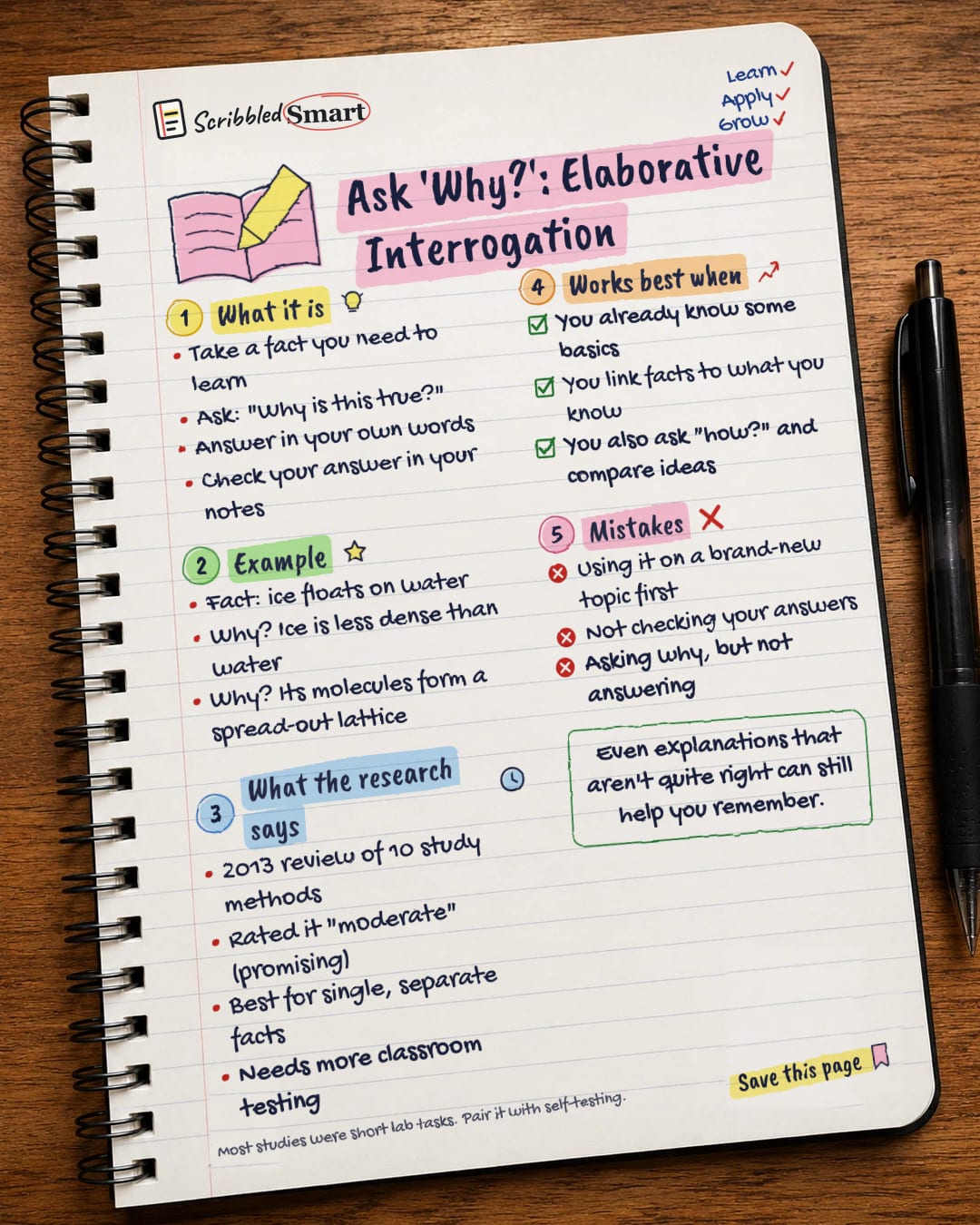
Study One-page note
Ask 'Why?': Elaborative Interrogation
One tiny question makes facts stick: why? Here's how elaborative interrogation works. Save this page.
Good to know
Most studies were short lab tasks. Pair it with self-testing.
What's on the page
The note as text, so you can read it, copy it or use a screen reader.
What it is
- Take a fact you need to learn
- Ask: "Why is this true?"
- Answer in your own words
- Check your answer in your notes
Example
- Fact: ice floats on water
- Why? Ice is less dense than water
- Why? Its molecules form a spread-out lattice
What the research says
- 2013 review of 10 study methods
- Rated it "moderate" (promising)
- Best for single, separate facts
- Needs more classroom testing
Works best when
- You already know some basics
- You link facts to what you know
- You also ask "how?" and compare ideas
Mistakes
- Using it on a brand-new topic first
- Not checking your answers
- Asking why, but not answering
Sources
- Dunlosky (2013), Strengthening the Student Toolbox, American Educator
- Dunlosky et al. (2013), PSPI 14(1)
- The Learning Scientists: Learn how to study using elaboration
- USGS Water Science School: Water density
- Kühl & Bertrams (2019), Frontiers in Psychology 10:707 (PMC)
- LEARN Quebec: A review of learning techniques and their efficacy
- Texas Center for Learning Disabilities summary
How we checked this
Every fact on this note comes from the 7 sources listed here, checked against official or peer-reviewed sources where possible. AI tools help with drafting; a person checks every fact against the sources. How we research
Spotted a mistake? Tell us and we'll fix it and log it on the corrections page.


