
Study One-page note
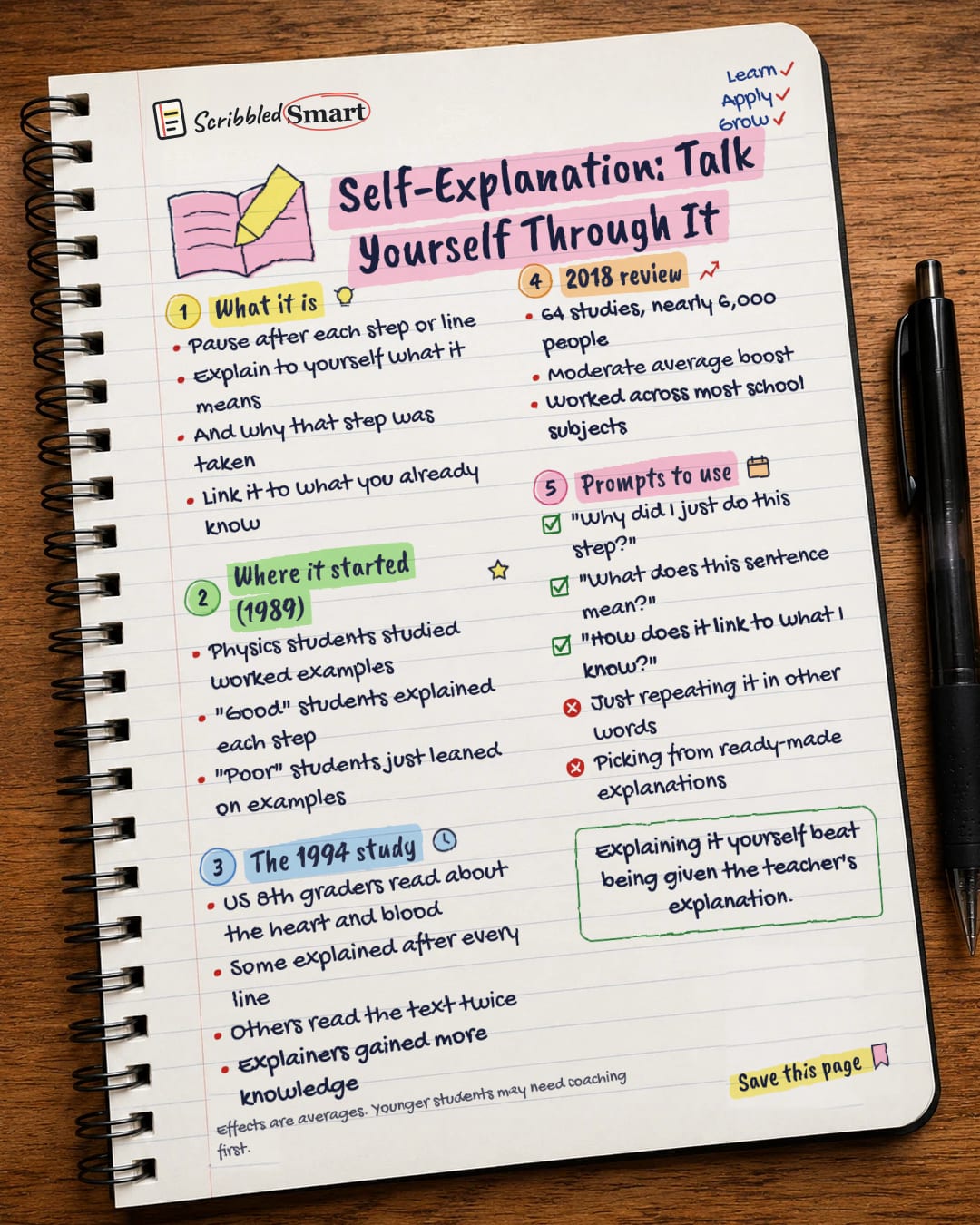
Self-Explanation: Talk Yourself Through It
Stuck on worked examples in maths or science? Talk yourself through every step. Save this page.
Good to know
Effects are averages. Younger students may need coaching first.
What's on the page
The note as text, so you can read it, copy it or use a screen reader.
What it is
- Pause after each step or line
- Explain to yourself what it means
- And why that step was taken
- Link it to what you already know
Where it started (1989)
- Physics students studied worked examples
- "Good" students explained each step
- "Poor" students just leaned on examples
The 1994 study
- US 8th graders read about the heart and blood
- Some explained after every line
- Others read the text twice
- Explainers gained more knowledge
2018 review
- 64 studies, nearly 6,000 people
- Moderate average boost
- Worked across most school subjects
Prompts to use
- "Why did I just do this step?"
- "What does this sentence mean?"
- "How does it link to what I know?"
- Just repeating it in other words
- Picking from ready-made explanations
Sources
- Chi, Bassok, Lewis, Reimann & Glaser (1989), Cognitive Science 13
- Chi, De Leeuw, Chiu & LaVancher (1994), Cognitive Science 18
- Bisra et al. (2018), Educational Psychology Review 30
- BPS Research Digest: Self-explanation is a powerful learning technique, according to meta-analysis of 64 studies
- Dunlosky (2013), Strengthening the Student Toolbox, American Educator
How we checked this
Every fact on this note comes from the 5 sources listed here, checked against official or peer-reviewed sources where possible. AI tools help with drafting; a person checks every fact against the sources. How we research
Spotted a mistake? Tell us and we'll fix it and log it on the corrections page.


