
AI & Tech One-page note
How GPS Works
Your phone doesn't talk to satellites. It listens to them, and does the maths itself. Here's how GPS finds you, and why the blue dot drifts indoors. Save this page.
Good to know
Simplified. Sources: GPS.gov (US government), Penn State. Checked Nov 2026.
What's on the page
The note as text, so you can read it, copy it or use a screen reader.
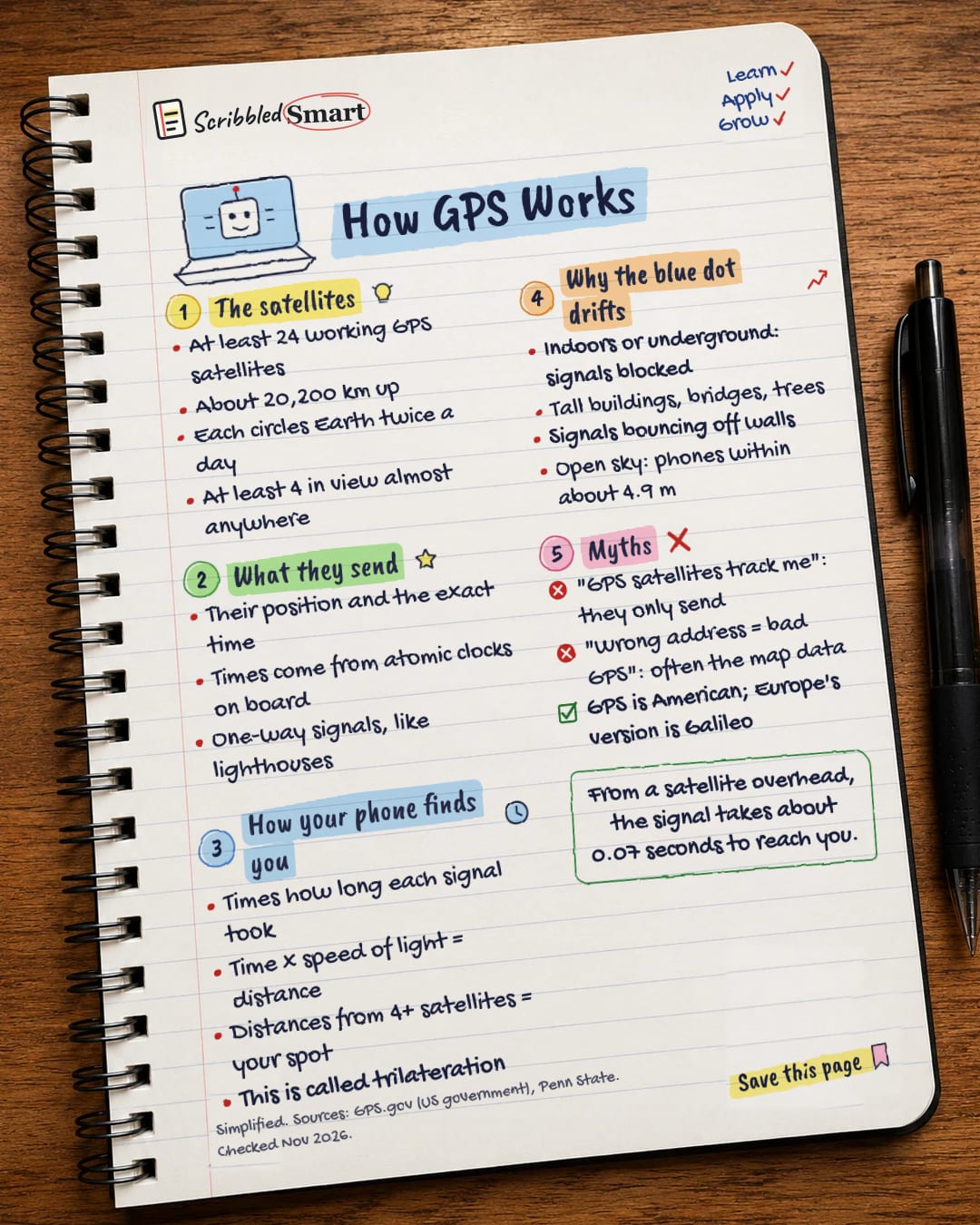
The satellites
- At least 24 working GPS satellites
- About 20,200 km up
- Each circles Earth twice a day
- At least 4 in view almost anywhere
What they send
- Their position and the exact time
- Times come from atomic clocks on board
- One-way signals, like lighthouses
How your phone finds you
- Times how long each signal took
- Time x speed of light = distance
- Distances from 4+ satellites = your spot
- This is called trilateration
Why the blue dot drifts
- Indoors or underground: signals blocked
- Tall buildings, bridges, trees
- Signals bouncing off walls
- Open sky: phones within about 4.9 m
Myths
- "GPS satellites track me": they only send
- "Wrong address = bad GPS": often the map data
- GPS is American; Europe's version is Galileo
Sources
How we checked this
Every fact on this note comes from the 8 sources listed here, checked against official or peer-reviewed sources where possible. AI tools help with drafting; a person checks every fact against the sources. How we research
Spotted a mistake? Tell us and we'll fix it and log it on the corrections page.


