
On this page
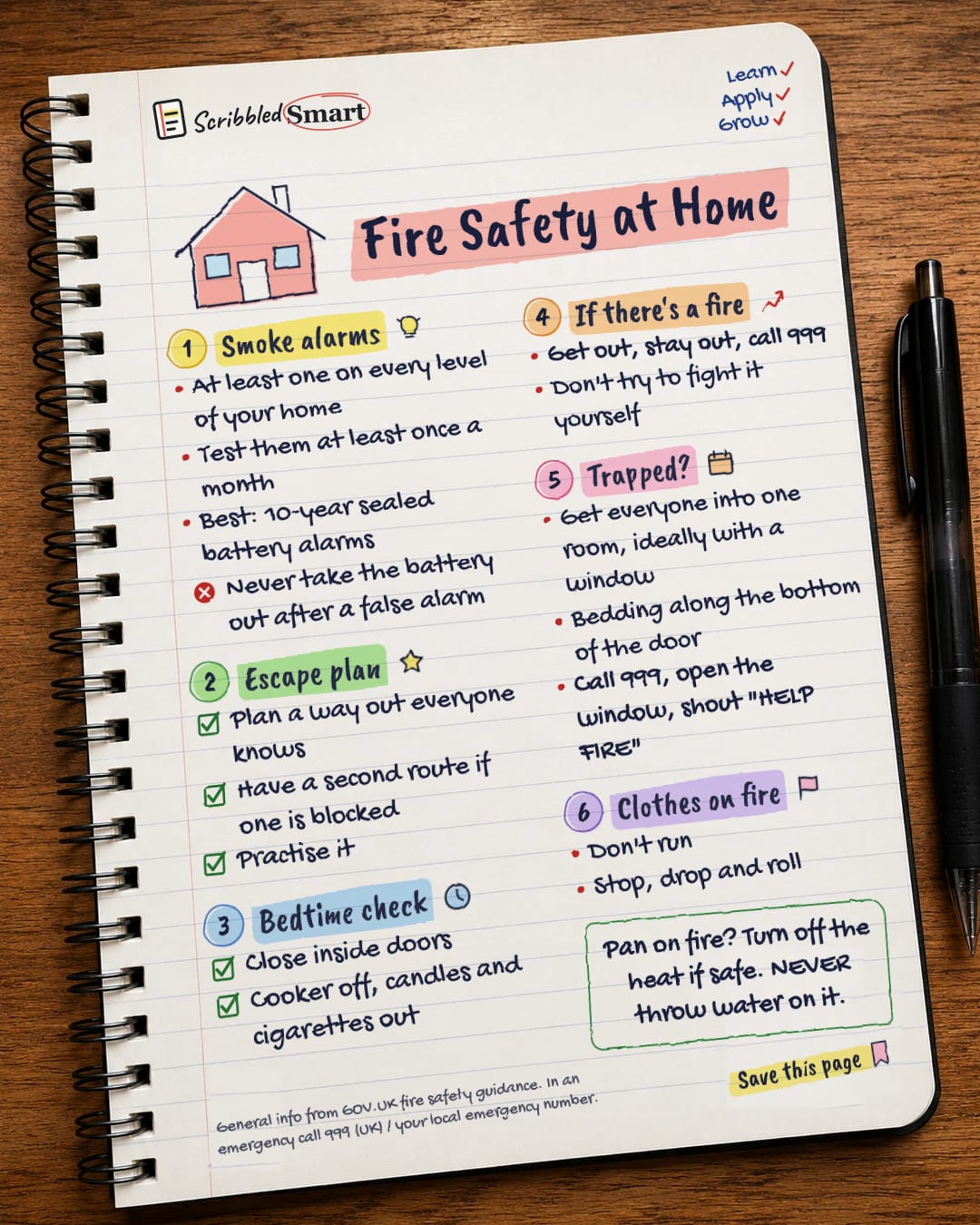
Fire safety at home starts with two things: working smoke alarms on every level, and an escape plan that everyone in your home knows. If a fire does start, the GOV.UK advice is simple: get out, stay out and call 999. This guide covers alarms, planning, a bedtime check, and what to do if you are trapped or your clothes catch fire.
🇬🇧 UK. Based on GOV.UK "Fire safety in the home" guidance (written for England), which matches advice from UK fire and rescue services.
In an emergency, call 999 (UK) or your local emergency number.
Smoke alarms: your first line of fire safety at home
Smoke alarms give you the warning you need to get out. The Fire Kills campaign says that in more than a third of fires in the home, smoke did not reach a smoke alarm in time. Here is what GOV.UK recommends.
- Fit at least one smoke alarm on every level of your home.
- Test them at least once a month. Fire services in Buckinghamshire and Hertfordshire give the same advice.
- Ten-year sealed battery alarms are the best option, according to GOV.UK.
- Standard battery alarms: change the battery every year.
- ✗ Never take the battery out or disconnect your alarm if it goes off by mistake.
Renting? Our guide to renting your first home in England covers what to check before you move in.
Free home fire safety visits
Many fire and rescue services offer free home fire safety visits. Check your local service to see if yours does.
How do you make a fire escape plan?
An escape plan means everyone knows how to get out before they ever need to. GOV.UK says:
- ✓ Plan an escape route and make sure everyone knows how to escape.
- ✓ Think of a second route in case the first one is blocked.
- ✓ Take a few minutes to practise your escape plan.
Do a bedtime check
A quick check before bed takes a minute. GOV.UK suggests:
- ✓ Close inside doors at night to stop a fire from spreading.
- ✓ Turn the cooker off.
- ✓ Put candles and cigarettes out.
Everyday habits
GOV.UK also advises:
- Never smoke in bed. Use a proper ashtray.
- Keep to one plug per socket, and don't overload extension leads.
If there's a fire: get out, stay out, call 999
If a fire starts, leave. Don't stay to fight it.
- Get out.
- Stay out.
- Call 999.
GOV.UK is clear: don't tackle fires yourself. Leave it to the professionals.
What should you do if you are trapped by a fire?
If you can't get out, GOV.UK says:
- Get everyone into one room, ideally with a window and a phone.
- Put bedding around the bottom of the door.
- Call 999.
- Open the window and shout "HELP FIRE".
If your clothes catch fire
GOV.UK gives a simple rule to remember.
- Don't run around.
- Stop, drop and roll. Lie down and roll around.
Pan fires
If a pan catches fire, GOV.UK says turn off the heat if it is safe to do so. Never throw water over it.
Fire safety at home: common mistakes
Each of these is simple to put right.
- ✗ Taking the battery out after a false alarm. Never disconnect your alarm.
- ✗ Not testing alarms. Test them at least monthly.
- ✗ Only having one way out. Plan a second route.
- ✗ Trying to fight the fire yourself. Get out, stay out, call 999.
- ✗ Throwing water on a pan fire. Turn off the heat if it's safe, and never use water.
FAQ
How often should you test your smoke alarm?
GOV.UK says test your smoke alarms at least monthly, and local fire services agree. Fit at least one alarm on every level of your home. If you have standard battery alarms, change the battery every year. GOV.UK says ten-year sealed battery alarms are the best option.
How many smoke alarms do I need?
GOV.UK says fit at least one smoke alarm on every level of your home. That means a home with two floors needs at least two. The Fire Kills campaign says that in more than a third of home fires, smoke did not reach a smoke alarm in time.
What should you do if your clothes catch fire?
Don't run around. GOV.UK says stop, drop and roll: lie down and roll around. These three words are short enough for everyone in your home to remember, so it is worth going over them together when you practise your escape plan. In an emergency, call 999 (UK).
What should you do if a pan catches fire?
GOV.UK says turn off the heat if it is safe to do so, and never throw water over it. More generally, GOV.UK says don't tackle fires yourself and leave it to the professionals. Its advice for any fire in the home is to get out, stay out and call 999.
Related reading
- First aid basics: including how to cool a burn.
- Moving house: who to tell: a good moment to test the alarms in your new home.
Sources
- GOV.UK: Fire safety in the home (accessible version)
- GOV.UK: Fire Kills campaign
- Buckinghamshire Fire & Rescue: Fire safety in the home
- Hertfordshire County Council: Fire safety at home
How we checked this
Every fact in this article comes from the 4 sources listed above, checked against official or peer-reviewed sources where possible. AI tools help with drafting; a person checks every fact against the sources. How we research
- Published and checked
🇬🇧 General info from GOV.UK fire safety guidance (England), which matches UK fire services' advice. In an emergency call 999 (UK) / your local emergency number.
Spotted a mistake? Tell us and we'll fix it and log it on the corrections page.


