
On this page
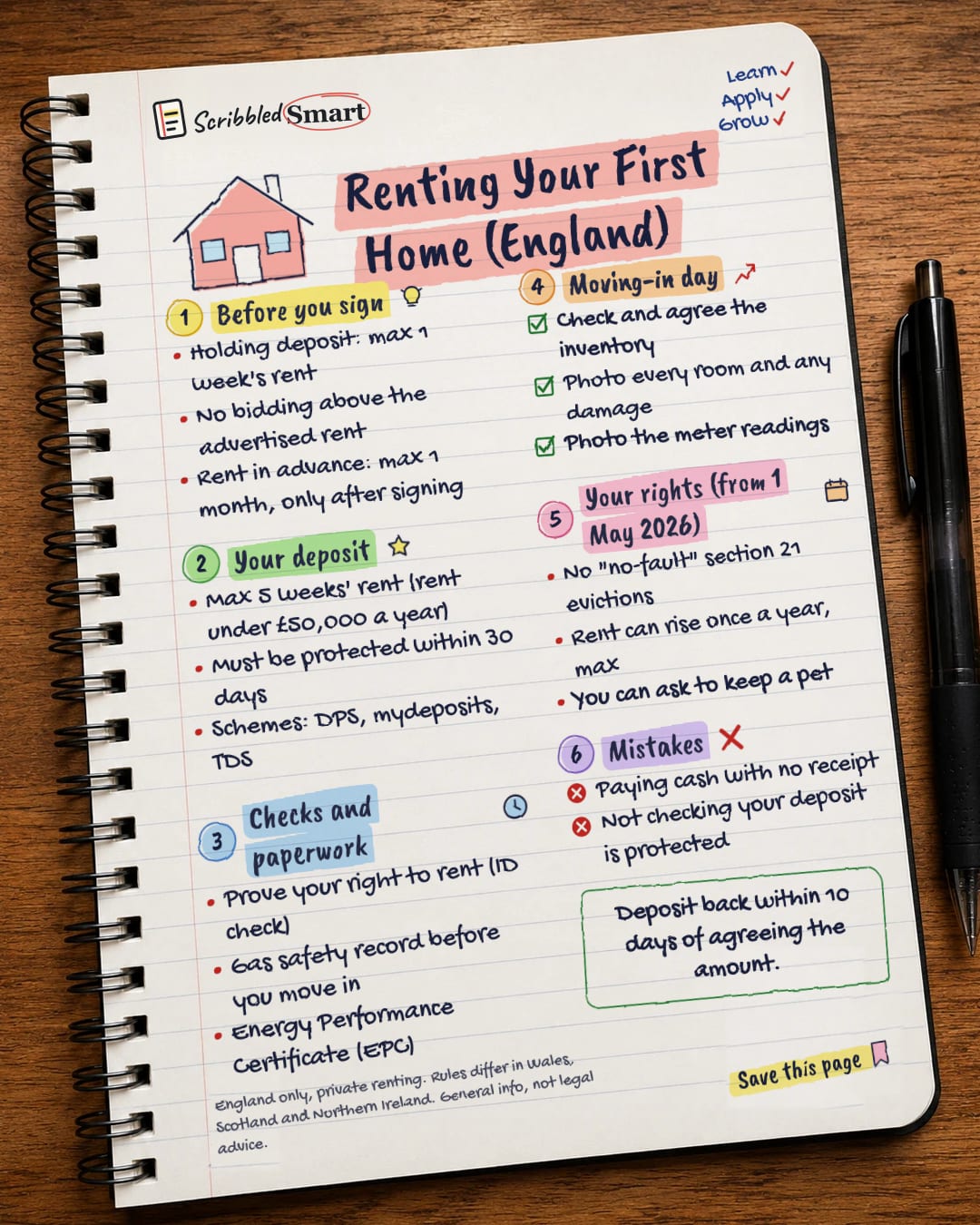
When you are renting your first home in England, the main rules are simple: a holding deposit is capped at 1 week's rent, a tenancy deposit is usually capped at 5 weeks' rent, and your landlord must protect it within 30 days. From 1 May 2026 you also have new rights under the Renters' Rights Act 2025. This guide walks through each stage, from before you sign to the day you move in.
🇬🇧 England only, private renting. Rules as of November 2026. Rules differ in Wales, Scotland and Northern Ireland.
Before you sign
Holding deposit
A holding deposit is money you pay to reserve a home while the checks are done. The maximum holding deposit is equal to 1 week's rent. It can be held for 15 days, unless you agree a different time in writing.
No bidding wars
Your landlord cannot accept or encourage offers above the advertised rent. So you should not be asked to "beat" another renter's offer. The advertised rent is the rent.
Rent in advance
You cannot be asked for rent before you sign the tenancy. After signing, the most you can be asked for in advance is 1 month's rent.
Fees you should not pay
Some payments are banned. These "prohibited payments" include being made to pay for cleaning, or for a professional clean when you move out. If someone asks for a fee, check the Tenant Fees Act guidance for tenants first.
How do tenancy deposits work in England?
How much it can be
The deposit limit depends on your yearly rent:
| Yearly rent | Maximum deposit |
|---|---|
| Under £50,000 | 5 weeks' rent |
| £50,000 to £100,000 | 6 weeks' rent |
Deposit protection
Your landlord must put your deposit in a government-approved scheme within 30 days of getting it. There are three schemes:
- Deposit Protection Service (DPS)
- MyDeposits
- Tenancy Deposit Scheme (TDS)
This rule (30 days, three schemes) applies in England and Wales. Scotland and Northern Ireland have different schemes.
Getting it back
When you move out, you and your landlord agree how much of the deposit you get back. You must then get it back within 10 days of you both agreeing the amount.
What checks and paperwork should you expect?
Right to rent
In England, you must prove your right to rent before you can rent a home. You do not need to prove your right to rent in Wales, Scotland or Northern Ireland.
Gas safety record
Your landlord must give you a copy of the gas safety check record before you move in, or within 28 days of the check.
Energy Performance Certificate (EPC)
Your landlord must provide an Energy Performance Certificate (EPC). Ask for a copy before you sign.
Smoke and carbon monoxide alarms
Your landlord must provide a smoke alarm on each storey. They must also fit a carbon monoxide (CO) alarm in any room with a solid fuel appliance. For testing alarms and planning a way out, see our home fire safety guide.
Moving-in day
None of these steps are legal rules. They are sensible habits that protect you if there is a dispute about your deposit later.
- Check and agree the inventory. This is the list of what is in the home and its condition. Read it, correct it, and agree it.
- Photograph every room. Include any marks, stains or damage, however small.
- Photograph the meter readings. This shows what you used and what the last person used. Our guide to who to tell when you move house covers sending readings to your energy supplier.
What are your rights as a renter from 1 May 2026?
The Renters' Rights Act 2025 changed private renting in England. On 1 May 2026, assured shorthold tenancies became assured periodic tenancies. Here are the changes most first-time renters need to know.
No more "no-fault" evictions
From 1 May 2026 you can no longer be evicted using the "no fault" section 21 process.
Rent rises
Your landlord can only increase the rent once a year. They cannot raise it in the first 12 months, and they must give you at least 2 months' notice.
Pets
You can ask to keep a pet. Your landlord should give you a reason if they refuse.
Ending your tenancy
On an assured periodic tenancy, you give 2 months' notice in writing if you want to leave.
Fair treatment
The GOV.UK overview also says landlords cannot refuse tenants because they are on benefits or have children.
More changes to come
Other parts of the Act come in later phases. The GOV.UK implementation roadmap sets these out, so check it for the latest dates.
Tips for renting your first home in England
Do:
- ✓ Keep a record of every payment you make.
- ✓ Check your deposit is protected after 30 days.
- ✓ Keep your photos and inventory somewhere safe until your deposit is back.
Avoid:
- ✗ Paying cash with no receipt. Without proof, it is hard to show what you paid.
- ✗ Not checking your deposit is protected. Your landlord has 30 days. If you have not heard which scheme it is in, ask your landlord.
Related reading
- Moving house: who to tell: the people to update once you have the keys.
- The 50/30/20 budget rule: a simple way to fit rent into your budget.
- Emergency fund: why a cash buffer helps when you need a deposit fast.
Sources
- GOV.UK: Tenancy deposit protection
- GOV.UK: Tenant Fees Act 2019, guidance for tenants
- GOV.UK: Renters' Rights Act overview for tenants
- GOV.UK: Prove your right to rent in England
- GOV.UK: Your landlord's safety responsibilities
- GOV.UK: Renting out a property, landlord responsibilities
- GOV.UK: How to rent (withdrawn 1 May 2026, kept for older tenancies)
- GOV.UK: Renters' Rights Act 2025 implementation roadmap
How we checked this
Every fact in this article comes from the 8 sources listed above, checked against official or peer-reviewed sources where possible. AI tools help with drafting; a person checks every fact against the sources. How we research
- Published and checked
- Next check
- Every 6 months while the Renters' Rights Act 2025 phases in. Next check by May 2027.
🇬🇧 England only, private renting. Rules differ in Wales, Scotland and Northern Ireland. General info, not legal advice.
Spotted a mistake? Tell us and we'll fix it and log it on the corrections page.


