
On this page
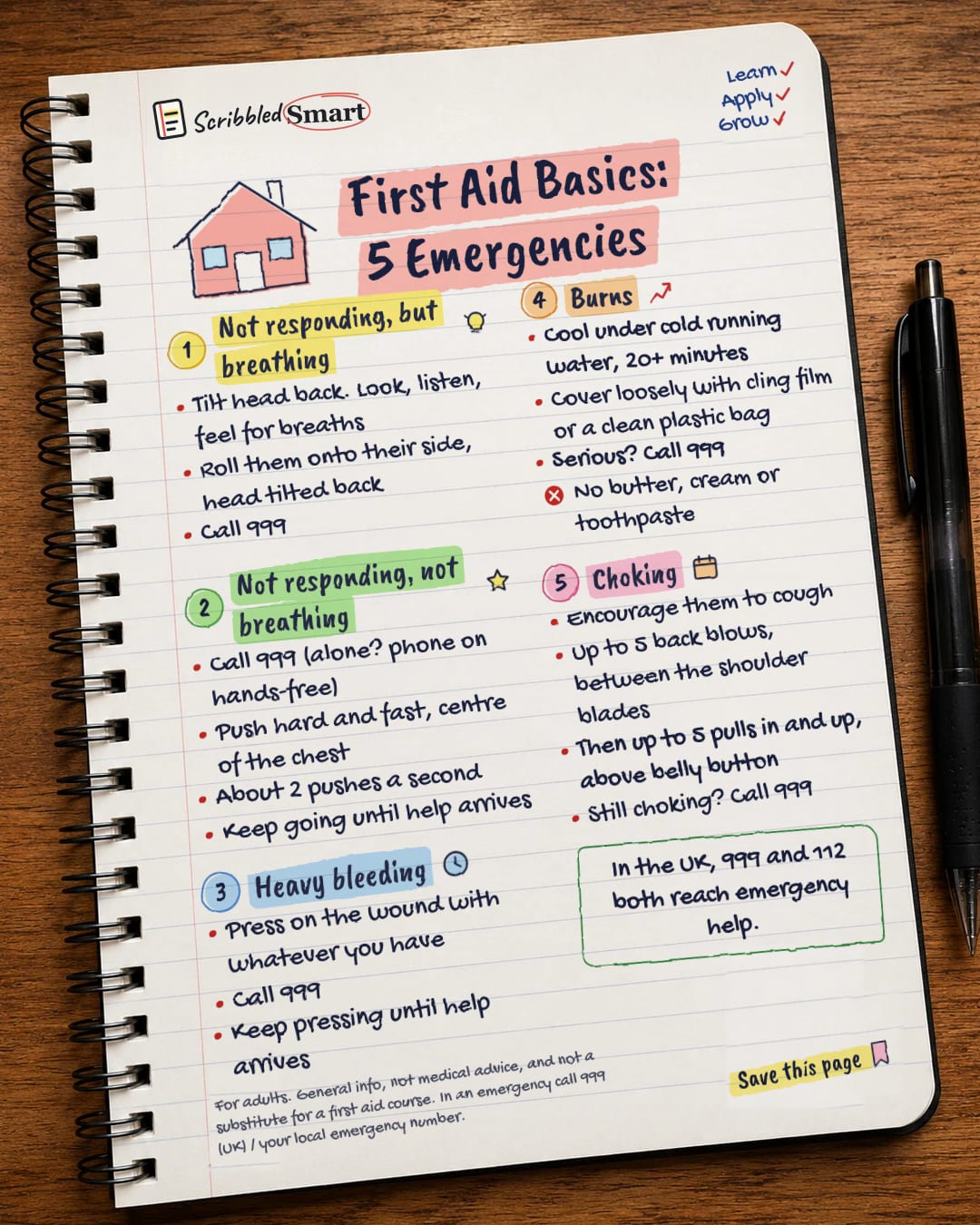
First aid basics come down to a few simple actions: check breathing, call 999, and then push, press, cool or clear depending on the emergency. This guide covers five common emergencies for adults, using the steps published by the British Red Cross and St John Ambulance. Read it now, while things are calm, so you are not reading it for the first time in a crisis.
In an emergency, call 999 (UK) or your local emergency number. 🇬🇧 In the UK, 999 and 112 both reach emergency help. Outside the UK, use your local emergency number wherever this guide says 999.
These steps are for adults. CPR and choking steps are different for children and babies, so they are not covered here.
1. Not responding, but breathing
If someone is not responding but may be breathing, follow the British Red Cross steps:
- Tilt the head back. Is their chest moving? Look, listen and feel for breaths.
- Move them onto their side and tilt their head back.
- Call 999.
This is a simple version of the recovery position. St John Ambulance has a page showing the full technique if you want to learn it in more detail.
2. Not responding, not breathing (CPR)
If they are not breathing, you need to start chest compressions. These are the British Red Cross compressions-only steps for people without CPR training.
- Call 999. If you are alone, put your phone on hands-free so you can keep your hands free.
- Push hard and fast in the centre of the chest. The British Red Cross says a rate of 2 pushes per second.
- Keep going until help arrives.
How fast and how deep
St John Ambulance gives the same advice in numbers:
| What | St John Ambulance guidance |
|---|---|
| Where | Centre of the chest |
| Rate | 100 to 120 pushes a minute (about 2 a second) |
| Depth | About 5 to 6 cm |
Defibrillators
St John Ambulance says to ask a helper to fetch a defibrillator. If you are alone, do not leave the person to go and find one.
Courses teach CPR in more depth. If you have not been trained, stick to the chest compressions above. To see why this matters, read our simple guide to how the heart pumps blood.
3. Heavy bleeding
The British Red Cross gives three steps:
- Press on the wound with whatever you have available.
- Call 999.
- Keep pressing on the wound until help arrives.
4. How should you treat a burn?
- Cool the burn under cold running water for at least 20 minutes.
- Cover it loosely with cling film or a clean plastic bag.
- If it is serious, call 999.
What not to do with a burn
- ✗ Don't put butter, cream or toothpaste on it.
- ✗ Don't remove clothes or anything that is stuck to the burn.
- ✗ Don't use adhesive plasters on a burn.
- ✗ Don't put the whole body under a cold shower. The British Red Cross warns this risks hypothermia (the body getting dangerously cold).
The British Red Cross also advises getting medical advice for any burn on a baby or child.
5. What do you do if an adult is choking?
If an adult is choking, the British Red Cross steps are:
- Encourage them to cough.
- Give up to 5 back blows between their shoulder blades.
- Then give up to 5 abdominal thrusts. Pull inwards and upwards, above their belly button.
- Still choking? Call 999.
First aid basics: tips and common mistakes
Do:
- ✓ Call 999 (UK) or your local emergency number. It is a step in all five emergencies on this page (for burns, when the burn is serious; for choking, if they are still choking).
- ✓ Use hands-free if you are alone, so you can talk to the call handler and keep helping.
- ✓ Keep going. With CPR and heavy bleeding, the advice is to continue until help arrives.
Avoid:
- ✗ Home remedies on burns, like butter, cream or toothpaste.
- ✗ Using these adult steps on a child or baby. Their steps are different.
- ✗ Adding steps you have not been trained in.
Where can you learn first aid properly?
This page is not a substitute for a first aid course. Both the British Red Cross and St John Ambulance run courses. The British Red Cross also has a first aid app and online learning. A course lets you practise these steps with a trainer.
Related reading
- Fire safety at home: smoke alarms, escape plans and what to do if clothes catch fire.
- How to change a tyre: another safety skill worth learning before you need it.
- Stress and your body: what stress does to you, including in an emergency.
Sources
- British Red Cross: Unresponsive and breathing
- British Red Cross: Unresponsive and not breathing
- British Red Cross: Bleeding heavily
- British Red Cross: Burns
- British Red Cross: Choking
- St John Ambulance: CPR
How we checked this
Every fact in this article comes from the 6 sources listed above, checked against official or peer-reviewed sources where possible. AI tools help with drafting; a person checks every fact against the sources. How we research
- Published and checked
For adults. General info, not medical advice, and not a substitute for a first aid course. In an emergency call 999 (UK) / your local emergency number.
Spotted a mistake? Tell us and we'll fix it and log it on the corrections page.


