
On this page
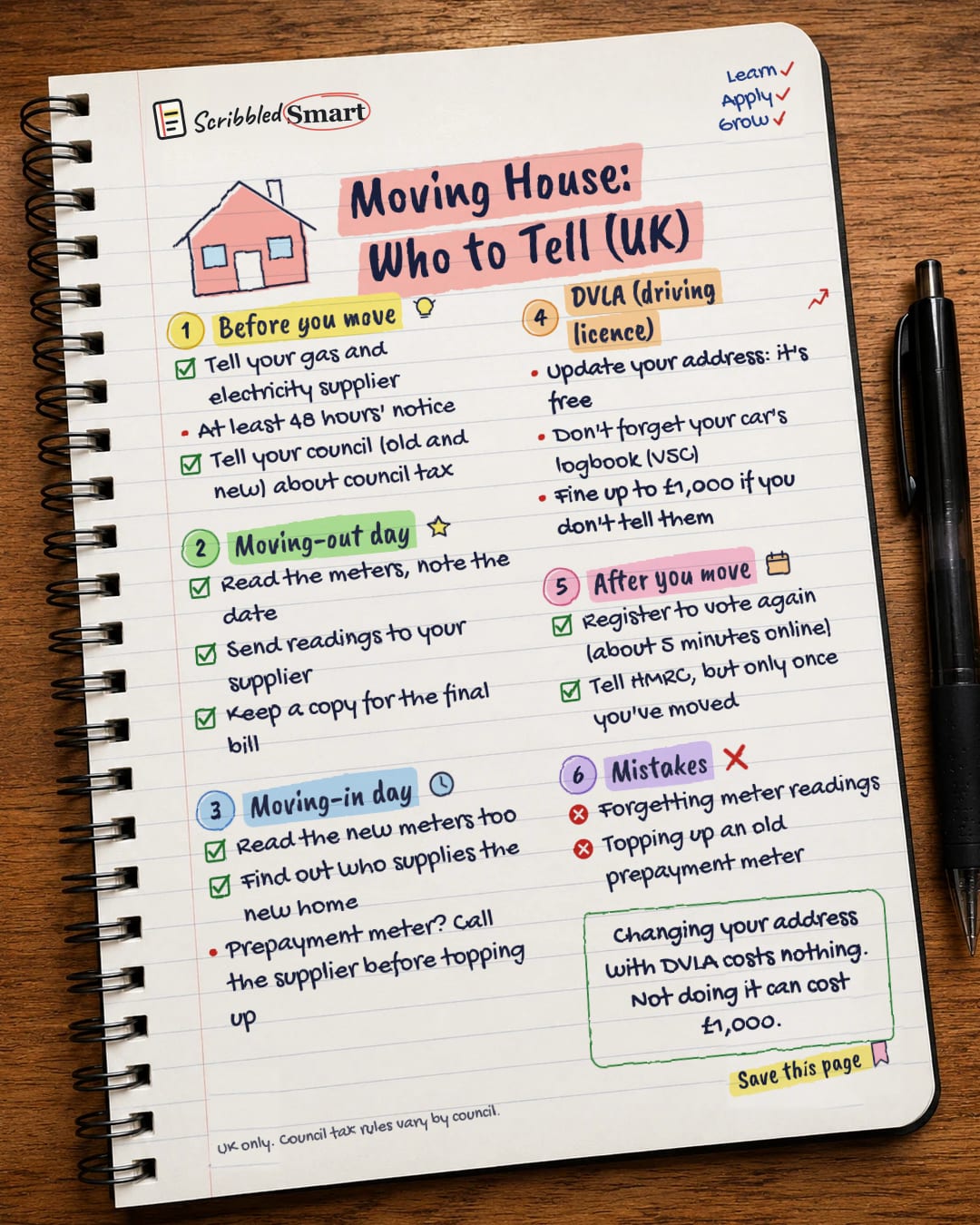
A moving house checklist UK movers can trust starts with five groups: your gas and electricity supplier, your council, DVLA, the electoral register and HMRC. Tell your energy supplier at least 48 hours before you move, read the meters on both moving days, and update your driving licence address, which is free but can cost you a fine of up to £1,000 if you forget. This guide puts each one in the right order.
🇬🇧 UK only. Rules as of November 2026. Council tax rules vary by council.
Who do you need to tell before you move?
The two jobs to do before moving day are telling your energy supplier and your council.
Your gas and electricity supplier
Citizens Advice says give your supplier at least 48 hours' notice that you are moving. (This figure is from the Citizens Advice page for England; there are separate versions for Wales and Scotland.)
Your council
When you move, tell the council at your old address that you are leaving, and register with the council at your new address. Council websites, such as Horsham, Hounslow and Central Bedfordshire, all say this.
Deadlines are different from council to council, so check your own council's website for when to tell them. If you get Council Tax Support or Housing Benefit, council sites say you may need to tell the benefits team separately too.
Moving-out day: meter readings
On the day you leave, read your gas and electricity meters. Citizens Advice says:
- ✓ Note the readings and the date.
- ✓ Send the readings to your supplier.
- ✓ Keep a record, in case you need to dispute your final bill.
A photo of each meter on your phone is an easy way to keep that record.
What should you check on moving-in day?
The new home needs the same care, plus one extra check.
- ✓ Read the meters on the day you move in, as Citizens Advice advises.
- ✓ Check who supplies the new home. It may not be the same company as your old one.
Prepayment meters
A prepayment meter is one you top up in advance with a key or card. If your new home has one, Citizens Advice says contact the current supplier straight away. Avoid using the key or card, or adding credit, until you have. Otherwise you could end up paying off the previous occupant's debts.
If you are renting, there are a few extra moving-in jobs, such as agreeing the inventory. Our guide to renting your first home in England covers them.
DVLA: your driving licence and logbook
If you drive, update DVLA (the Driver and Vehicle Licensing Agency). Forgetting this one can mean a fine.
- Changing your address on your driving licence is free. GOV.UK says it does not cost anything.
- Update your vehicle logbook (V5C) too, if you are the registered keeper of a vehicle.
- You can be fined up to £1,000 if you do not tell DVLA when your address changes.
After you move: voting and HMRC
Two more jobs come once you are settled in.
Register to vote again
You need to register to vote again when you change address. GOV.UK says it usually takes about 5 minutes online. In Northern Ireland, paper registration forms go to the Electoral Office for Northern Ireland.
Curious how your vote counts? Read our explainer on how UK general elections work.
Tell HMRC
HMRC is the UK's tax authority. GOV.UK says you need to wait until you have moved before telling HMRC about your new address.
Moving house checklist UK: common mistakes
Watch out for these four slip-ups.
- ✗ Forgetting meter readings. Without them, it is harder to dispute your final bill.
- ✗ Topping up an old prepayment meter. Contact the supplier first, so you don't pay someone else's debt.
- ✗ Forgetting DVLA. It is free to update, and the fine can be up to £1,000.
- ✗ Telling HMRC too early. Wait until you have moved.
Not on this list
This checklist covers only the organisations we checked against their own guidance. Others, such as your bank, GP or employer, are not covered here, so add anyone else you deal with to your own list.
FAQ
How much notice do I need to give my energy supplier when moving?
Citizens Advice says give your gas and electricity supplier at least 48 hours' notice that you are moving. Then read your meters on moving-out day, note the date, send the readings to your supplier and keep a record in case you dispute your final bill. Read the new meters on moving-in day too.
Is it free to change the address on my driving licence?
Yes. GOV.UK says changing the address on your driving licence does not cost anything. You should also change the address on your vehicle logbook (V5C) if you are the registered keeper. If you do not tell DVLA when your address changes, you can be fined up to £1,000.
When should I tell HMRC I'm moving?
Only after you have moved. GOV.UK says you need to wait until you have moved before telling HMRC about your change of address. Do the other jobs, like energy and council tax, before moving day, then update HMRC and register to vote once you are in your new home.
Do I need to register to vote again when I move?
Yes. GOV.UK says you need to register again if you change address. It usually takes about 5 minutes online. If you live in Northern Ireland and use a paper form, it goes to the Electoral Office for Northern Ireland rather than your local council.
Related reading
- Fire safety at home: test the smoke alarms in your new place.
- How to read your payslip (UK): check your details are right after you update HMRC.
Sources
- Citizens Advice: Moving home, dealing with your energy supply
- GOV.UK: Change the address on your driving licence
- GOV.UK: Register to vote
- GOV.UK: Tell HMRC about a change of address
- Horsham District Council: Tell us you're moving
- Hounslow Council: Council Tax when moving house
- Central Bedfordshire Council: Moving home, changes to Council Tax
How we checked this
Every fact in this article comes from the 7 sources listed above, checked against official or peer-reviewed sources where possible. AI tools help with drafting; a person checks every fact against the sources. How we research
- Published and checked
🇬🇧 UK only. Council tax rules vary by council. General info, not legal advice.
Spotted a mistake? Tell us and we'll fix it and log it on the corrections page.


