
On this page
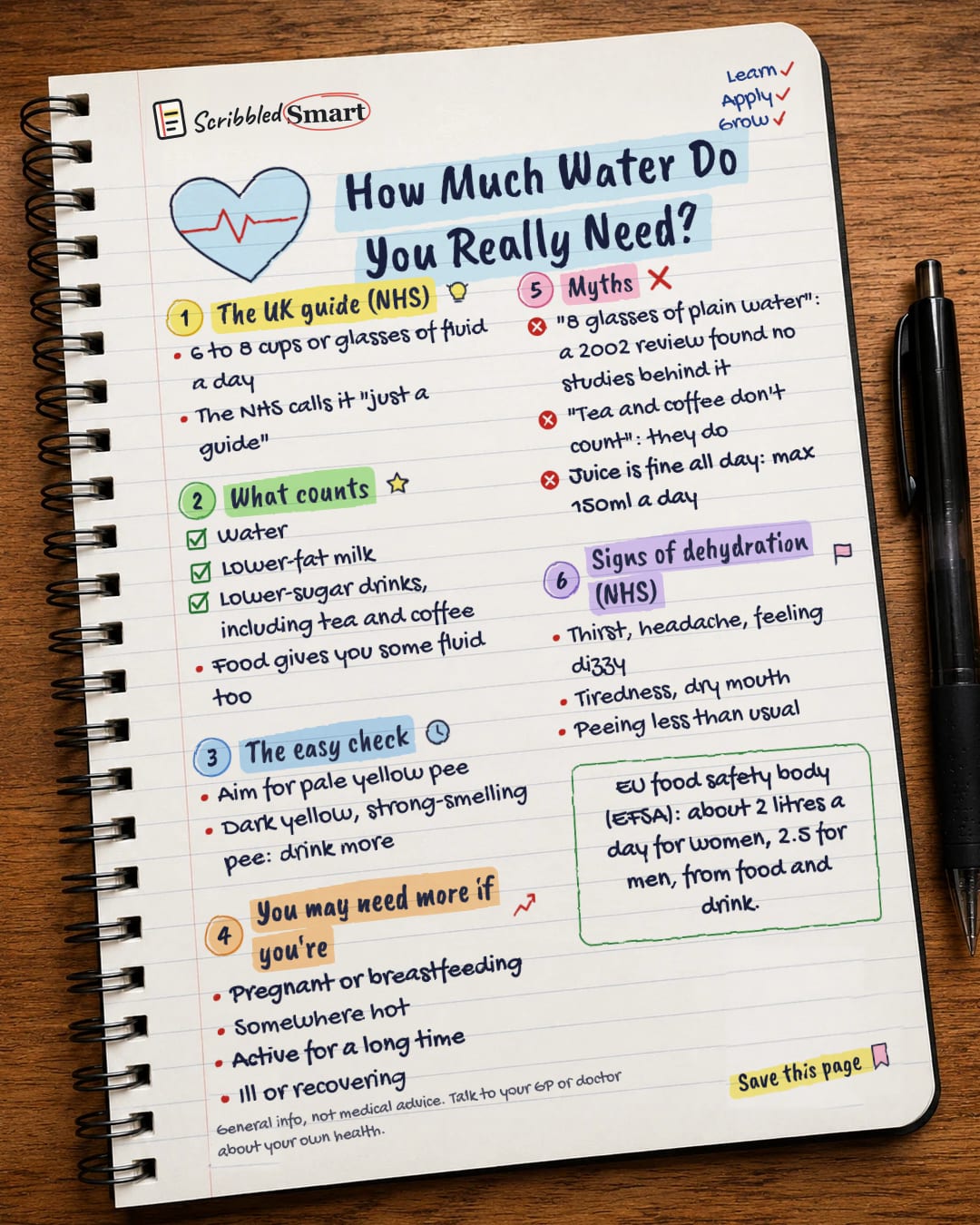
How much water do you need? In the UK, the NHS guide is to aim for 6 to 8 cups or glasses of fluid a day, and that fluid doesn't all have to be plain water. Tea, coffee and lower-fat milk count too. This article explains what counts, a simple way to check you're drinking enough, when you might need more, and which popular water rules don't hold up.
How much water do you need a day?
In the Eatwell Guide, the UK government recommends that people aim to drink 6 to 8 cups or glasses of fluid a day. The NHS is careful to say this is "just a guide". Your own need can change with the weather, how active you are and your health.
The European figure
The European Food Safety Authority (EFSA), the EU's food safety body, sets reference values for total water. It says about 2.0 litres a day is adequate for women and 2.5 litres for men.
Two things to know about these figures. First, they include water from food as well as drinks, so they are not a "drink this much" target. Second, they apply to moderate temperatures and moderate activity.
EFSA also says pregnant women need about 300ml more a day, and breastfeeding women about 700ml more.
Which drinks count towards your fluid?
You don't have to drink plain water all day. The NHS says these all count:
- water
- lower-fat milk
- lower-sugar drinks, including tea and coffee
We also get some fluid from the foods we eat. The EFSA reference values include this moisture from food.
Drinks to go easy on
Sugary drinks are high in calories and can damage your teeth, says the NHS. It suggests swapping them for diet or no-added-sugar versions. To spot the sugar in a drink, it helps to know how to read UK food labels.
Fruit juice and smoothies do count, but the NHS says to keep them to a maximum of one small glass (150ml) a day.
How can you tell if you're drinking enough?
You don't need to count every glass. The NHS says to drink enough so that your pee is a clear, pale yellow colour.
Dark yellow, strong-smelling pee is one of the signs of dehydration. If you see it, drink more.
When you may need more water
The NHS says you may need more fluid if you are:
- pregnant or breastfeeding
- somewhere hot
- active for long periods
- ill or recovering from illness
Water myths, checked
Myth: you need 8 glasses of plain water
In 2002, H. Valtin published a review in a physiology journal asking whether there was scientific evidence for "8 x 8", meaning eight 8-ounce glasses of water a day. It reported that no scientific studies were found in support of it.
To be fair, the NHS guide of 6 to 8 glasses is close to 8 glasses. The myth is that it must all be plain water, and that there is a hard scientific rule. Valtin's review looked at healthy adults in a mild climate with a mostly inactive lifestyle. The review also said larger amounts of fluid are advisable for some diseases and for hard work or exercise in the heat.
Myth: tea and coffee don't count
They do. The NHS lists tea and coffee among the drinks that count. Valtin's review also said caffeinated drinks may be counted.
Myth: juice is fine all day
Juice counts as fluid, but the NHS limit is one small glass (150ml) a day for fruit juice and smoothies.
Signs of dehydration
The NHS lists these signs of dehydration:
- feeling thirsty
- headache
- feeling dizzy or light-headed
- feeling tired
- dry mouth, lips and tongue
- dark yellow, strong-smelling pee
- peeing less often than usual
When to get help
🇬🇧 In the UK, the NHS says to ask for an urgent GP appointment or get help from NHS 111 if you are unusually tired, feel dizzy when you stand up and it doesn't go away, have dark pee or are peeing less, or have fast breathing or a fast heart rate.
Signs of shock, such as confusion, cold skin or being very drowsy, need 999 or A&E.
Outside the UK, contact your own doctor, or call your local emergency number for signs of shock.
Tips for drinking enough
- Drink regularly through the day.
- Swap sugary drinks for diet or no-added-sugar versions.
- Choose lower-fat milk.
- Use your pee colour as your guide, not a fixed number of glasses.
Related reading
- 5 a day: what counts towards your fruit and veg, including the juice limit.
- Reading food labels: how to spot sugar in drinks and food.
- Sleep better: why tea and coffee should stop 6 hours before bed.
Sources
- NHS: Water, drinks and your health
- NHS: Dehydration
- Valtin H (2002), "Drink at least eight glasses of water a day." Really? Am J Physiol Regul Integr Comp Physiol (PubMed 12376390)
- EFSA: Press release on dietary reference values (26 March 2010)
- EFSA Journal (2010): Scientific Opinion on Dietary Reference Values for water (first published at http://www.efsa.europa.eu/en/scdocs/doc/1459.pdf)
How we checked this
Every fact in this article comes from the 5 sources listed above, checked against official or peer-reviewed sources where possible. AI tools help with drafting; a person checks every fact against the sources. How we research
- Published and checked
- Next check
- yearly
General info, not medical advice. Talk to your GP or doctor about your own health. If you think you're seriously dehydrated, contact NHS 111; for signs of shock, call 999 or go to A&E.
Spotted a mistake? Tell us and we'll fix it and log it on the corrections page.


