
On this page
- Reading food labels: start with the traffic lights
- What counts as "high" or "low" per 100g?
- What does the "%" on a food label mean?
- What's on every nutrition label
- The ingredients list
- What's the difference between use-by and best before?
- The big mistake: trusting the portion size
- Quick tips
- Related reading
- Sources
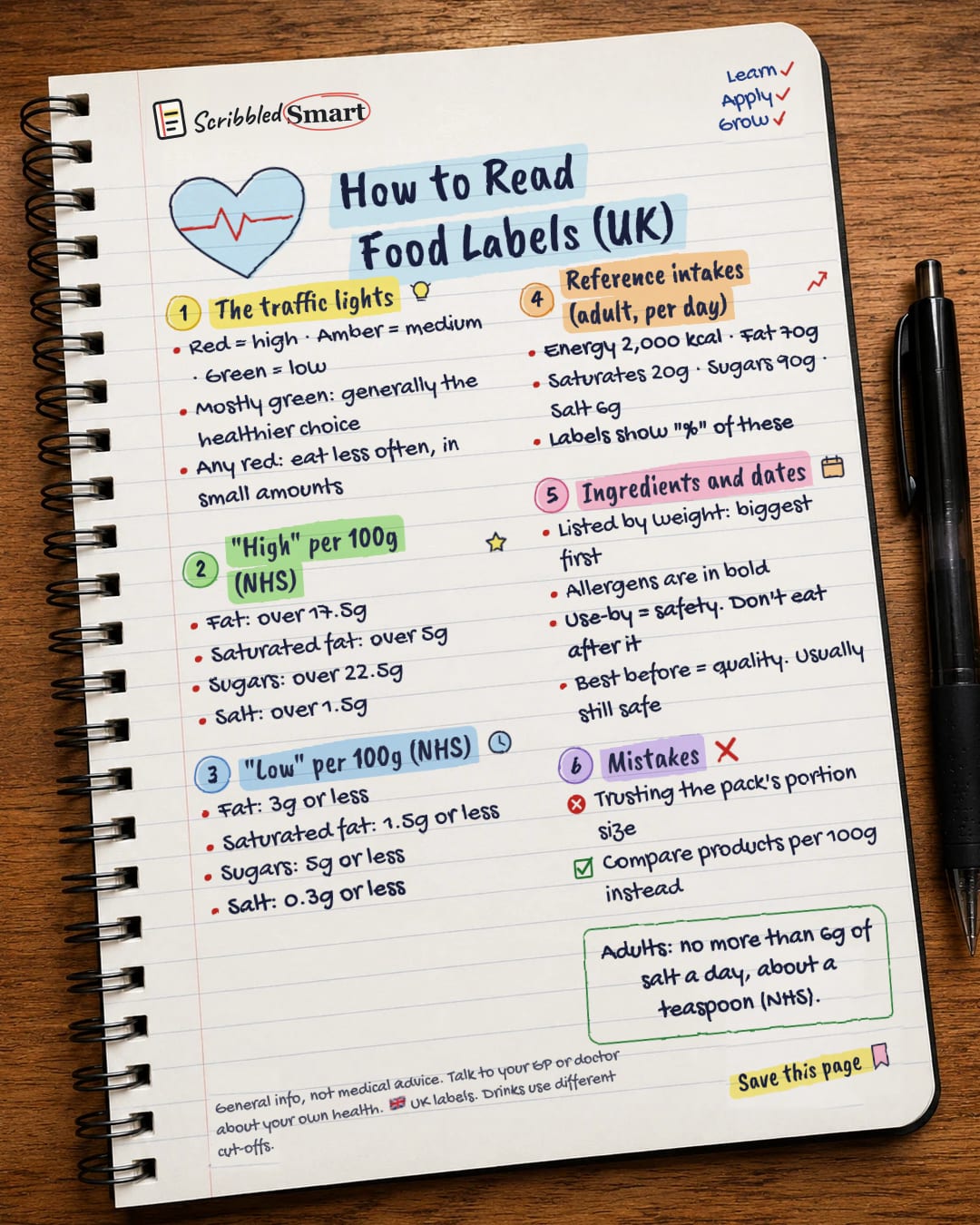
Reading food labels in the UK is easiest with the traffic lights: red means high, amber means medium and green means low in fat, saturated fat, sugars or salt. Mostly green is generally the healthier choice. This article gives you the exact "high" and "low" cut-offs per 100g, explains reference intakes, and shows how to read the ingredients list and dates.
Reading food labels: start with the traffic lights
Many UK food labels use a red, amber and green colour code. The NHS explains it like this:
- Red means high
- Amber means medium
- Green means low
If a food has all or mostly green lights, it is generally a healthier choice. If it has any reds, the NHS says to eat it less often and in small amounts.
What counts as "high" or "low" per 100g?
The colours are based on set cut-offs. These are the NHS figures for food, per 100g.
| Per 100g (NHS) | High (red) | Low (green) |
|---|---|---|
| Fat | more than 17.5g | 3g or less |
| Saturated fat | more than 5g | 1.5g or less |
| Total sugars | more than 22.5g | 5g or less |
| Salt | more than 1.5g | 0.3g or less |
Anything between the high and low figures is medium (amber).
These cut-offs are for food. The NHS says different criteria are used for drinks, so drinks are judged on different cut-offs.
What does the "%" on a food label mean?
Labels often show each nutrient as a percentage of an adult's reference intake. Reference intakes are set in UK law (retained Regulation (EU) No 1169/2011, Annex XIII). For an adult, per day, they are:
| Nutrient | Reference intake (adult, per day) |
|---|---|
| Energy | 8,400 kJ / 2,000 kcal |
| Total fat | 70g |
| Saturates | 20g |
| Sugars | 90g |
| Salt | 6g |
So if a sandwich says "30%" next to salt, it has 30% of 6g, which is 1.8g.
One important point about sugar. The 90g figure is for total sugars, including those naturally in fruit and milk. It isn't a recommended amount of added sugar.
Salt and saturated fat limits
The NHS says adults should have no more than 6g of salt a day, which is about a teaspoonful. For saturated fat, the NHS says men should have no more than 30g a day and women no more than 20g.
What's on every nutrition label
Every pre-packed food's nutrition label shows energy (in kJ and kcal), fat, saturates, carbohydrate, sugars, protein and salt. The NHS says this information is given per 100g or 100ml.
The ingredients list
Ingredients must be listed in descending order of weight. That means the main ingredients come first.
This is a handy shortcut. The NHS says if the first few ingredients are things like cream, butter or oil, the food is likely to be high in fat.
Allergens are highlighted in bold in the ingredients list, so they are easy to spot.
What's the difference between use-by and best before?
These two dates mean different things. GOV.UK puts it simply: use-by dates relate to the safety of food, while best before dates relate to quality.
Use-by
Eating food after the use-by date could make you ill, so don't eat it after that date. There is one exception. GOV.UK says food can be eaten after its use-by date if it was cooked or frozen on or before that date. If you cook it before the use-by, cool it, put it in the fridge and eat it within 48 hours, or freeze it. Our guide to use-by vs best before dates goes into more detail.
Best before
After the best before date, food is usually still safe to eat, but it may not be at its best quality. You'll see best before on frozen, dried and tinned foods, and on cheese. Use your sight, taste and smell to judge it.
The big mistake: trusting the portion size
The NHS warns that the manufacturer's idea of a portion may be different from yours. A "per portion" figure can look low if the portion is small.
The fix: compare products per 100g instead. The traffic light cut-offs are per 100g, so this gives you a fair, like-for-like comparison.
Quick tips
- Look for mostly green, and treat any red as an "eat less often" food.
- Compare two products per 100g, not per portion.
- Check the first few ingredients.
- Check allergens in bold.
- Never eat food past its use-by date unless it was frozen or cooked on or before it.
- Clothes have their own label code too: see how to read laundry symbols.
Related reading
- Use-by vs best before: a fuller look at food dates and storage.
- 5 a day: what counts towards your fruit and vegetables.
- Protein basics: how much protein you need and where to find it on the label.
- How much water: what to drink, and which sugary drinks to swap.
Sources
- NHS: How to read food labels
- legislation.gov.uk: Regulation (EU) No 1169/2011, Annex XIII
- GOV.UK: Understanding food labelling, best before and use-by dates
- FSA: Best before and use-by dates (now redirects to the GOV.UK guide)
- NHS: 8 tips for healthy eating
How we checked this
Every fact in this article comes from the 5 sources listed above, checked against official or peer-reviewed sources where possible. AI tools help with drafting; a person checks every fact against the sources. How we research
- Published and checked
- Next check
- yearly
General info, not medical advice. Talk to your GP or doctor about your own health. 🇬🇧 UK labels; drinks use different cut-offs.
Spotted a mistake? Tell us and we'll fix it and log it on the corrections page.


