
On this page
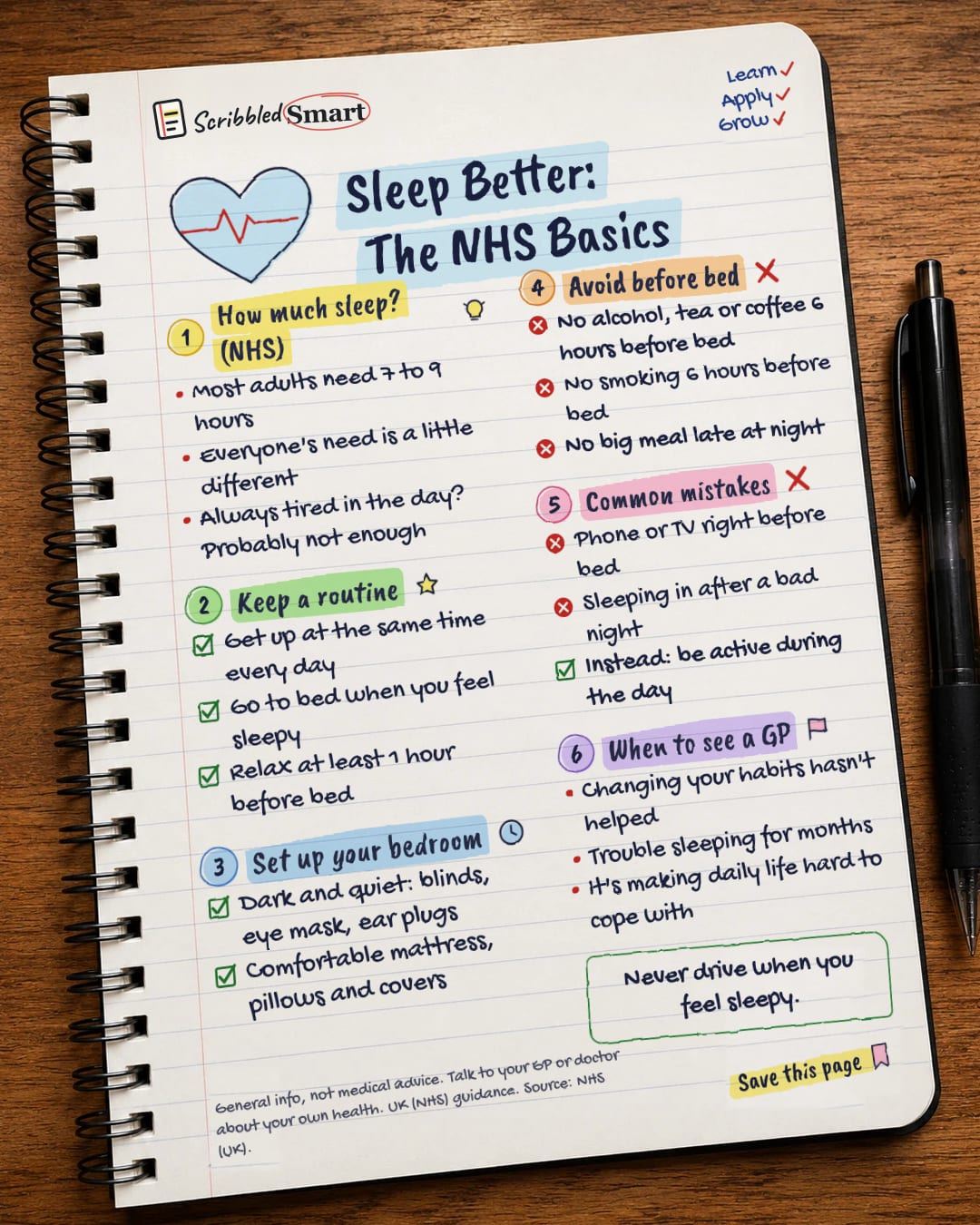
To sleep better, the NHS says to keep a regular routine, make your bedroom dark, quiet and comfortable, and avoid alcohol, tea, coffee and smoking for at least 6 hours before bed. Most adults need around 7 to 9 hours a night. This article walks through each piece of that advice, the common mistakes that undo it, and when it is time to talk to a GP.
How much sleep do you need?
The NHS says most healthy adults need around 7 to 9 hours of sleep a night. The exact amount can be different for each person, so there is no single perfect number.
Children need more. The NHS gives 9 to 13 hours for children, and 12 to 17 hours for toddlers and babies.
Signs you're not getting enough
A simple test from the NHS: if you are constantly tired during the day, you probably don't get enough sleep. Other signs NHS Every Mind Matters lists are:
- finding it hard to wake up
- feeling very tired, irritable or sleepy in the day
- finding it hard to focus
Keep a routine
The NHS advice is to keep regular hours. In practice, that means:
- Get up at the same time every day. Weekends included.
- Only go to bed when you feel sleepy.
- Relax for at least 1 hour before bed. The NHS suggests things like a bath or a book.
Put together, that gives you a simple rule: a fixed time to get up, a flexible time to go to bed, and a calm hour in between. If a new routine is hard to keep, it helps to understand how habits really form.
Set up your bedroom to sleep better
Your bedroom should help you switch off. The NHS recommends making it dark and quiet. Curtains or blinds, an eye mask and ear plugs can all help.
Comfort matters too. The NHS says to make sure your mattress, pillows and covers are comfortable. If one of these keeps waking you, it is worth fixing.
When should you stop drinking coffee before bed?
"The 6-hour rule" is our shorthand for one piece of NHS advice. For at least 6 hours before bed, avoid:
- alcohol
- tea and coffee
- smoking
NHS Every Mind Matters repeats the same 6-hour advice. The NHS also says not to eat a big meal late at night.
If you usually go to bed at 11pm, that means your last coffee or tea should be by about 5pm.
Common mistakes that stop you sleeping well
Even with a good routine, a few habits can work against you.
Phone or TV right before bed
The NHS advises against watching TV or using devices like smartphones right before going to bed. The NHS gives blue light as the reason. However, a 2023 Cochrane review of blue-light filtering glasses (Singh et al.) found the effects on sleep were unclear, because the trials were mixed. So the advice to put the screen down stays, but the blue-light reason is not settled.
Sleeping in after a bad night
It is tempting to lie in after a rough night. The NHS says not to, and to keep regular hours instead.
Not moving enough in the day
The NHS advice is to be active and exercise regularly during the day.
Things that can affect your sleep
Some things outside your routine can disturb sleep:
- Medicines. Some medicines affect sleep. NHS Every Mind Matters suggests speaking to a GP or pharmacist.
- Menopause and perimenopause. These can affect sleep too. The NHS suggests contacting your GP.
- Pharmacy sleep aids. The NHS says these can cause drowsiness the next day.
When should you see a GP about sleep?
The NHS says to see a GP if:
- changing your sleeping habits hasn't helped
- you have had trouble sleeping for months
- your sleep problems are affecting your daily life in a way that makes it hard to cope
The NHS describes insomnia that lasts 3 months or longer as long-term insomnia.
One safety rule above all: never drive when you feel sleepy. This comes straight from the NHS insomnia advice.
Related reading
- Sleep and memory: why all-nighters backfire when you are studying.
- Stress and your body: how stress can affect your sleep and what helps.
- Screens and your eyes: more on screen habits and eye comfort.
- How habits form: how to make a new bedtime routine stick.
Sources
- NHS: Insomnia
- NHS Every Mind Matters: Sleep
- Singh et al. (2023), Blue-light filtering spectacle lenses for visual performance, sleep, and macular health in adults, Cochrane Database of Systematic Reviews (PubMed)
How we checked this
Every fact in this article comes from the 3 sources listed above, checked against official or peer-reviewed sources where possible. AI tools help with drafting; a person checks every fact against the sources. How we research
- Published and checked
- Next check
- yearly
General info, not medical advice. Talk to your GP or doctor about your own health.
Spotted a mistake? Tell us and we'll fix it and log it on the corrections page.


