
On this page
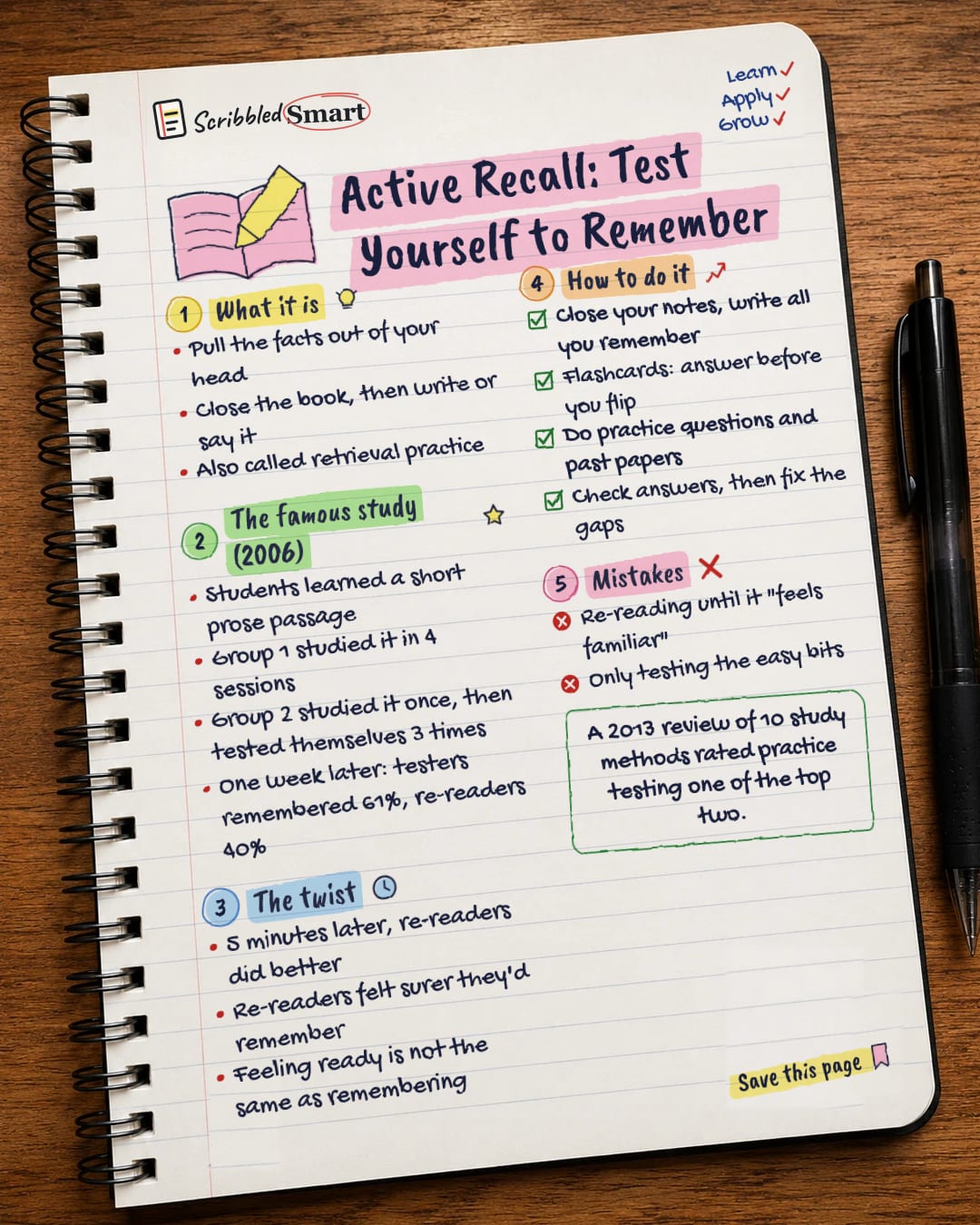
Active recall means pulling facts out of your head, for example by closing the book and writing down everything you remember, instead of reading your notes again. Researchers also call it retrieval practice or practice testing. This article explains the famous 2006 study behind it, why it feels harder than re-reading, and how to use it when you revise.
What is active recall?
Active recall is simple. You close your notes, then write or say what you know. The effort of finding the answer in your memory is the point.
It is also known as retrieval practice. A large 2013 review used the term "practice testing" for the same idea: self-testing or doing practice tests.
The famous active recall study (2006)
The best-known study is by Roediger and Karpicke, published in Psychological Science in 2006. University students read short science passages of about 250 words.
How the study worked
In the main experiment, students had four 5-minute periods. They were split into three groups:
| Group | What they did in the four periods |
|---|---|
| Re-read only (SSSS) | Read the passage 4 times |
| Mostly re-read (SSST) | Read it 3 times, then 1 recall test |
| Mostly tested (STTT) | Read it once, then 3 recall tests |
A recall test meant writing down as much of the passage as they could. There was no feedback. Nobody told them what they got right or wrong. So the benefit came from the act of recalling itself.
What students remembered a week later
One week later, the groups were tested again. The results were clear:
- Mostly tested: 61% of ideas recalled
- Mostly re-read: 56%
- Re-read only: 40%
The re-read-only group read the passage about 14.2 times in total. The mostly-tested group read it only about 3.4 times. Less reading, more remembering.
Forgetting over the week showed the same pattern. The re-read-only group forgot 52% of what they had known at 5 minutes. The mostly-tested group forgot just 14%.
An earlier experiment in the same paper compared one test with one extra read. Testing won after 2 days and after 1 week.
Why does re-reading feel like it works better?
Re-reading wins in the short term and feels more convincing, which can mislead you about how much you will remember. On a test just 5 minutes after studying, the re-readers did better: 83% against 71% for the testers, according to the paper. (A university press release at the time gave slightly different figures.)
The re-readers also felt surer. They predicted they would remember the passage better than the other groups did. A week later, they remembered the least.
So feeling ready is not the same as remembering. Re-reading makes the page feel familiar. Testing makes the memory last.
What the big 2013 review said
In 2013, five psychologists led by Dunlosky reviewed 10 common study methods. Practice testing was rated "high utility", one of the top two methods. The other was spreading study out over time (distributed practice).
Re-reading was rated low utility. As Dunlosky put it, "By just replacing rereading with delayed retrieval practice, students would benefit."
How do you use active recall when you revise?
You don't need special tools. Try these:
- Brain dump. Close your notes and write all you remember about a topic. This is the free-recall method used in the 2006 study, and it fits neatly into short Pomodoro work sessions.
- Flashcards. Say or write the answer before you flip the card.
- Practice questions and past papers. These are forms of practice testing.
- Check, then fix the gaps. After testing, look at your notes and correct what you missed. Feedback was not part of the 2006 study, but checking your answers is sensible common advice.
Tips and common mistakes
Active recall feels harder than re-reading. That is normal, and it is not a sign it isn't working.
Common mistakes:
- Re-reading until it "feels familiar". Familiar is not the same as remembered.
- Only testing the easy bits. It is tempting to quiz yourself on what you already know. Spend time on the parts you can't recall.
A word of caution about the evidence. The 2006 study used university students, short prose passages and a one-week gap. Each group had 30 students. The results are strong, but don't assume they prove the same thing for every kind of learning forever.
Related reading
- Spaced repetition: the other top-rated method, and it pairs well with self-testing.
- Why highlighting and re-reading don't work well: why the methods most students use feel good but help little.
- The Feynman technique: explaining from memory is another way to practise recall.
Sources
- Roediger & Karpicke (2006): Test-Enhanced Learning (PDF)
- WashU Source: Repeated test-taking better for retention than repeated studying (2006)
- APS Observer: Test-enhanced learning
- APS: Which study strategies make the grade?
How we checked this
Every fact in this article comes from the 4 sources listed above, checked against official or peer-reviewed sources where possible. AI tools help with drafting; a person checks every fact against the sources. How we research
- Published and checked
Spotted a mistake? Tell us and we'll fix it and log it on the corrections page.


