
On this page
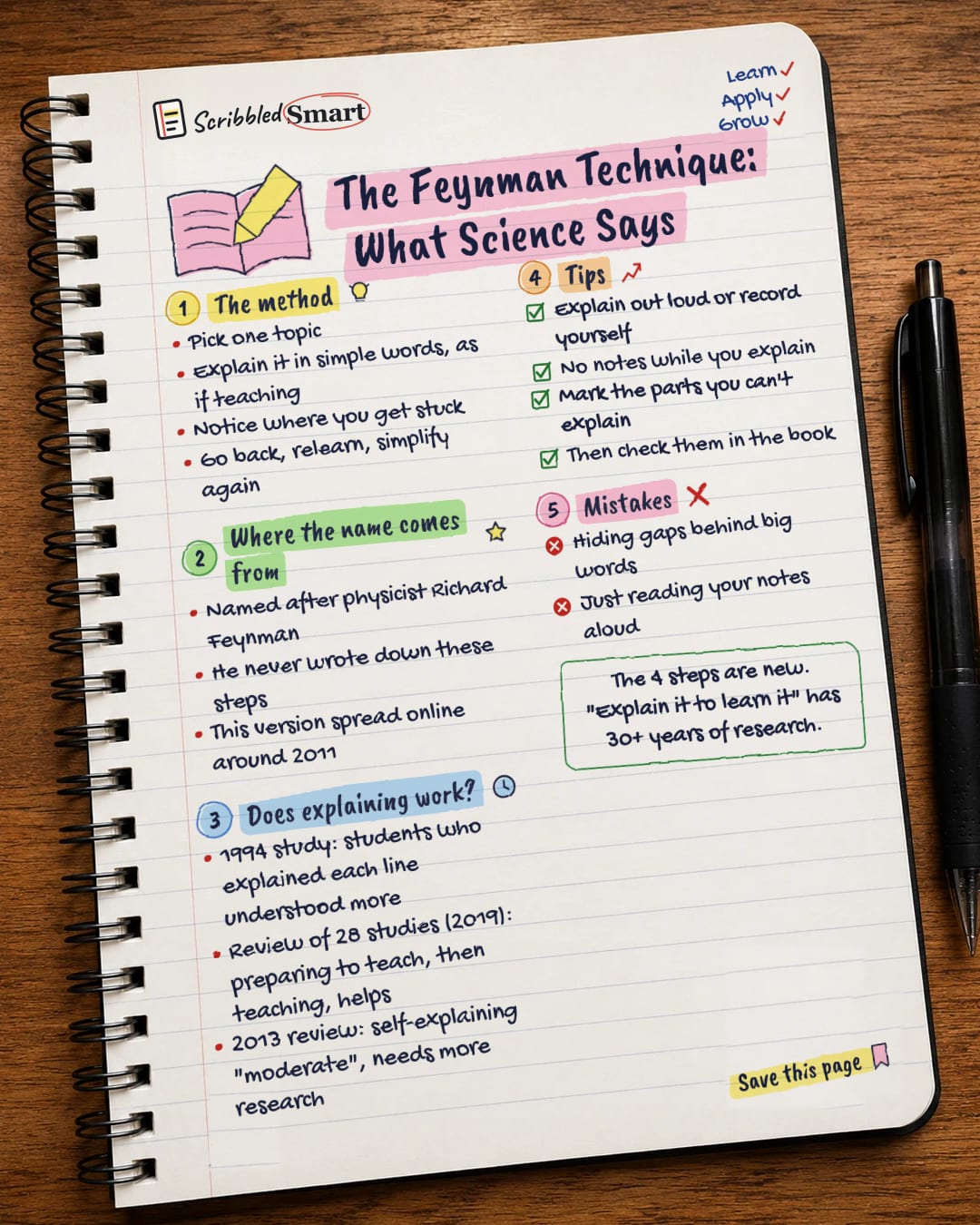
The Feynman technique is a study method where you explain a topic in simple words, as if teaching someone, so you can spot the parts you don't really understand. The four steps are fairly new and have never been tested by name. But the idea underneath them, "explain it to learn it", has more than 30 years of research behind it. Here is the method, where it came from, and what the evidence actually shows.
How do you use the Feynman technique?
The popular online version has four steps:
- Pick one topic. Keep it focused.
- Explain it in simple words, as if you were teaching someone else.
- Notice where you get stuck. Those stumbles are the gaps in your understanding.
- Go back, relearn, and simplify again. Then try explaining once more.
No research paper defines these steps. They come from blogs and popular guides that broadly agree.
Where the name comes from
The method is named after the physicist Richard Feynman. But according to histories of the technique, no four-step method appears in anything Feynman wrote. We found no source that says otherwise.
This version seems to have spread online around 2011. Sources disagree on the exact month, so "around 2011" is as precise as we can be.
You will see many "Feynman quotes" attached to the method online. Many of them can't be traced, so we don't use any here.
Does explaining things actually help you learn?
Yes, explaining helps, though the effects are moderate. No study has tested the Feynman technique itself, so the honest question is whether its main ingredient, explaining, works.
Self-explanation (1994 study)
In a 1994 study by Chi and colleagues, eighth-graders read a text about the circulatory system. Fourteen students were prompted to explain each line to themselves. Ten others read the text twice.
The students who explained each line improved more from their first test to their final test. It is a small study, so treat it as a promising early finding.
Learning by teaching (review of 28 studies)
A 2019 meta-analysis by Kobayashi looked at learning by teaching across 28 studies. As summarised in a book chapter by Fiorella:
- Preparing to teach and then actually teaching gave a benefit (an effect size of about 0.5–0.6).
- Preparing to teach alone gave a smaller benefit (about 0.3–0.4).
In other words, the full act of explaining to someone seems to matter more than just planning to.
The 2013 review: "moderate"
In 2013, Dunlosky and colleagues rated 10 study techniques. Self-explanation was rated "moderate" utility. That was not because it failed, but because the evidence was still limited at the time.
What the details show
Fiorella and Mayer (2013, 2014) found that preparing to teach helped on an immediate test, but not always on a delayed one. Actually teaching, by recording a video lesson for an imagined student, gave the best long-term results.
Other studies cited by Fiorella found that explaining for others can beat a plain free-recall test. And in Roscoe and Chi (2008), interactive teaching, where you answer a learner's questions, beat recording a video lecture.
Why does explaining something make it stick?
Fiorella describes explaining as a "generative learning" activity. You select the key information, organise it, and connect it to what you already know.
Explaining also means pulling information from memory. That retrieval itself strengthens memory, which is why it links closely to active recall.
Tips for using the Feynman technique
- Explain out loud or record yourself. Several studies on learning by teaching used recorded video lessons to an imagined student.
- No notes while you explain. That way you are recalling, not reading.
- Mark the parts you can't explain. Be honest about the stumbles.
- Then check them in the book. Fix the gaps, then explain again.
Mistakes that hide your gaps
- Hiding gaps behind big words. If you can only explain it with jargon, you may not understand it yet.
- Just reading your notes aloud. That is reading, not explaining.
FAQ
Did Richard Feynman invent the Feynman technique?
Not in its four-step form. The method is named after the physicist Richard Feynman, but histories of the technique say no four-step method appears in anything he wrote. This version seems to have spread online around 2011. Sources disagree on the exact month, so the date is approximate.
Is the Feynman technique backed by science?
Not by name, but its ingredients are. No study has tested "the Feynman technique" itself. A small 1994 study found that students who explained each line of a text improved more, and a 2019 review of 28 studies found benefits from preparing to teach and then teaching. The effects are moderate, not magic.
Is it better to teach someone or just prepare to teach?
Actually teaching seems to help more. In research summarised by Fiorella, preparing to teach and then teaching gave a bigger benefit than preparing alone. Some studies found that preparing to teach helped on an immediate test but not always on a delayed one, while recording a lesson gave the best long-term results.
Related reading
- Active recall: explaining from memory is a form of testing yourself.
- Why highlighting and re-reading don't work well: why reading your notes aloud isn't enough.
- Imposter syndrome: useful if spotting your own gaps feels uncomfortable.
Sources
- Learning subwiki: Feynman technique
- Arizona State University: Chi et al. (1994), Eliciting self-explanations improves understanding
- Fiorella, L.: Learning by Teaching (chapter PDF, UNH)
- APS: Which study strategies make the grade?
How we checked this
Every fact in this article comes from the 4 sources listed above, checked against official or peer-reviewed sources where possible. AI tools help with drafting; a person checks every fact against the sources. How we research
- Published and checked
Spotted a mistake? Tell us and we'll fix it and log it on the corrections page.


