
On this page
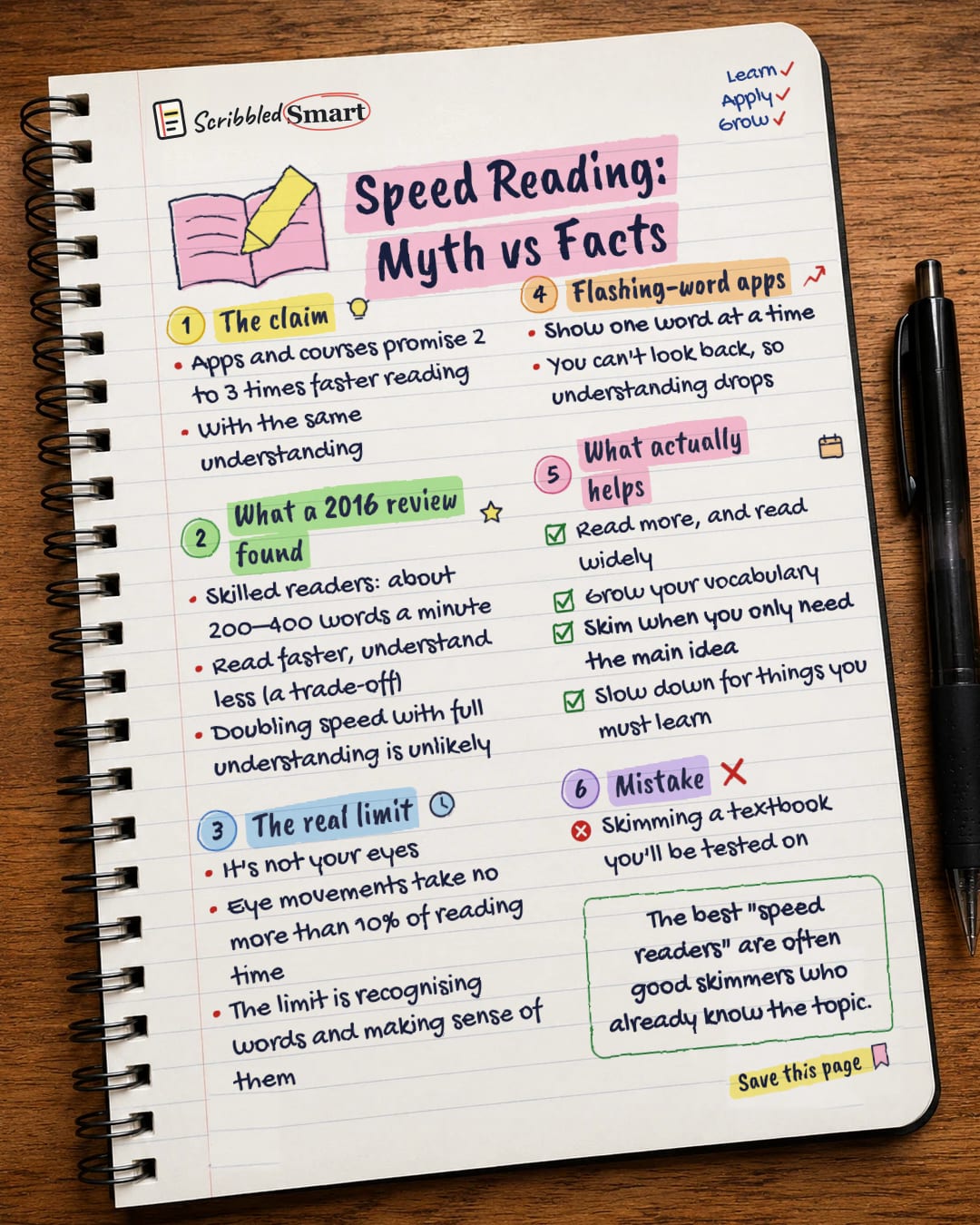
Speed reading, in the sense of doubling or tripling your reading speed while understanding just as much, is unlikely to work, according to a 2016 scientific review. When people read faster, they understand less. That doesn't mean reading can't improve. It means the improvement comes slowly, from practice and vocabulary, not from a trick.
What do speed reading courses promise?
Many promise to double or triple how fast you read, with no loss of understanding. That is the claim scientists set out to check.
The review was published in 2016 in Psychological Science in the Public Interest. Its authors were Rayner, Schotter, Masson, Potter and Treiman, and its title was "So Much to Read, So Little Time: How Do We Read, and Can Speed Reading Help?"
What the 2016 speed reading review found
The promises are too good to be true. The review's main points, as reported by the Association for Psychological Science (APS), were:
- Typical speed. Skilled readers read at about 200–400 words a minute.
- A trade-off. Trained speed readers did read faster, but their understanding dropped.
- No easy doubling. It is unlikely that anyone can double or triple their speed without losing comprehension.
Many speed-reading websites quote much bigger figures, such as reading over 1,000 words a minute. We could not verify those, so we don't repeat them as fact.
Why your eyes aren't the problem
It is tempting to think faster eyes mean faster reading. But eye movements take up no more than 10% of reading time.
The real bottleneck is your brain's language work. You have to recognise each word and combine the words into meaning. That takes time no matter how fast your eyes move.
Looking back is useful
It is easy to think going back over words is wasted time. But these backward eye movements (called regressions) do a job. They move your eyes back to text you didn't understand the first time.
Do flashing-word apps work?
Not well for understanding. Some apps show you one word at a time in the same spot on the screen, at high speed. Researchers call this RSVP.
The idea is to remove eye movements altogether. The catch is that you can't look back. According to the APS, removing eye movements, including looking back, generally reduces accuracy at higher speeds.
What about the "inner voice"?
Many courses say you should stop "hearing" words in your head (subvocalisation). We could not confirm what the 2016 review says about this, so we are not making any claim either way.
How to actually read better
You can get better at reading, but slowly. The APS put it plainly: there is "no quick fix". Practice can bring modest gains.
- Read more, and read widely. Regular practice is the route the APS points to.
- Grow your vocabulary. The APS says reading practice and exposure to varied writing build vocabulary.
- Skim when you only need the main idea. Skimming works well when the gist is enough.
- Slow down for things you must learn. If understanding matters, speed is the wrong goal.
Who are the best "speed readers"?
According to the APS, people who seem to be great speed readers are often good skimmers who already know a lot about the topic. Their background knowledge fills the gaps.
The big speed reading mistake for students
The main mistake is skimming a textbook you will be tested on. Skimming gives you the gist, but exams usually need detail and understanding. For study material, slower reading followed by testing yourself with active recall is a safer plan.
A note on our sources: we did not read the full 34-page review. The facts here come from the APS press release and APS summary page written about it.
FAQ
Does speed reading really work?
Not in the way most courses promise. A 2016 review of the science found that people who are trained to read faster tend to understand less. It concluded that doubling or tripling your speed without losing comprehension is unlikely. Some modest gains are possible through regular reading practice.
What is a normal reading speed?
According to the Association for Psychological Science, reporting on a 2016 review, skilled readers typically read at about 200–400 words a minute. Going much faster than that usually means understanding less, because the real limit is how quickly your brain recognises words and builds meaning.
Is skimming the same as speed reading?
Not quite. Skimming means deliberately reading for the main idea, and the APS says it works well when the gist is all you need. Many people who appear to be fast readers are skilled skimmers who already know the topic. Skimming is a poor choice for material you'll be tested on.
Related reading
- Why highlighting and re-reading don't work well: another popular study habit that feels better than it works.
- The multitasking myth: why splitting your attention costs more than it saves.
- Deep work and focused attention: making room for the slow, careful reading that real learning needs.
Sources
- APS: Speed reading promises are too good to be true, scientists find (2016)
- APS: So Much to Read, So Little Time (publication page)
- Washington University in St. Louis: research profile for the 2016 review
How we checked this
Every fact in this article comes from the 3 sources listed above, checked against official or peer-reviewed sources where possible. AI tools help with drafting; a person checks every fact against the sources. How we research
- Published and checked
Spotted a mistake? Tell us and we'll fix it and log it on the corrections page.


