
On this page
The Pomodoro Technique is a simple way to work in short, focused rounds: you pick one task, work on it for 25 minutes, then take a 5-minute break. After four rounds, you take a longer break. This article explains where the method came from, how to use it, and what research on planned breaks actually found.
What is the Pomodoro Technique?
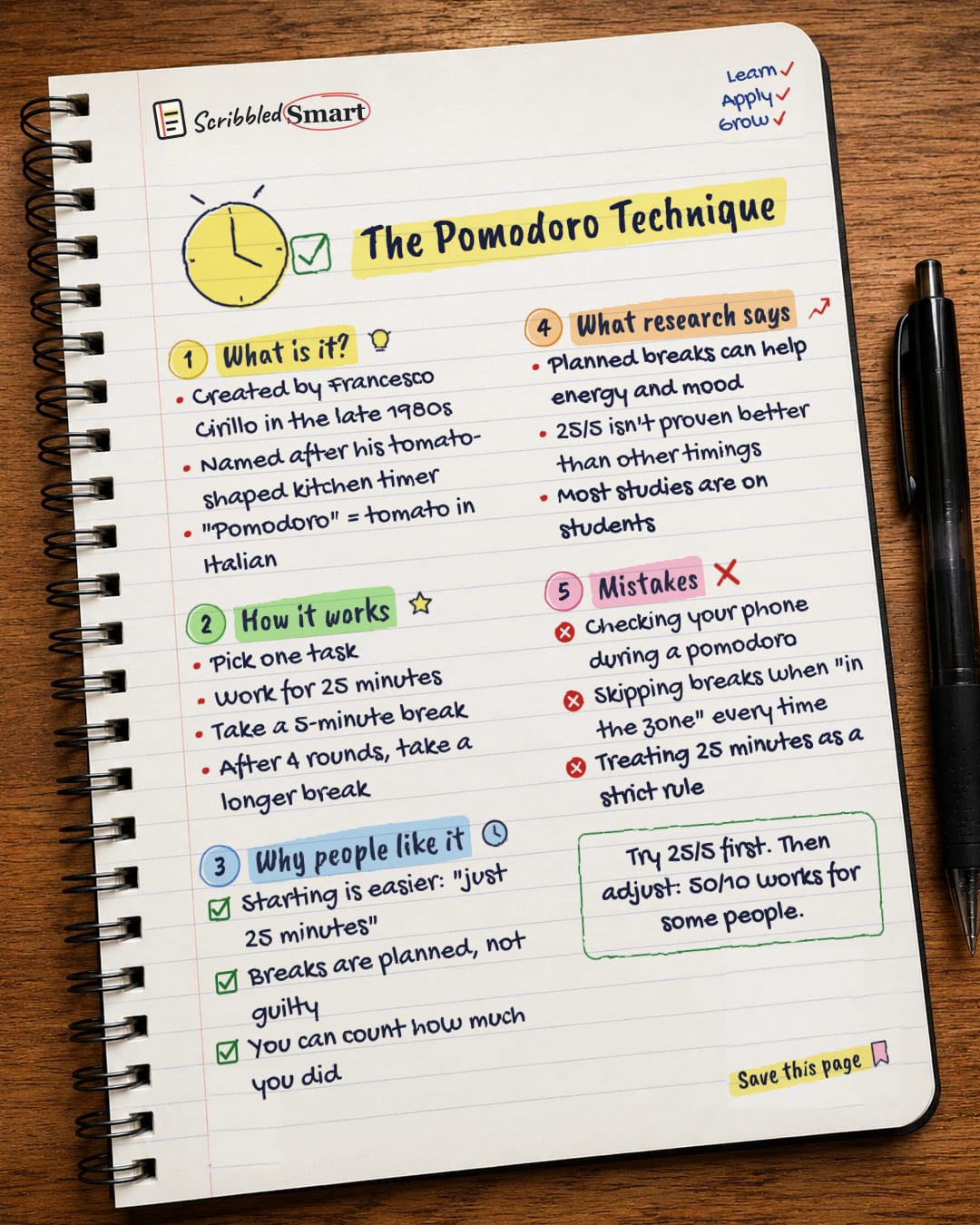
The Pomodoro Technique was created by Francesco Cirillo in the late 1980s, when he was a university student. He named it after his tomato-shaped kitchen timer. "Pomodoro" is the Italian word for tomato.
On his own website, Cirillo says he created the method in the 1980s to understand his relationship with time. He says it grew into a method for planning work, handling interruptions and learning from experience.
That matters, because it's easy to think the Pomodoro Technique is just a timer. The official Pomodoro Technique site calls it "a complete system for dealing with time". With a timer, pencil and paper, you learn to plan your work, estimate effort, handle interruptions, take breaks, record what happens and improve the way you work.
How long is a Pomodoro, and how does it work?
The basic steps are short:
- Pick one task. Just one.
- Work for 25 minutes. This is one "pomodoro".
- Take a 5-minute break.
- After four rounds, take a longer break.
The point of the 25 minutes is focus. The official site says to work on one activity at a time and handle interruptions, so during a pomodoro you work on that single task and nothing else.
Why people like it
People tend to like the Pomodoro Technique for three simple reasons:
- Starting is easier. "Just 25 minutes" feels much smaller than "write the whole essay".
- Breaks are planned, not guilty. You rest because the timer says so, not because you gave up.
- You can count what you did. Four pomodoros on a task is a clear record of effort.
Does the Pomodoro Technique actually work?
The honest answer is: planned breaks can help how you feel, but the exact 25/5 timing is not proven to be special.
The 2023 study on planned breaks
A study by Biwer and colleagues, published in 2023 in the British Journal of Educational Psychology, compared different ways of taking breaks. It involved 87 bachelor's and master's students at a Dutch university during one day of real-life self-study.
The students were split into three groups:
| Group | How they took breaks |
|---|---|
| Self-regulated | Chose their own break times |
| Pomodoro-style | 6-minute break after each 24-minute block |
| Shorter cycles | 3-minute break after each 12-minute block |
Students who chose their own breaks studied in longer stretches and took longer breaks. But they also reported more tiredness and distraction, and lower concentration and motivation, than the groups with set breaks.
There was no difference between the groups in how much mental effort they put in, or how many tasks they finished. The authors concluded that pre-set breaks had mood benefits and seemed to have efficiency benefits, because students got similar work done in less time. They also said more research is needed.
What we still don't know
Keep three limits in mind:
- 25/5 isn't proven better than other timings. The study's Pomodoro-style group used 24/6, and a 12/3 group was tested too.
- Most studies are on students. The 2023 study was one day with university students. Results may differ for other people and other work.
- Mood was self-reported. Students said how tired or focused they felt.
So the fair summary is that planned breaks can help energy and mood. That's a good reason to try the method, without promising more than the evidence shows. For a separate review of short pauses, see our article on whether short micro-breaks boost energy.
How to start the Pomodoro Technique today
You don't need special kit. Any timer works.
- Write down the one task you will work on.
- Set a timer for 25 minutes and start.
- When it rings, stop and take a real 5-minute break.
- After four rounds, take a longer break.
- Before you finish for the day, count your pomodoros.
Try 25/5 first. Then adjust. Some people find 50 minutes of work and a 10-minute break suits them better. The technique is flexible, so pick the rhythm that keeps you focused.
Common Pomodoro mistakes
- Checking your phone during a pomodoro. This breaks the "one task, no interruptions" rule.
- Skipping breaks every time you're "in the zone". Now and then is fine, but the planned break is part of the method.
- Treating 25 minutes as a strict rule. It's a starting point. Change it if a different length works better for you.
- Thinking it's only a timer. The full method also covers planning your work, estimating effort and recording what you did.
Related reading
- Take micro-breaks: what a 2022 review found about short breaks and energy.
- Deep work: how to protect longer blocks of focus for hard tasks.
- Why we procrastinate: why a tiny first step, like "just 25 minutes", makes starting easier.
- Active recall: a study method that pairs well with focused study rounds.
Sources
- Wikipedia: Pomodoro Technique
- Rework: History of the Pomodoro Technique
- Preprints.org (2025): Pomodoro research
- Maastricht University: Biwer et al. (2023), Understanding effort regulation
- Francesco Cirillo: official site
- Pomodoro Technique: official site
How we checked this
Every fact in this article comes from the 6 sources listed above, checked against official or peer-reviewed sources where possible. AI tools help with drafting; a person checks every fact against the sources. How we research
- Published and checked
Spotted a mistake? Tell us and we'll fix it and log it on the corrections page.


