
On this page
Does highlighting work? A little, but not reliably: a major 2013 review rated both highlighting and re-reading as "low utility" study methods. Yet re-reading was by far the most common strategy in a 2009 survey of US students, and it feels like it works. This page looks at how common they are, why they trick your brain, and what to do with your highlighter instead.
How many students rely on re-reading?
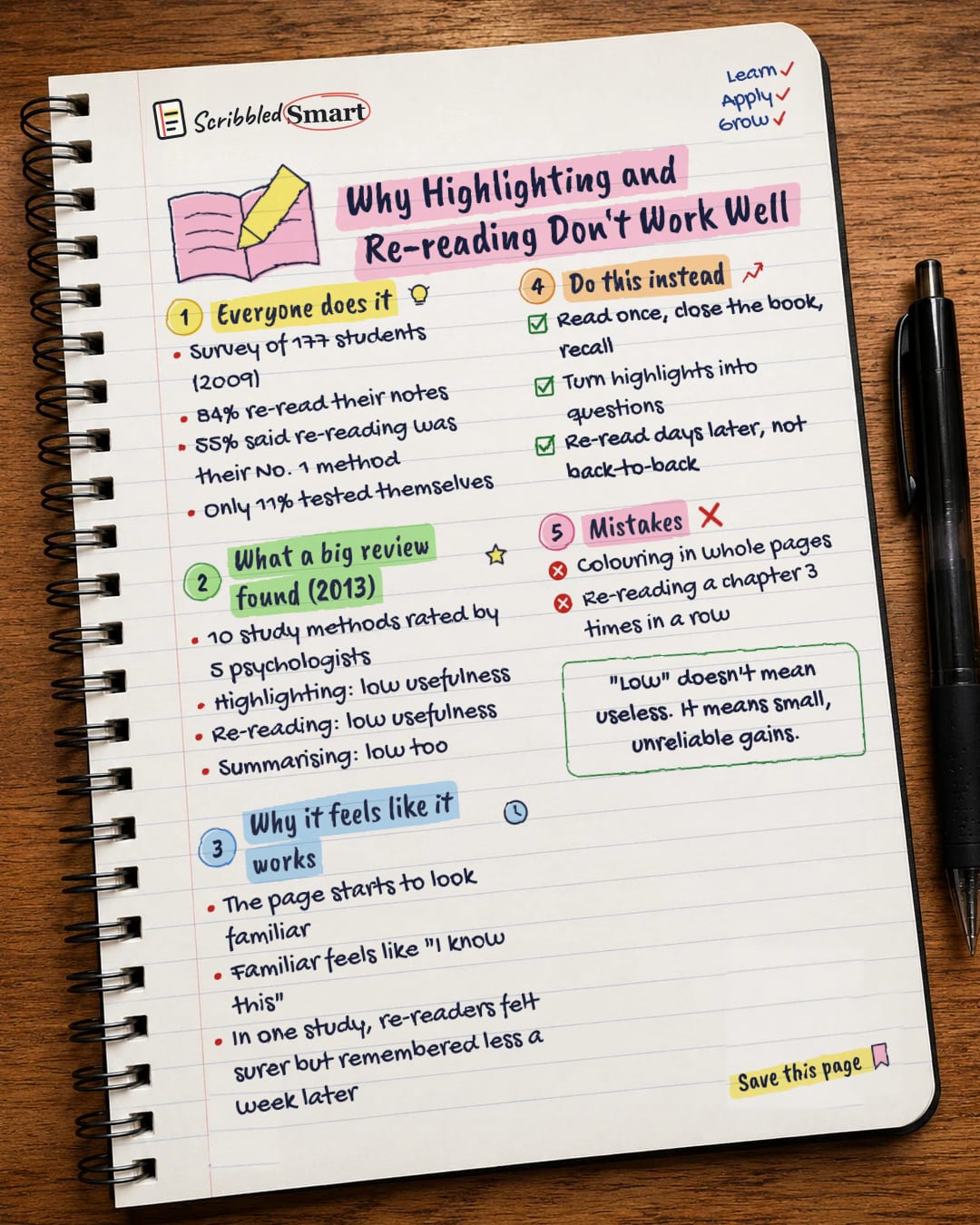
In one US survey, most of them did. A 2009 survey by Karpicke, Butler and Roediger asked 177 students at Washington University (in the US) how they study:
| What students reported | Share |
|---|---|
| Re-read their notes or textbook | 84% |
| Said re-reading was their No. 1 strategy | 55% |
| Practised retrieval (tested themselves) | 11% (19 of 177) |
Some students also used flashcards (40%) or practice problems (43%). The authors say these could partly count as self-testing.
In a separate question, students were asked what they would do after reading a chapter once. 57% chose to re-read and 21% chose "something else", so 78% would not test themselves.
Even students who did self-test mostly said they did it to check what they knew, not to help them remember.
One limit: this was one US university. These percentages don't describe all students everywhere.
Does highlighting work? The 2013 review's verdict
Not well, according to the evidence. In 2013, five psychologists (Dunlosky, Rawson, Marsh, Nathan and Willingham) rated 10 common study techniques.
Five were rated low utility:
- Highlighting and underlining
- Re-reading
- Summarising
- The keyword mnemonic
- Imagery for text
According to summaries of the review, these techniques "do not consistently boost students' performance".
Low is not the same as useless
The rating was a judgement across many studies and situations. Some studies show highlighting helps a little when students are trained to highlight well. So it is fair to say highlighting is weak and unreliable. It is not fair to say it never works.
Why does re-reading feel like it's working?
Re-reading creates a feeling of familiarity, and your brain mistakes that for knowing. Researchers call this a fluency illusion.
Kornell and Bjork (2008) put it this way: back-to-back study "provides a sense of ease, which learners assume will translate to good memory".
The study that shows the gap
A 2006 study by Roediger and Karpicke tested this directly. One group re-read a passage 4 times. Another group read it once, then tested themselves 3 times.
The re-readers predicted they would remember more. One week later, they recalled 40% of the passage. The testers recalled 61%.
They felt surer, but remembered less.
What should you do instead of highlighting?
Swap passive marking for active recall. As Dunlosky said, "By just replacing rereading with delayed retrieval practice, students would benefit."
- Read once, close the book, recall. Write down what you remember, then check. Our guide to testing yourself with active recall explains the method in full.
- Turn highlights into questions. A highlighted sentence becomes a quiz question for later.
- Re-read days later, not back-to-back. Back-to-back re-reading is weak, but spaced re-reading tends to help (Rawson and Kintsch, 2005, cited by Karpicke and colleagues).
Wondering whether simply reading faster would help? See what the research says about speed reading.
Common highlighting and re-reading mistakes
- Colouring in whole pages. If everything is highlighted, nothing stands out.
- Re-reading a chapter 3 times in a row. It feels thorough, but back-to-back reading fades fast.
If you like your highlighter, keep it. Just treat highlighting as the first step, not the whole job.
FAQ
Is highlighting a waste of time?
Not entirely, but it is a weak study method on its own. A 2013 review of 10 techniques rated highlighting "low utility" because it doesn't reliably improve results. Some studies show small gains when students are trained to highlight well. Try using it as a starting point for writing your own questions.
Why is re-reading not effective?
Re-reading makes material feel familiar, and that feeling is easily mistaken for real memory. In a 2006 study, students who re-read a passage 4 times felt more confident, yet a week later they recalled 40% of it. Students who tested themselves instead recalled 61%.
What should I do instead of re-reading my notes?
Try reading once, closing the book and writing down everything you remember, then checking your notes. The lead author of the 2013 review said students would benefit just by replacing re-reading with delayed retrieval practice. If you do re-read, leave a gap of days rather than reading back-to-back.
How many students actually test themselves?
In a 2009 survey of 177 students at one US university, only 11% said they practised retrieval, while 84% re-read. Some others used flashcards or practice problems, which the authors say could partly count. The survey covers one university, so the figures don't apply to all students.
Related reading
- Spaced repetition and how long to leave between reviews: how to make re-reading and self-testing count by spreading them out.
- The Feynman technique for explaining what you've learned: another active alternative to reading your notes.
- Why we procrastinate on hard tasks: helpful if harder study methods are easy to put off.
Sources
- Karpicke, Butler & Roediger (2009): Metacognitive strategies in student learning (PDF, Purdue Learning Lab)
- APS: Which study strategies make the grade?
- Roediger & Karpicke (2006): Test-Enhanced Learning (PDF)
- Kornell & Bjork (2008): Learning Concepts and Categories (PDF, UCLA Bjork Lab)
How we checked this
Every fact in this article comes from the 4 sources listed above, checked against official or peer-reviewed sources where possible. AI tools help with drafting; a person checks every fact against the sources. How we research
- Published and checked
Spotted a mistake? Tell us and we'll fix it and log it on the corrections page.


