
On this page
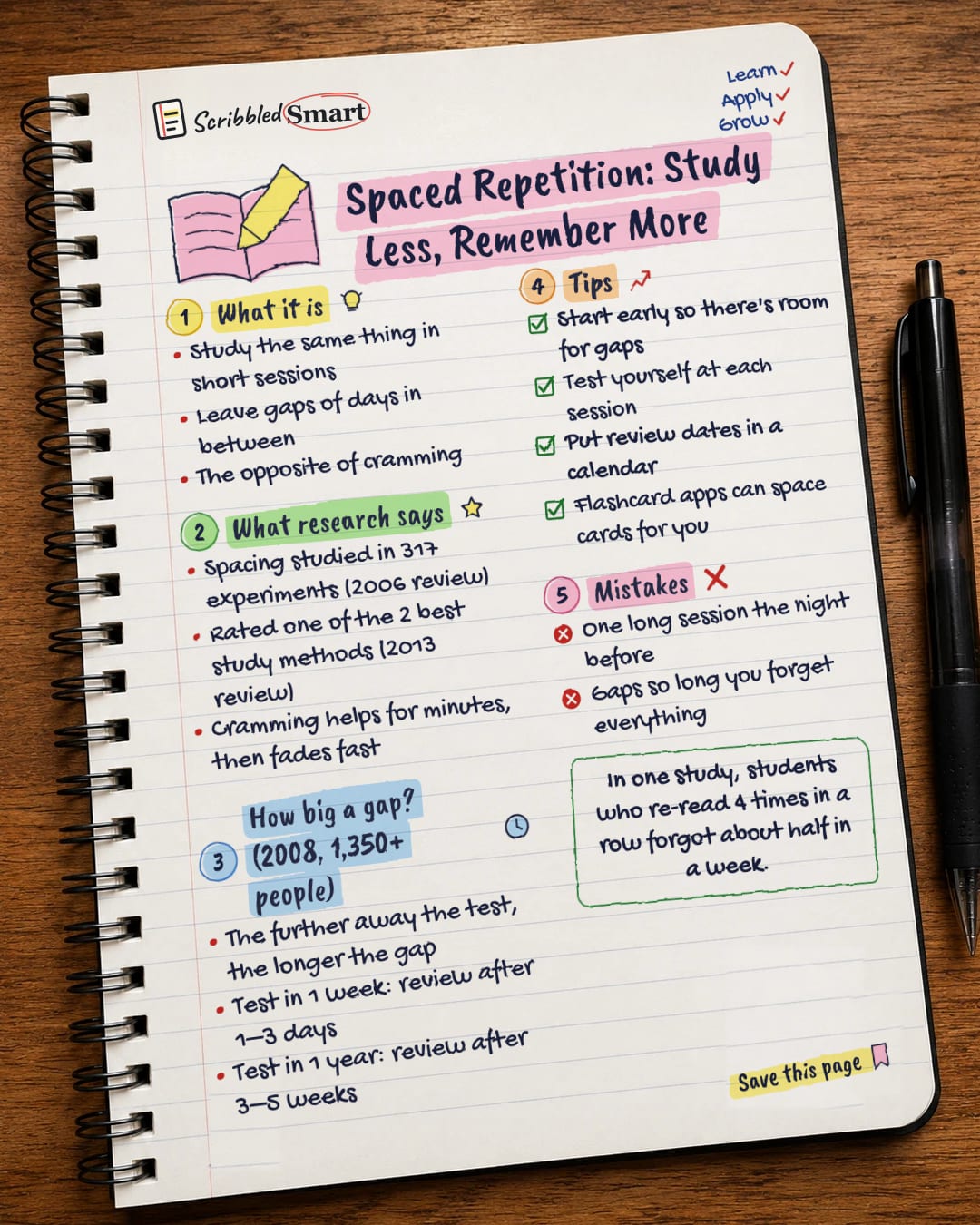
Spaced repetition means studying the same material in several sessions spread out over time, instead of cramming it all at once. Researchers call it distributed practice, and a major 2013 review rated it one of the two best study methods. This article covers what the research says, how long your gaps should be, and how to plan your revision around it.
What is spaced repetition?
You study a topic, leave it for a while, then come back to it. For tests a week to a year away, the best gaps in one large study were days to weeks (see below).
Cramming is the opposite. You do all the work in one long session, often the night before. Researchers call this massed practice.
Does spaced repetition really work?
The evidence for spacing is large, especially for facts and words.
Hundreds of experiments
A 2006 review by Cepeda and colleagues pulled together research on spacing in verbal recall tasks, such as learning words and facts. It covered 839 assessments in 317 experiments from 184 articles.
Rated one of the two best methods
In 2013, Dunlosky and colleagues rated 10 popular study techniques. Only two were rated "high utility": distributed practice (spacing) and practice testing.
Cramming fades fast
A 2006 study by Roediger and Karpicke shows how quickly crammed material fades. Students who re-read a passage 4 times in one session did best on a test 5 minutes later (83%). But one week later they did worst (40%).
Over that week, they forgot about half (52%) of what they had known. Students who tested themselves instead forgot just 14%.
One caution: that study compared re-reading with testing, not spaced study with cramming. It is used here only to show how fast back-to-back study fades.
How big should the gap be?
The further away your test, the longer the gap between reviews should be. A 2008 study by Cepeda and colleagues tested more than 1,350 people. Gaps between study sessions ranged up to 3.5 months, and the final test came up to a year later.
The main finding: the further away the test, the longer the best gap.
Based on the study's summary, the best gap was roughly 20–40% of the time until a 1-week test, and roughly 5–10% of the time until a 1-year test. Here is what that works out to:
| When is your test? | Best gap (from the study) | Worked out | Rounded |
|---|---|---|---|
| In 1 week | 20–40% of 7 days | 0.2–0.4 × 7 = 1.4–2.8 days | Review after 1–3 days |
| In 1 year | 5–10% of 365 days | 0.05–0.10 × 365 = 18–37 days | Review after 3–5 weeks |
Treat these as rough guides, not a formula. The paper says no single fixed ratio works for every delay.
Too long is also a problem
Past the best gap, longer gaps slowly reduced final test scores. If you wait so long that you have forgotten almost everything, you are nearly starting again.
Spacing works for re-reading too
Even re-reading works better when spaced out. Earlier research (Rawson and Kintsch, 2005) found spaced re-reading helps more than back-to-back re-reading.
Why it matters for school and university
The 2008 study's authors noted that "many educational practices are highly inefficient", because courses rarely revisit earlier material. You can fix this yourself by building reviews into your own plan.
Tips for using spaced repetition
- Start early. You need enough days before the exam to leave gaps.
- Test yourself at each session. Practice testing is the other top-rated method, so combine the two using active recall, where you quiz yourself from memory.
- Put review dates in a calendar. Then you don't have to remember when to come back.
- Try a flashcard app. Many flashcard apps schedule reviews for you. We have not checked studies on any particular app.
Spacing mistakes to avoid
- One long session the night before. It may feel productive, but it fades fast.
- Gaps so long you forget everything. Spacing helps, but only up to a point.
A note on the evidence: most spacing studies use word lists, facts and other verbal material. Effects on complex skills have been studied less.
FAQ
Is cramming really that bad?
Back-to-back study fades fast. In a 2006 study, students who re-read a passage 4 times in one session did best on a test 5 minutes later, but worst a week later. By then they had forgotten about half (52%) of what they had known. That study compared re-reading with testing, not spacing with cramming.
What is the difference between spaced repetition and active recall?
Spaced repetition is about when you study, in short sessions spread over days or weeks. Active recall is about how you study, by testing yourself from memory instead of re-reading. A 2013 review of 10 methods rated both "high utility", the only two to get that rating, so combining them makes sense.
Does spaced repetition work for everything?
It is best supported for facts and words. Most spacing studies, including a 2006 review of 317 experiments on verbal recall, use word lists, facts and other verbal material. Effects on complex skills have been studied less, so it is less clear how well spacing works for them.
Related reading
- Active recall: the other top-rated study method, ideal for each spaced session.
- Interleaving: another way to arrange practice, by mixing problem types.
- Sleep and memory: why all-nighters before exams backfire.
- Time blocking: a way to put your review sessions in the calendar.
Sources
- Cepeda et al. (2006): Distributed practice in verbal recall tasks (USF repository)
- Cepeda et al. (2008): Spacing effects in learning (USF repository)
- APS: Which study strategies make the grade?
- Roediger & Karpicke (2006): Test-Enhanced Learning (PDF)
How we checked this
Every fact in this article comes from the 4 sources listed above, checked against official or peer-reviewed sources where possible. AI tools help with drafting; a person checks every fact against the sources. How we research
- Published and checked
Spotted a mistake? Tell us and we'll fix it and log it on the corrections page.


