
On this page
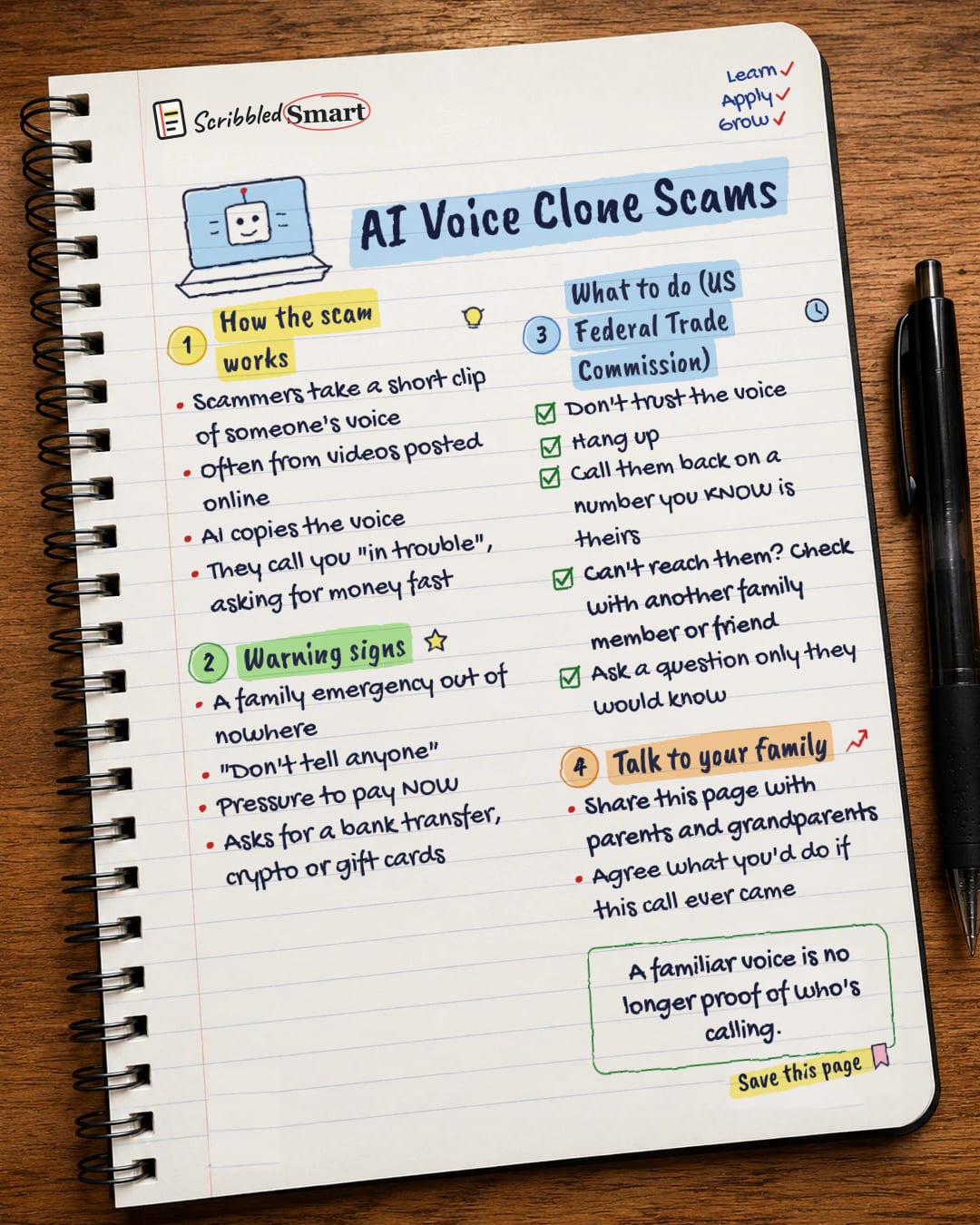
AI voice clone scams use artificial intelligence to copy the voice of someone you love, then call you pretending they're in trouble and need money fast. The US Federal Trade Commission (FTC), the American consumer protection regulator, warns that scammers can do this with just a short clip of a person's voice, often taken from videos posted online. A few simple steps can stop the scam, whoever's voice is on the line.
How AI voice clone scams work
The scam is an old trick, the fake family emergency, made more convincing with AI. According to the FTC, it usually goes like this:
- The scammer gets a short clip of someone's voice. Often this comes from videos or audio the person has posted online.
- AI copies the voice. Voice cloning software learns to sound like that person.
- They call you. The "loved one" says they're in trouble and need money urgently.
Because the voice sounds right, your instinct is to help. That's exactly what the scammer is counting on.
The FTC warned about AI being used in these schemes in March 2023, and has since published more work on the harms of AI-enabled voice cloning.
How can you tell if a call is an AI voice clone?
The biggest warning sign is pressure: a sudden emergency, a demand for secrecy and a rush to pay. The FTC highlights these signs:
- A family emergency out of nowhere. There was no hint of trouble before the call.
- "Don't tell anyone." The FTC notes that callers may ask you to keep it secret, which stops you checking with others.
- Pressure to pay now. You're pushed to act before you've had time to think.
- An unusual way to pay. The FTC warns to be wary of anyone who asks you to wire money, send cryptocurrency or buy gift cards. Scammers ask for these because they make it hard to get your money back.
These are the same pressure tactics found in scam texts and emails. Our guide on how to spot a scam message explains the five warning signs the UK's cyber security agency uses.
What should you do if you get the call?
Stop, hang up and check the story yourself before you send anything. The FTC's advice comes down to a few clear steps:
- ✓ Don't trust the voice. The FTC puts it in exactly those words. A familiar voice is no longer proof of who's calling.
- ✓ Hang up. You don't owe the caller more time.
- ✓ Call them back on a number you know is theirs. Use the number saved in your phone, not one the caller gives you.
- ✓ Can't reach them? Check with someone else. Call another family member or a friend who would know where they are.
- ✓ Ask a question only they would know. The FTC's examples are "What kind of dog do you have?" and "Where did you spend Thanksgiving last year?"
If the story is true, a few minutes of checking won't change much. If it's a scam, those minutes save your money.
Talk to your family about AI voice clone scams
The best time to plan for this call is before it happens. Share what you've learned with your family, including parents and grandparents.
Agree together what you'd each do if a call like this came. For example: always hang up and call back on the saved number, and always check with another relative before sending any money. Then nobody has to work out what to do in the middle of a frightening call.
If you've already paid
🇬🇧 UK only. The FTC is a US regulator, so here are the UK routes. If you've lost money, or think a fraudster has access to your account, tell your bank or payment provider as soon as possible. Use a number you know is real, such as the one on their website or the back of your card, or call 159 to reach your bank.
Then report it:
- Report Fraud: report at reportfraud.police.uk or on 0300 123 2040. Report Fraud replaced Action Fraud from 4 December 2025.
- Scotland: fraud is reported to Police Scotland on 101 instead.
- In an emergency, call 999.
Outside the UK? Contact your bank and your national fraud agency.
Common mistakes
- ✗ Believing a voice because it sounds right. With AI, sounding right proves nothing.
- ✗ Calling back the number that called you. Always use a number you already have.
- ✗ Keeping it secret because you were asked to. Secrecy is a tactic. Telling someone lets you check the story.
- ✗ Paying by gift card, crypto or bank transfer under pressure. Pause first, every time.
Related reading
- Two-step verification: protect your accounts so scammers can't get in, even with your password.
- How AI chatbots work: a plain-English look at the AI technology behind today's tools.
- How to spot a job scam: another scam that uses pressure and urgency to rush you.
Sources
- FTC: Scammers use AI to enhance their family emergency schemes
- FTC: Family emergency scams
- FTC: Scammers use fake emergencies to steal your money
- FTC: Fighting back against harmful voice cloning (2024)
- FTC: Preventing the harms of AI-enabled voice cloning
- GOV.UK: Report Fraud, new service from City of London Police
- GOV.UK Stop! Think Fraud: Reporting fraud
How we checked this
Every fact in this article comes from the 7 sources listed above, checked against official or peer-reviewed sources where possible. AI tools help with drafting; a person checks every fact against the sources. How we research
- Published and checked
- Next check
- Yearly
General info. Advice is based on US FTC guidance; UK reporting routes can change, so check the official pages linked above.
Spotted a mistake? Tell us and we'll fix it and log it on the corrections page.


