
On this page
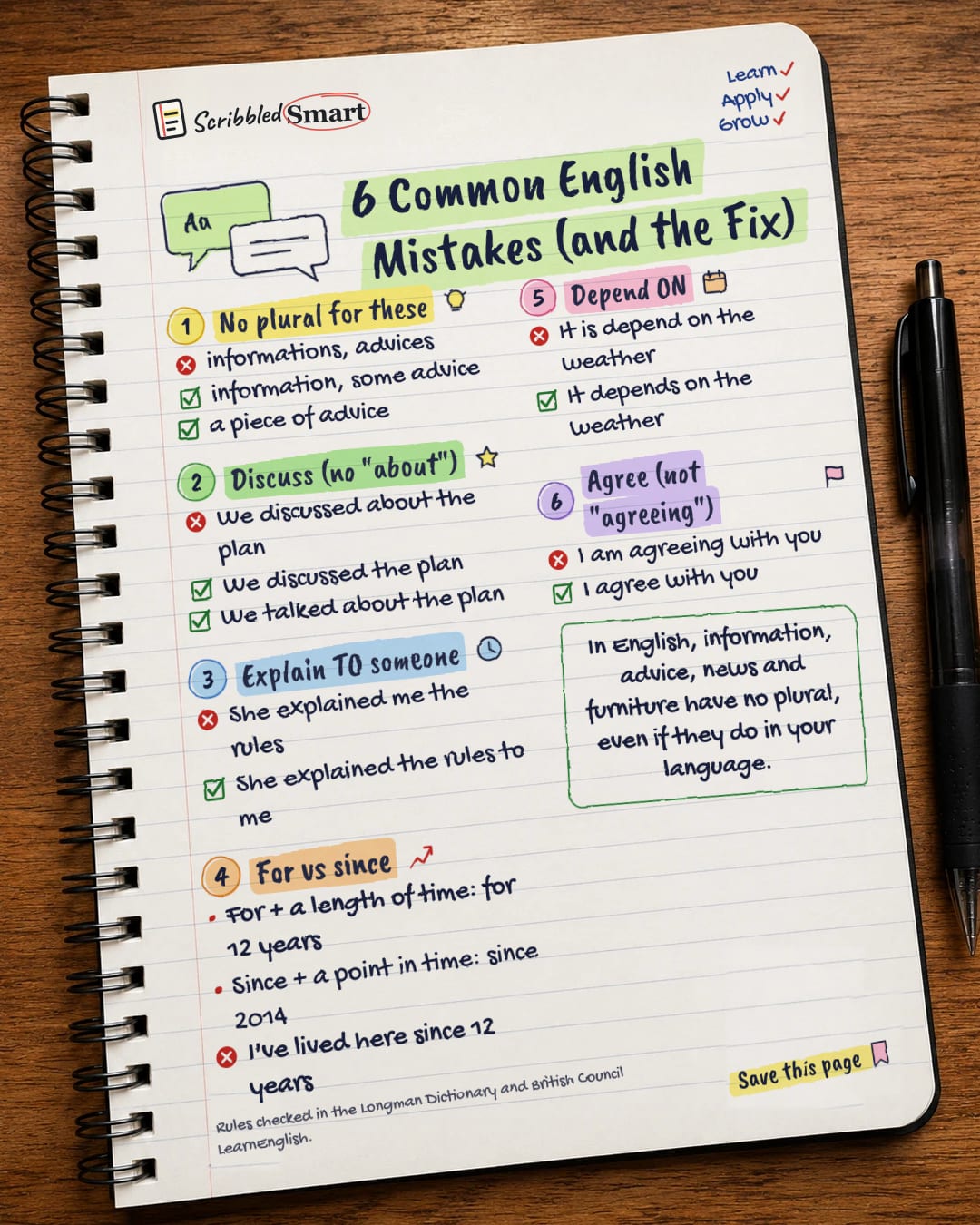
Many common English mistakes are small ones, such as saying "informations", "discuss about", "explained me", "since 12 years", "it is depend on" and "I am agreeing". Each one has a simple fix. This guide shows you the wrong form, the right form and the reason, using notes from the Longman Dictionary of Contemporary English and the British Council.
1. Can you say "informations" or "advices"?
Some nouns in English are uncountable. That means you cannot count them or make them plural. The Longman Dictionary says "information" is an uncountable noun and is not used in the plural. The same is true of "advice".
- ✗ I need some informations about the course.
- ✓ I need some information about the course.
- ✗ She gave me some advices.
- ✓ She gave me some advice.
- ✓ She gave me a piece of advice.
"An advice" is also wrong. If you want to talk about one item, use "a piece of": a piece of advice, a piece of information.
Why this one is so common
The British Council explains that some common nouns, like information, are uncountable in English even though they have plurals in other languages. So if your first language says "informations" or "advices", English feels strange here. It is not you. It is the language.
The British Council's list of uncountable nouns also includes news, furniture, baggage, equipment, homework, knowledge, luggage, machinery, money and traffic.
Some uncountable nouns cannot take "a piece of" at all. You would not say "a piece of accommodation", "a piece of money" or "a piece of traffic". Use other words instead, such as "flats" or "sums of money".
2. Is "discuss about" wrong?
"Discuss" goes straight to the thing you are talking about. The Longman Dictionary says: don't say "discuss about something".
- ✗ We discussed about the plan.
- ✓ We discussed the plan.
- ✓ We talked about the plan.
The dictionary also notes that in everyday English, people usually say "talk about" rather than "discuss". So "talk about" is the friendly, everyday choice, and "discuss" is a little more formal. Our guide to formal vs informal English shows more word pairs like this one.
3. Explain something TO someone
With "explain", the thing being explained comes first, and the person comes after "to". The Longman Dictionary flags "Alan explained me the system" as wrong.
- ✗ She explained me the rules.
- ✓ She explained the rules to me.
- ✓ Can you explain this word to me?
A good way to remember it: you explain something, and you explain it to someone.
4. When do you use "for" or "since"?
Here is the rule from the Longman Dictionary:
| Word | Use it with | Example |
|---|---|---|
| for | a length of time | I've lived here for 12 years. |
| since | a point in time | I've lived here since 2014. |
The dictionary says: don't use "since" with a period of time. It gives "He has been living in England since 12 years" as an example of what not to say.
- ✗ I've lived here since 12 years.
- ✓ I've lived here for 12 years.
- ✓ I've lived here since 2014.
Ask yourself: is it how long (12 years, three weeks, a long time)? Use "for". Is it when it started (2014, Monday, last summer)? Use "since".
5. Depend ON
"Depend" is a verb, so you do not need "is" in front of it. The Longman Dictionary flags "The cost is depend on the time of year" as wrong.
- ✗ It is depend on the weather.
- ✓ It depends on the weather.
The dictionary also flags "It is depending (on) what you want." The simple form is the right one: "It depends on what you want."
6. Agree (not "agreeing")
"Agree" is not used in the progressive (the "-ing" form with "am", "is" or "are"). The Longman Dictionary flags "I am agreeing completely" as wrong.
- ✗ I am agreeing with you.
- ✓ I agree with you.
- ✓ I completely agree.
Don't forget the "with" when you name the person. The dictionary also flags "I agree Tanya". The right form is "I agree with Tanya".
How to avoid these common English mistakes
- Learn the right form as a whole phrase. Say "a piece of advice", "it depends on" and "explain it to me" out loud until they feel normal.
- Check the noun first. Before you add an "s", ask whether the noun is uncountable. Information, advice and furniture never take one.
- Ask "how long" or "when"? This one question sorts out "for" and "since".
- Watch out for "is" before a verb. "It is depend" and "it is depending" both need to become "it depends".
- Don't add extra words. "Discuss about" and "explain me" both come from adding or moving a small word. The correct forms are simpler.
Related reading
- Affect vs effect: five more pairs of words that trip up learners and native speakers alike.
- Phrasal verbs: the small words that change a verb's meaning, and where they go in a sentence.
- Formal vs informal English: when to use "discuss" and when "talk about" sounds better.
- Active recall: a study method that helps the right forms stick.
Sources
- Longman Dictionary of Contemporary English: information
- Longman Dictionary of Contemporary English: advice
- Longman Dictionary of Contemporary English: discuss
- Longman Dictionary of Contemporary English: explain
- Longman Dictionary of Contemporary English: since
- Longman Dictionary of Contemporary English: depend
- Longman Dictionary of Contemporary English: agree
- British Council LearnEnglish: Uncount nouns
- British Council LearnEnglish: Nouns: countable and uncountable
How we checked this
Every fact in this article comes from the 9 sources listed above, checked against official or peer-reviewed sources where possible. AI tools help with drafting; a person checks every fact against the sources. How we research
- Published and checked
Spotted a mistake? Tell us and we'll fix it and log it on the corrections page.


