
On this page
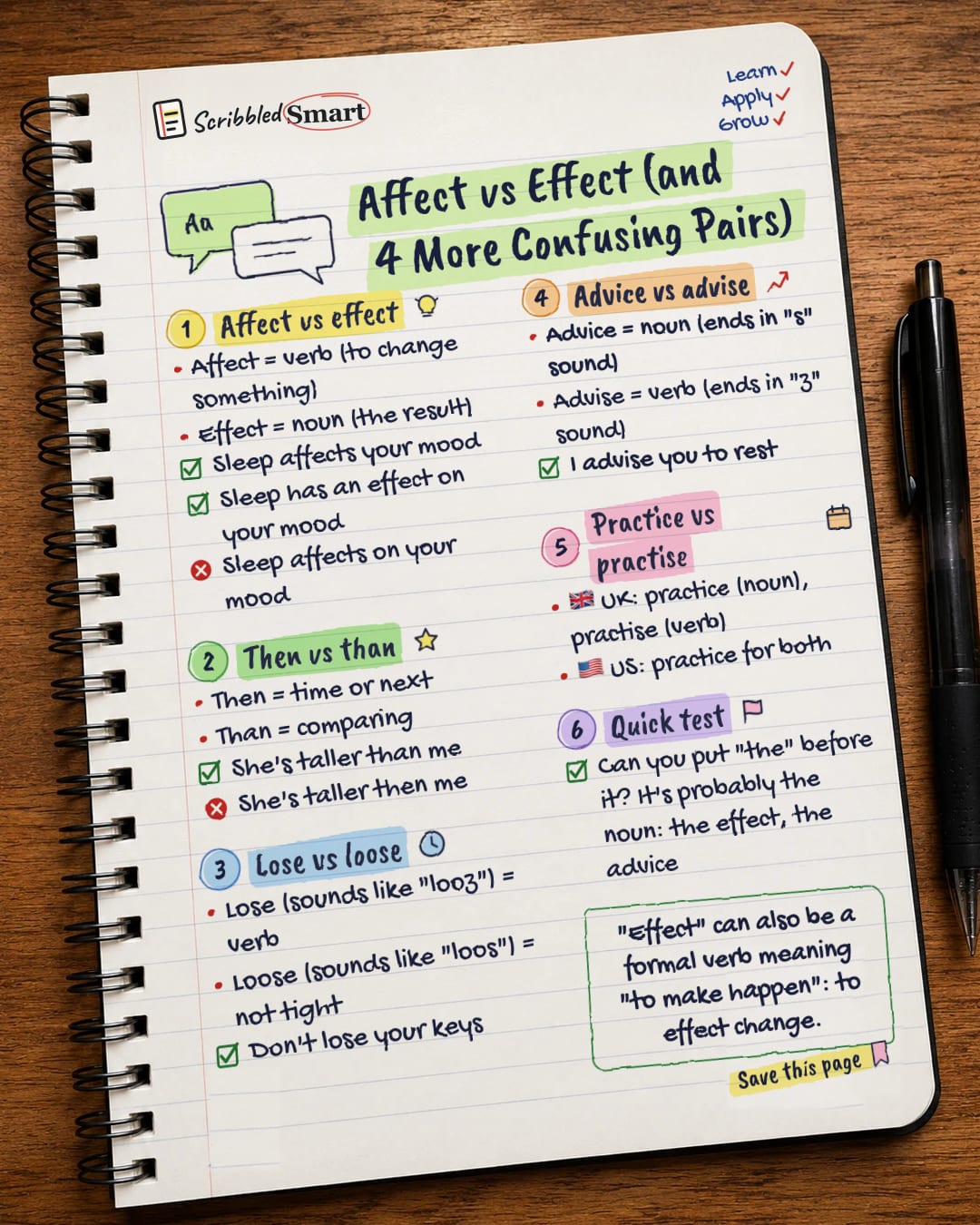
In the affect vs effect question, "affect" is a verb that means to change something, and "effect" is a noun that means the result. So sleep affects your mood, and sleep has an effect on your mood. This guide explains that pair, then four more pairs that are easy to mix up: then/than, lose/loose, advice/advise and practice/practise.
Affect vs effect: verb or noun?
Most of the time, "affect" is the verb and "effect" is the noun. Here is what the dictionary says.
The Longman Dictionary of Contemporary English defines the verb "affect" as doing something that produces an effect or change in something or in someone's situation. It defines the noun "effect" as a change that is caused by an event or action.
Side by side:
| Word | Part of speech | Meaning | Example |
|---|---|---|---|
| affect | verb | to change something | Stress affects your sleep. |
| effect | noun | the result | Stress has an effect on your sleep. |
The "affects on" mistake
The dictionary is clear on this: you say that something affects another thing. "Smoking affects your health" is right. "Smoking affects on your health" is wrong.
The word "on" belongs with the noun, in the phrase "have an effect on something".
- ✓ Sleep affects your mood.
- ✓ Sleep has an effect on your mood.
- ✗ Sleep affects on your mood.
When "effect" is a verb
There is one exception worth knowing. "Effect" can also be a formal verb meaning "to make something happen". The Longman Dictionary gives the example "their ability to effect change".
So "to effect change" means to make change happen. Because this use is formal, you will mostly meet it in formal writing. In everyday English, "affect" is the verb you need.
Other meanings of "affect"
The Longman Dictionary lists two more senses of the verb "affect". It can mean to make someone feel strong emotions. In formal English, it can also mean to pretend to have a particular feeling. In both cases, it is still a verb.
When do you use "then" or "than"?
These two look alike but do different jobs.
- Then is about time. The Longman Dictionary says it is used for a particular time in the past or future, or to say what happens next.
- Than is for comparing. The dictionary says it is used when comparing two things, people or situations.
Examples:
- ✓ We had lunch, then we went for a walk.
- ✓ She's taller than me.
- ✗ She's taller then me.
If you are comparing, with words like "taller", "better" or "more", the word you need is "than".
Lose vs loose
The trick here is the sound. The Longman Dictionary tells readers not to confuse the adjective "loose" (said with an "s" sound, so it rhymes with "goose") with the verb "lose" (said with a "z" sound, so it rhymes with "choose").
- Lose (verb): Don't lose your keys.
- Loose (adjective): The dictionary's first meaning is "not firmly fastened in place". That means not tight. My shoelace is loose.
Advice vs advise
Again, sound helps. In the Longman Dictionary, "advice" ends in an "s" sound and is a noun. "Advise" ends in a "z" sound and is a verb.
- ✓ Can I give you some advice?
- ✓ I advise you to rest.
- ✗ I advice you to rest.
Remember: you give advice (a thing), but you advise someone (an action).
Is it "practice" or "practise"?
This pair depends on where you are.
| Noun | Verb | |
|---|---|---|
| 🇬🇧 British English | practice | practise |
| 🇺🇸 American English | practice | practice |
The Longman Dictionary lists "practise" as British English and "practice" as American English for the verb, and gives "practice" as the noun in the word family.
- 🇬🇧 I need to practise the piano. I have piano practice on Tuesday.
- 🇺🇸 I need to practice the piano. I have piano practice on Tuesday.
If you write for a UK reader, use "practise" for the action. If you write for a US reader, "practice" works for both. For more spelling splits like this, see our guide to British vs American English.
A quick test for nouns
A handy rule of thumb (not a grammar law): if you can put "the" before the word, it is probably the noun.
- "the effect" makes sense, so "effect" is the noun.
- "the advice" makes sense, so "advice" is the noun.
- "the practice" makes sense, so "practice" is the noun.
This works because nouns take articles like "the" and "a". It is a quick check, not a perfect one, so use it as a starting point.
One more pair: except
"Except" looks a lot like "accept", but it does a different job. The Longman Dictionary says "except" is used to introduce the only person or thing about which a statement is not true.
- ✓ Everyone came except Sam.
So "except" points to the one left out.
Tips and common mistakes
- Say it out loud. Lose/loose and advice/advise are easier by sound than by spelling.
- Look for "on". If you wrote "affects on", change it to "affects" or "has an effect on".
- Spot the comparison. Taller, better, more, less: these are followed by "than".
- Know your reader. For a UK audience, write "practise" as a verb. For a US audience, use "practice".
- Use the "the" test carefully. It helps most of the time, but it is a rule of thumb only.
Related reading
- Its vs it's: the apostrophe rule that fixes its/it's, your/you're and their/they're.
- British vs American English: more spelling differences like practise/practice.
- Common English mistakes: why "advices" and "informations" are wrong.
- Write a CV: a document where it is worth checking for mix-ups like affect/effect.
Sources
- Longman Dictionary of Contemporary English: affect
- Longman Dictionary of Contemporary English: effect
- Longman Dictionary of Contemporary English: then
- Longman Dictionary of Contemporary English: than
- Longman Dictionary of Contemporary English: loose
- Longman Dictionary of Contemporary English: advice
- Longman Dictionary of Contemporary English: advise
- Longman Dictionary of Contemporary English: practise
- Longman Dictionary of Contemporary English: except
How we checked this
Every fact in this article comes from the 9 sources listed above, checked against official or peer-reviewed sources where possible. AI tools help with drafting; a person checks every fact against the sources. How we research
- Published and checked
Spotted a mistake? Tell us and we'll fix it and log it on the corrections page.


