
On this page
- The one rule behind its vs it's
- It's vs its
- Is it "your welcome" or "you're welcome"?
- What is the difference between their, there and they're?
- Is it "whose" or "who's"?
- The quick test
- A note on noun possessives and plurals
- Tips and common mistakes
- Related reading
- Sources
The difference in its vs it's is simple: "it's" is short for "it is" or "it has", and "its" means belonging to it. The apostrophe shows that letters are missing, not that something belongs to someone. Once you know that one rule, it also fixes your/you're, their/they're and whose/who's. This guide explains each pair and gives you a quick test you can use every time.
The one rule behind its vs it's
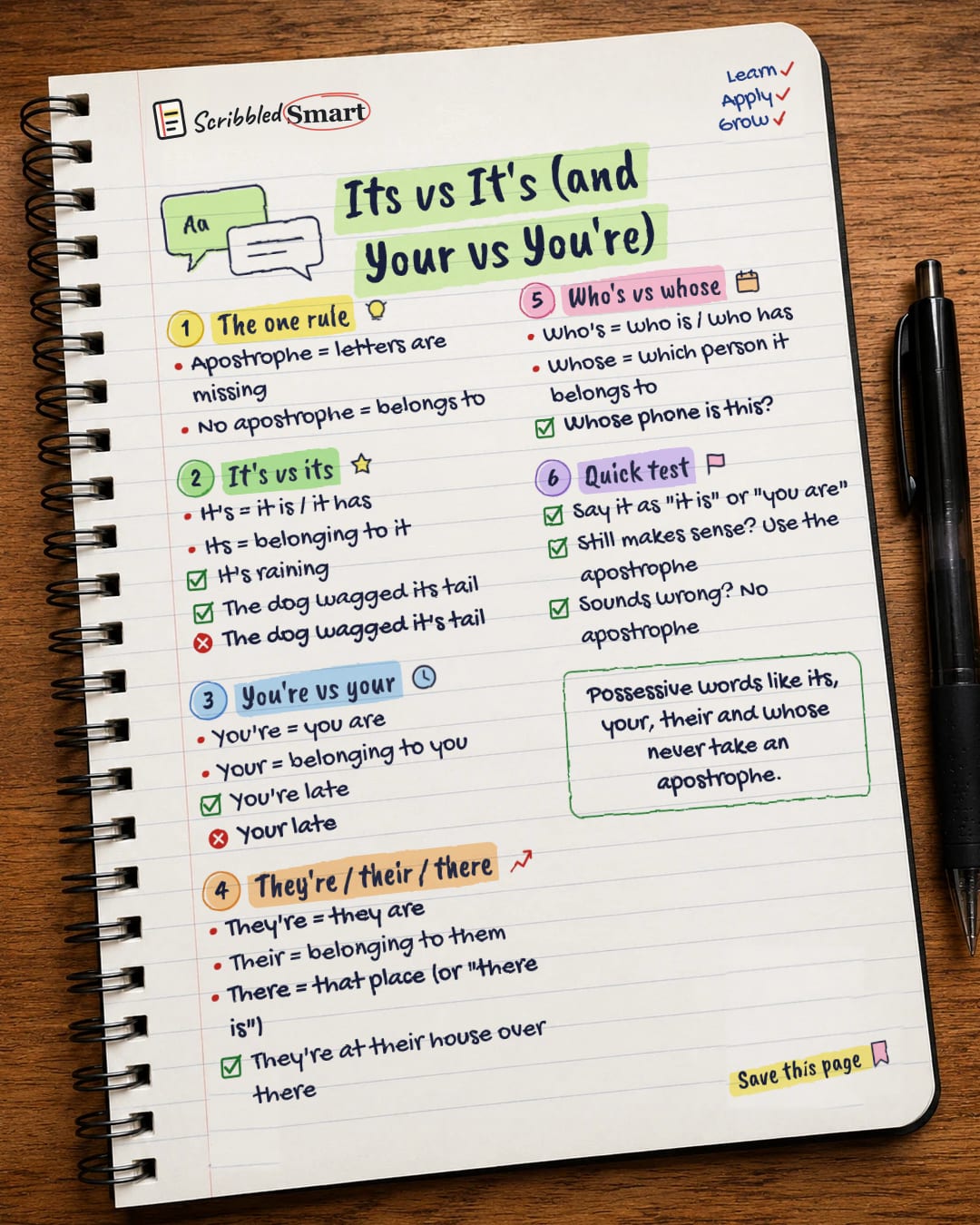
An apostrophe in these short words means letters are missing. No apostrophe means something belongs to someone or something.
Purdue OWL, the writing guide from Purdue University, lists one main job of the apostrophe as showing that letters have been left out. That is what happens in short forms like "it's" and "you're".
Purdue also says not to use apostrophes for personal pronouns, the relative pronoun "who", or for noun plurals. Words like "its", "your", "their" and "whose" already show ownership by themselves. They never need an apostrophe.
So:
| With an apostrophe | Without an apostrophe |
|---|---|
| Letters are missing | Belongs to |
| it's, you're, they're, who's | its, your, their, whose |
This can feel odd at first, because with nouns an apostrophe does show ownership ("the owner's car"). But these small words are different. They are already possessive, so they do not need one.
It's vs its
The Longman Dictionary of Contemporary English says "it's" is the short form of "it is" (as in "It's raining") and also the short form of "it has". It adds: do not confuse it with "its", which is the possessive form of "it".
"Its" is used for something that belongs to, or is connected with, a thing or animal that has already been mentioned.
- ✓ It's raining. (It is raining.)
- ✓ It's been a long day. (It has been a long day.)
- ✓ The dog wagged its tail.
- ✗ The dog wagged it's tail.
Is it "your welcome" or "you're welcome"?
The Longman Dictionary says "you're" is the short form of "you are". "Your" shows that something belongs to, or is connected with, the person you are speaking or writing to.
- ✓ You're late. (You are late.)
- ✓ You're welcome. (You are welcome.)
- ✓ Is this your coat?
- ✗ Your late.
What is the difference between their, there and they're?
This is a group of three, so take it slowly.
- They're is the short form of "they are".
- Their means belonging to or connected with people or things already mentioned.
- There means in or to a particular place that is not where you are. It is also used in "there is" and "there are".
One sentence uses all three:
- ✓ They're at their house over there.
And some more:
- ✓ There is a café on the corner.
- ✓ Their car is red.
- ✗ Their at home. (This should be "They're at home".)
Is it "whose" or "who's"?
The Longman Dictionary says "who's" is the short form of "who is" or "who has". "Whose" is used to ask which person or people a particular thing belongs to.
- ✓ Who's coming tonight? (Who is coming?)
- ✓ Who's seen my keys? (Who has seen my keys?)
- ✓ Whose phone is this?
- ✗ Who's phone is this?
"Whose" can also be used for things, not just people, as in "a house whose roof leaks". This guide sticks to the question form.
The quick test
Here is a test that works for every pair in this guide:
- Say the sentence with the full form: "it is", "it has", "you are", "they are", "who is" or "who has".
- Does it still make sense? Use the apostrophe.
- Does it sound wrong? Use the word with no apostrophe.
Let's try it:
| Sentence | Say it in full | Result |
|---|---|---|
| The dog wagged (its / it's) tail. | "The dog wagged it is tail." | Sounds wrong, so use its |
| (Your / You're) late. | "You are late." | Makes sense, so use you're |
| (Whose / Who's) phone is this? | "Who is phone is this?" | Sounds wrong, so use whose |
| (Its / It's) been cloudy. | "It has been cloudy." | Makes sense, so use it's |
Remember to try "it has" and "who has" as well as "it is" and "who is". "It's been cloudy" only passes the test if you think of "it has".
A note on noun possessives and plurals
Nouns are a different story. With a noun, the apostrophe does show ownership: "the owner's car" or "two cats' toys". You can read more about that in our punctuation guide.
Purdue OWL also notes that you do not need an apostrophe for plurals of capital letters, numbers and symbols, such as "CDs" or "the 1990s", though some editors still use one.
Tips and common mistakes
- Slow down when you write fast. Check each one before you press send.
- Use the test when you proofread. Read each "its", "your", "their" and "whose" and try the full form.
- Never add an apostrophe to a possessive word. "Its", "your", "their" and "whose" never take one.
- Remember "it has" and "who has". They are short forms too.
- Don't use an apostrophe for a simple plural. "Apples for sale", not "apple's for sale".
Related reading
- Punctuation: apostrophes with nouns, plus commas, colons and semicolons.
- Affect vs effect: more pairs of words that people confuse.
- Email phrases: polished phrases for emails, where small slips are easy to spot.
Sources
- Purdue OWL: Apostrophe
- Longman Dictionary of Contemporary English: it's
- Longman Dictionary of Contemporary English: its
- Longman Dictionary of Contemporary English: you're
- Longman Dictionary of Contemporary English: your
- Longman Dictionary of Contemporary English: they're
- Longman Dictionary of Contemporary English: their
- Longman Dictionary of Contemporary English: there
- Longman Dictionary of Contemporary English: who's
- Longman Dictionary of Contemporary English: whose
How we checked this
Every fact in this article comes from the 10 sources listed above, checked against official or peer-reviewed sources where possible. AI tools help with drafting; a person checks every fact against the sources. How we research
- Published and checked
Spotted a mistake? Tell us and we'll fix it and log it on the corrections page.


