
On this page
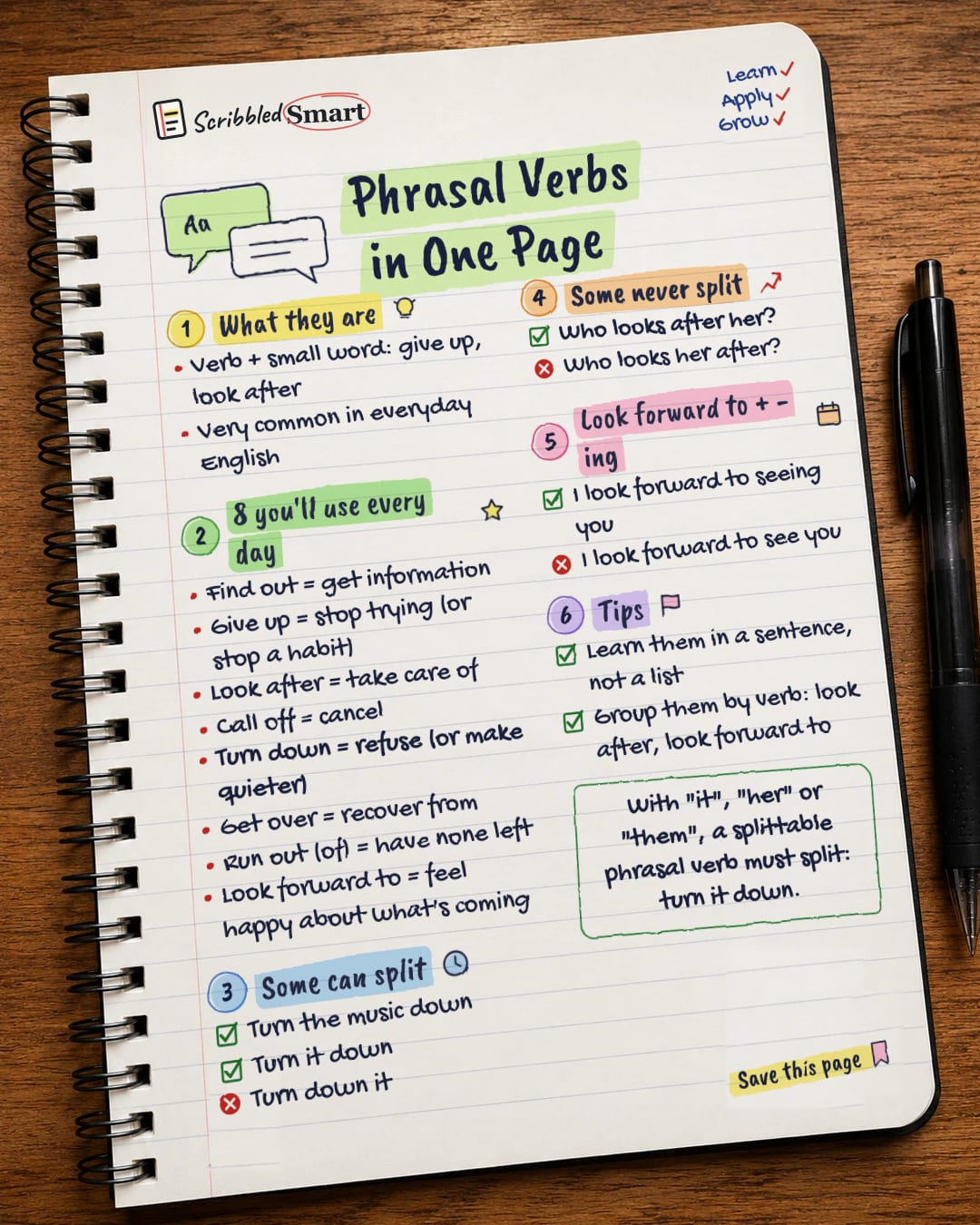
Phrasal verbs are verbs made of a main verb plus a small word called a particle, like "give up" or "look after". They are very common in English, especially in informal contexts. This page covers eight useful ones, explains which ones can split and which can't, and fixes a mistake with "look forward to".
What are phrasal verbs?
A phrasal verb is a verb joined to one or two small words that change its meaning. The British Council says phrasal verbs are made up of a verb and a particle or, sometimes, two particles. A particle is a small word such as "up", "out", "after" or "off".
- give + up = give up
- look + after = look after
- look + forward + to = look forward to
The British Council also says phrasal verbs are very common in English, especially in more informal contexts.
8 useful phrasal verbs and their meanings
Here are eight useful phrasal verbs, with meanings from the Longman Dictionary of Contemporary English.
| Phrasal verb | Meaning | Example |
|---|---|---|
| find out | get information, after trying or by chance | I found out the train was late. |
| give up | stop trying, or stop a habit | Don't give up now. / He gave up sugar. |
| look after | take care of | Who looks after your cat? |
| call off | cancel a planned event | They called off the match. |
| turn down | refuse, or make quieter | She turned down the job. / Turn the TV down. |
| get over | recover from an illness | It took me a week to get over my cold. |
| run out (of) | have none left | We've run out of milk. |
| look forward to | feel excited and pleased about something coming | I'm looking forward to the holidays. |
Notes on a few of these
- Give up has two meanings in the dictionary: to stop trying to do something, and to stop doing something you do regularly, like a habit.
- Turn down also has two: to refuse an offer, request or invitation, and to make a machine produce less heat, sound and so on.
- Look after is labelled "especially British English" in the Longman Dictionary, which gives "take care of" as a synonym.
- Get over is defined in the dictionary as becoming well again after an illness.
Which phrasal verbs can split?
Some phrasal verbs can split, with the object in the middle, and some can't. The British Council calls these separable and non-separable.
Separable: the object can go in the middle
With a separable phrasal verb, a noun object can go after the particle or between the verb and the particle. "Turn down" is separable.
- ✓ Turn down the music.
- ✓ Turn the music down.
The pronoun rule
The British Council says separable phrasal verbs must be separated when you use a personal pronoun, such as "it", "her" or "them".
- ✓ Turn it down.
- ✗ Turn down it.
- ✓ They've called it off.
Non-separable: they never split
Some phrasal verbs always stay together. The British Council says that even when there is a personal pronoun, the verb and particle remain together. "Look after" is one of these.
- ✓ Who looks after her when you're at work?
- ✗ Who looks her after?
Other non-separable examples from the British Council include "come across", "turn into" and "look into". More separable ones include "bring up", "fill in" and "pick up".
Three-part phrasal verbs
Some phrasal verbs have two particles. The British Council lists examples like these:
- come up with
- get rid of
- get on with
- put up with
- look forward to
These three-part phrasal verbs never split.
Is it "look forward to see" or "look forward to seeing"?
This one follows a fixed pattern. The Longman Dictionary gives the pattern "look forward to doing something". Here, "to" is a preposition, so it is followed by a noun or an -ing form, not by the base form of a verb.
- ✓ I look forward to seeing you.
- ✓ I'm looking forward to the weekend.
- ✗ I look forward to see you.
The dictionary also flags "I'm looking forward for your visit" as wrong. The word after "forward" is always "to".
You'll often see this phrase at the end of an email. Our list of professional email phrases shows how to use "I look forward to hearing from you".
Tips for learning phrasal verbs
The British Council's main advice is to learn phrasal verbs in context.
- ✓ Learn them in a sentence, not a list. The British Council advises learning phrasal verbs in context and writing your own example sentence.
- ✓ Group them by verb or by particle. The British Council suggests organising your notes by the main verb (look after, look forward to, look into) or by the particle.
- ✓ Check if it splits. When you learn a new one, note whether it is separable. It changes where "it" goes.
- ✓ Notice the style. Phrasal verbs are common in informal English. See our guide to formal vs informal English for when to choose a more formal word.
Related reading
- English idioms explained: more phrases whose meaning you can't guess from the words.
- Formal vs informal English: when a phrasal verb fits and when a single verb sounds better.
- Email phrases that sound professional: including the classic "I look forward to hearing from you".
- Active recall: test yourself so new verbs stick.
Sources
- British Council LearnEnglish: Phrasal verbs (B1–B2)
- British Council LearnEnglish: Phrasal verbs, why they're good to know
- Longman Dictionary of Contemporary English: find out
- Longman Dictionary of Contemporary English: give up
- Longman Dictionary of Contemporary English: look after
- Longman Dictionary of Contemporary English: call off
- Longman Dictionary of Contemporary English: turn down
- Longman Dictionary of Contemporary English: get over
- Longman Dictionary of Contemporary English: run out
- Longman Dictionary of Contemporary English: look forward to
How we checked this
Every fact in this article comes from the 10 sources listed above, checked against official or peer-reviewed sources where possible. AI tools help with drafting; a person checks every fact against the sources. How we research
- Published and checked
Spotted a mistake? Tell us and we'll fix it and log it on the corrections page.


