
On this page
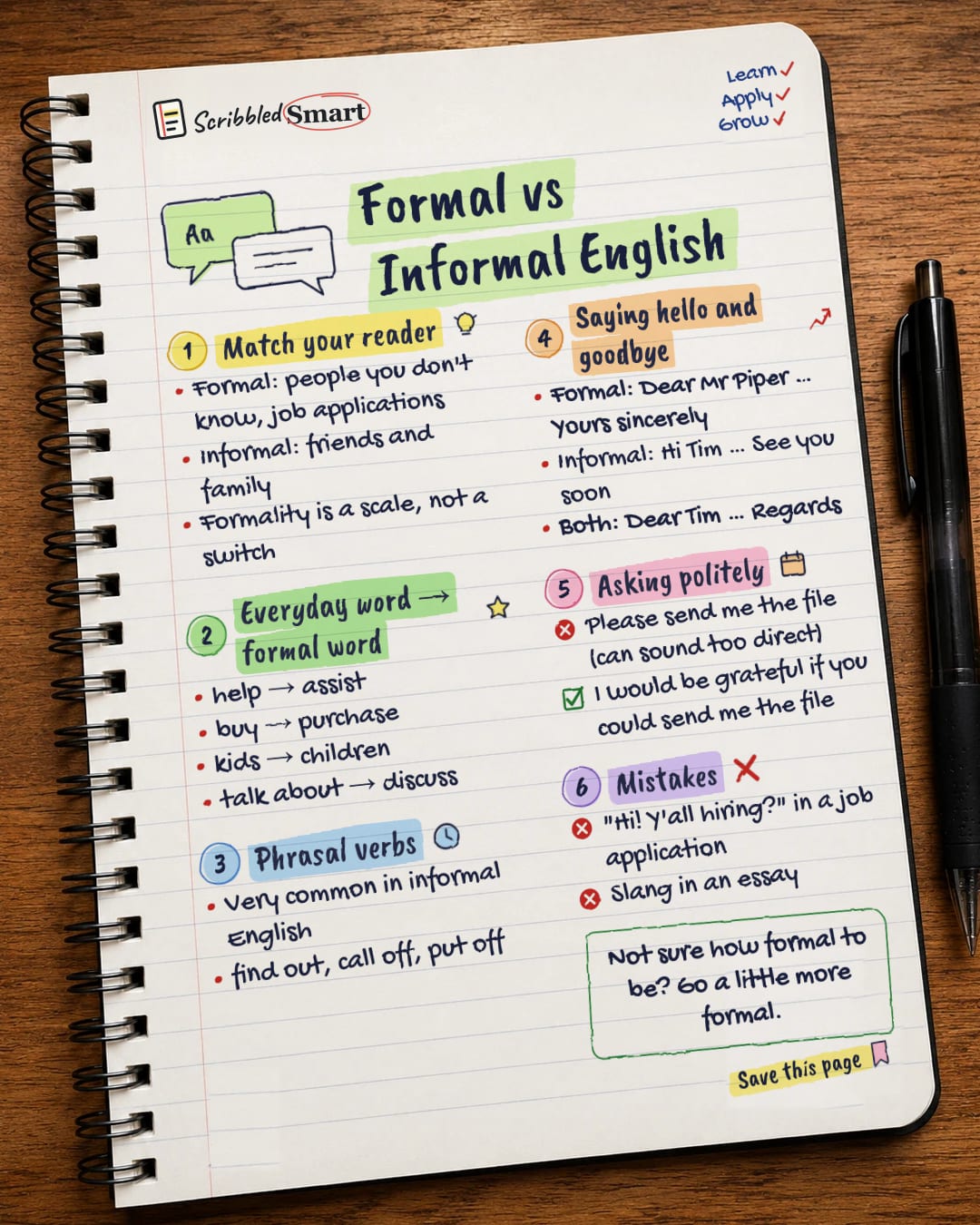
The choice between formal vs informal English depends on who you are writing to: use formal English for people you don't know and for things like job applications, and informal English for friends and family. Formality is not an on-off switch. It is a scale, and you slide along it to suit your reader. Below you'll find the word swaps, greetings and polite phrases that move you up or down that scale.
Who are you writing for?
Your reader decides the style. Purdue OWL, a university writing guide, says the level of formality you use should be decided by what your audience expects and by your purpose.
A formal style suits:
- people you don't know
- job applications
- essays and academic writing
An informal style suits:
- friends and family
- quick messages to people you know well
Purdue also says that formality exists on a scale. A note to your manager might be fairly formal; a message to a colleague you work with every day can be more relaxed. You don't have to choose between two boxes.
Everyday words and their formal versions
Many everyday words have a more formal partner. The Longman Dictionary of Contemporary English marks these clearly.
| Everyday word | Formal word | What the dictionary says |
|---|---|---|
| help | assist | "Assist" is labelled formal. People usually say "help" in everyday English. |
| buy | purchase | "Purchase" is labelled formal and means to buy something. |
| kids | children | "Kid" is informal. For formal or written styles, use "child". |
| talk about | discuss | In everyday English, people usually say "talk about" rather than "discuss". |
Examples:
- Informal: Can you help me with this?
- Formal: Could you assist me with this?
- Informal: The kids loved it.
- Formal: The children enjoyed it.
Formal does not mean complicated
Formal writing still needs to be clear. GOV.UK, the UK government website, says all its content must be in plain English. Its style guide lists "utilise" as a word to avoid: just say "use". So pick the formal word when it fits, but don't reach for long words just to sound clever.
Use nouns to sound more formal
The British Council says that using nouns instead of verbs can make your writing sound more formal. Here is its example:
- Less formal: My circumstances have changed.
- More formal: There has been a change in my circumstances.
Phrasal verbs are common in informal English
Phrasal verbs are especially common in informal English. The British Council says phrasal verbs are very common in English, especially in more informal contexts. A phrasal verb is a verb plus a small word, such as:
- find out
- call off
- put off
You don't need to avoid them in formal writing. Just notice that they make your style more relaxed. Our guide to phrasal verbs in one page explains how they work.
One word of warning: phrasal verbs and single-word verbs are not always exact matches. The Longman Dictionary shows that "postpone" means changing a planned date, while "put off" is about delaying doing something. So don't treat every phrasal verb as an informal copy of a formal word.
Greetings and sign-offs
How you open and close a message sets the tone. The British Council's business email lessons sort greetings and sign-offs into three groups:
| Style | Opening | Closing |
|---|---|---|
| Formal | Dear Mr Piper | Yours sincerely |
| Informal | Hi Tim | See you soon |
| Works for both | Dear Tim | Regards |
If you write lots of emails, our list of professional email phrases has more openings and closings.
How do you make a request sound more polite?
Softer wording makes a request sound more polite. A British Council tutor says that "Please send me…" can sound too direct in a formal email. It is not wrong, but it can seem abrupt. The British Council's advice for polite requests is to use "I would be grateful if you could…".
- Can sound too direct: Please send me the file.
- More polite: I would be grateful if you could send me the file.
Can you use contractions in formal writing?
Contractions (like "I'm" and "don't") are not banned in formal writing. Sources do not support a hard rule. The British Council says contractions are common, especially in speech, and its own model job email uses "I'm writing…". GOV.UK avoids negative contractions such as "can't", but that is for accessibility (some readers misread them), not formality.
Formal vs informal English mistakes to avoid
The first two mistakes below come from using a relaxed style where a formal one is expected.
- ✗ Too casual in a job application. Purdue OWL gives an example of a job application that starts "Hi! I read in the paper that y'all were looking for a receptionist." For a job application, that is far too informal.
- ✗ Slang in an essay. Purdue says to avoid slang or idiomatic expressions in general academic writing.
- ✓ When unsure, go a little more formal. A British Council tutor says it is generally better to be more formal if you aren't sure, though the tutor also notes that norms vary from country to country.
Related reading
- Email phrases that sound professional: ready-made openings, requests and sign-offs.
- Phrasal verbs explained: the everyday verbs that make English sound natural.
- How to write a cover letter: a formal piece of writing where tone really matters.
- Everyday English phrases: the informal, spoken side of English.
Sources
- Purdue OWL: Levels of Formality
- Purdue OWL: Using appropriate language
- Longman Dictionary of Contemporary English: assist
- Longman Dictionary of Contemporary English: purchase
- Longman Dictionary of Contemporary English: kid
- Longman Dictionary of Contemporary English: discuss
- Longman Dictionary of Contemporary English: postpone
- British Council LearnEnglish: Phrasal verbs
- British Council LearnEnglish: Unit 4 Starting and finishing emails
- British Council LearnEnglish: An email request (C1)
- GOV.UK: Style guide A to Z
How we checked this
Every fact in this article comes from the 11 sources listed above, checked against official or peer-reviewed sources where possible. AI tools help with drafting; a person checks every fact against the sources. How we research
- Published and checked
Spotted a mistake? Tell us and we'll fix it and log it on the corrections page.


