
On this page
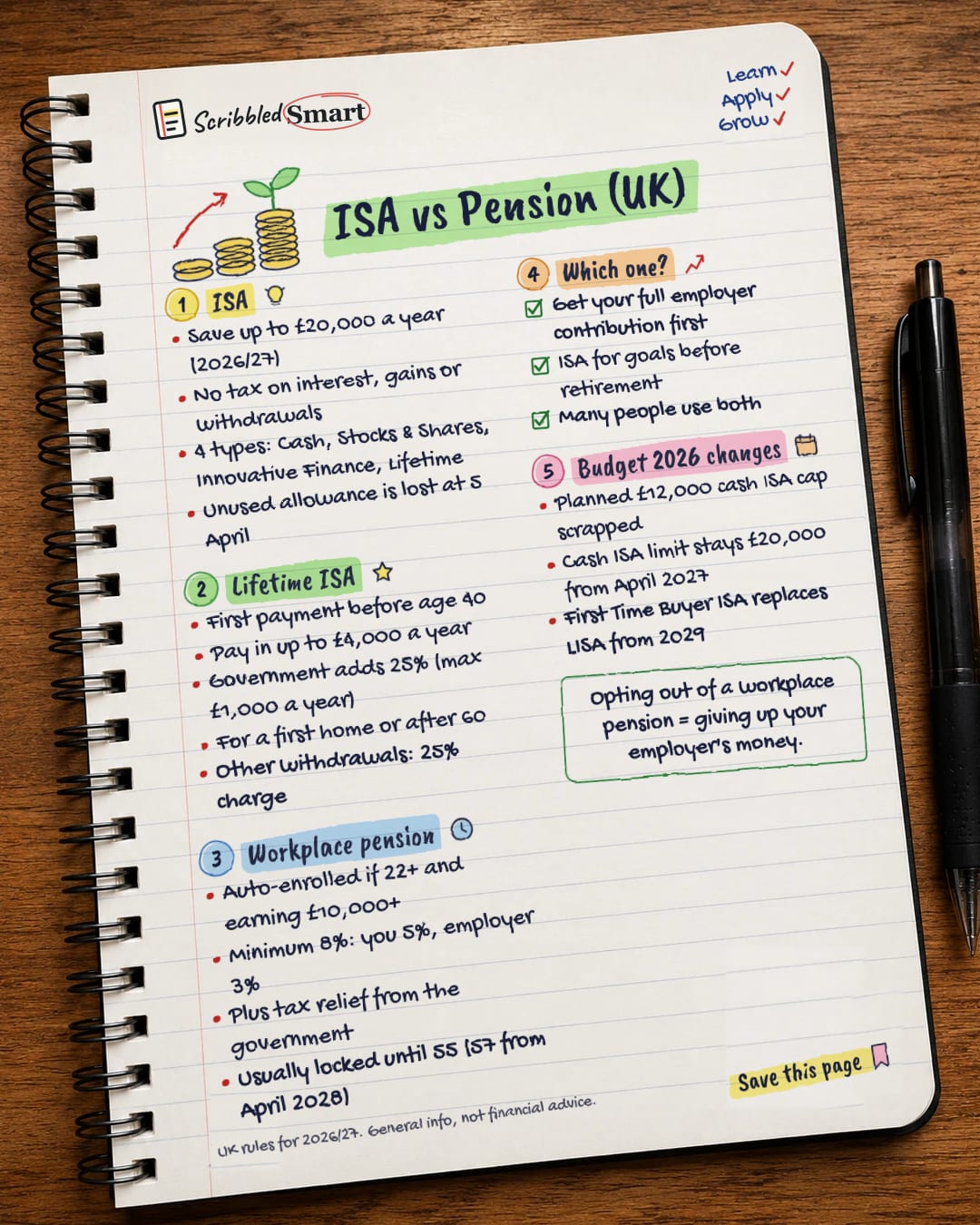
ISA vs pension? An ISA is flexible, tax-free saving you can use any time. A pension is for retirement, and it comes with extra money from your employer and the government, but it's usually locked until 55 (57 from April 2028). Many people use both: they get their full employer pension contribution first, then use an ISA for goals before retirement. These are 🇬🇧 UK rules for the 2026/27 tax year.
What is an ISA?
An ISA (Individual Savings Account) is a tax-free wrapper for savings or investments. According to GOV.UK:
- You can save up to £20,000 a year in the 2026/27 tax year.
- There's no tax on interest, investment gains or withdrawals.
- You must be 18 or over and UK resident to open one.
- Any allowance you don't use is lost at the end of the tax year (5 April). It doesn't roll over.
The 4 types of ISA
- Cash ISA: a savings account.
- Stocks & Shares ISA: investments such as index funds.
- Innovative Finance ISA
- Lifetime ISA: for a first home or later life (below).
The Lifetime ISA (LISA)
The Lifetime ISA is designed for young people saving for a first home or for later life (GOV.UK).
- You must make your first payment before age 40.
- You can pay in up to £4,000 a year (until you're 50). This counts towards your £20,000 ISA allowance.
- The government adds a 25% bonus, up to £1,000 a year.
Using a Lifetime ISA for a first home
GOV.UK sets these rules:
- Buy the home at least 12 months after your first payment into the LISA.
- No withdrawal charge if the property costs £450,000 or less.
- If it costs more than £450,000, there's a 20% withdrawal charge.
Other Lifetime ISA withdrawals
Taking money out for any other reason before 60 means a 25% charge. Withdrawals are free after 60, or if you're terminally ill.
Workplace pensions
Auto-enrolment
Your employer must automatically enrol you into a workplace pension if you (GOV.UK):
- are aged 22 to State Pension age
- earn £10,000 or more a year
- ordinarily work in the UK
MoneyHelper mentions that the minimum age may fall to 18 in future. This is not yet in force.
How much goes in
The legal minimum is 8% in total:
| Who | Minimum |
|---|---|
| You | 5% |
| Your employer | 3% |
On top of that, you get tax relief from the government. For a basic-rate taxpayer, that effectively means 20% is added. Higher-rate taxpayers can claim more.
In most schemes, contributions are worked out on "qualifying earnings", between £6,240 and £50,270 a year (GOV.UK). That's why "8% of your salary" usually isn't exactly 8% of your full pay.
When you can access a pension
You usually can't touch a pension until the minimum pension age: 55, rising to 57 from 6 April 2028 (Finance Act 2022). Some people have a protected pension age.
When you do take it, you can usually take up to 25% as a tax-free lump sum, with a maximum of £268,275 (GOV.UK).
How much you can pay in
There's a yearly limit on pension saving called the annual allowance. GOV.UK puts it at £60,000 this tax year (checked 15 November 2026). The lifetime allowance has been abolished.
What does opting out of a workplace pension cost you?
If you opt out, you give up your employer's contribution: free money worth at least 3% of qualifying earnings. MoneyHelper warns that opting out can mean losing valuable retirement benefits. Over decades, the effect of compound interest makes that loss much bigger.
ISA vs pension: which should you choose?
| ISA | Workplace pension | |
|---|---|---|
| Access | Any time (LISA: rules apply) | Usually from 55 (57 from April 2028) |
| Free money | LISA only: 25% bonus | Employer contribution + tax relief |
| Tax | None on interest, gains or withdrawals | Tax relief going in; 25% usually tax-free coming out |
| Yearly limit | £20,000 (2026/27) | Annual allowance £60,000 |
- ✅ Get your full employer contribution first. It's money you'd otherwise miss out on.
- ✅ Use an ISA for goals before retirement: a house deposit, a car, or a safety net once your emergency fund is in place.
- ✅ Many people use both.
Budget 2026: what changed for ISAs
The Autumn Budget 2025 planned to cut the cash ISA limit to £12,000 for under-65s from April 2027. Budget 2026 (28 October 2026) reversed that. The government "decided not to reduce the cash ISA limit, so that it remains at £20,000" (HM Treasury), and HMRC confirms the £20,000 cash ISA limit is kept from 6 April 2027.
Two Lifetime ISA changes came in the same Budget (HMRC, October 2026):
- If you use a Lifetime ISA for a first home over £450,000, the withdrawal charge is 20% (it was 25%) for withdrawals on or after 29 October 2026.
- A new First Time Buyer ISA will replace the Lifetime ISA from April 2029: up to £4,000 a year with a 25% government bonus, and total bonuses capped at £20,000.
Existing Lifetime ISAs carry on for now, and HMRC hasn't yet said what will happen to them when the First Time Buyer ISA starts. We'll update this article when HMRC publishes the details.
Related reading
- How to read your payslip (UK): see your pension deduction each month.
- Index funds explained: what many people hold inside a Stocks & Shares ISA.
- 6 money mistakes in your 20s: including opting out of your pension.
- Compound interest explained: why starting early matters.
Sources
- GOV.UK: Individual Savings Accounts
- HM Treasury: Budget 2026
- HMRC: Tax-free savings newsletter 24 (October 2026)
- GOV.UK: Lifetime ISA
- GOV.UK: Withdrawing money from your Lifetime ISA
- Lifetime ISA campaign (GOV.UK)
- GOV.UK: Joining a workplace pension
- GOV.UK: What you, your employer and the government pay
- GOV.UK: Increasing Normal Minimum Pension Age
- GOV.UK: Cash ISA limit reduction
- GOV.UK: ISA reform 2027 anti-circumvention factsheet
- MoneyHelper: Lifetime ISAs
- MoneyHelper: Supporting yourself financially (16–24)
- GOV.UK: Tax on your private pension contributions: annual allowance
- GOV.UK: Tax when you get a pension: what's tax-free
How we checked this
Every fact in this article comes from the 15 sources listed above, checked against official or peer-reviewed sources where possible. AI tools help with drafting; a person checks every fact against the sources. How we research
- Published and checked
- Next check
- every April (new tax year); must update before 6 April 2027; check First Time Buyer ISA details as HMRC publishes them
🇬🇧 UK rules for 2026/27. General info, not financial advice.
Spotted a mistake? Tell us and we'll fix it and log it on the corrections page.


