
On this page
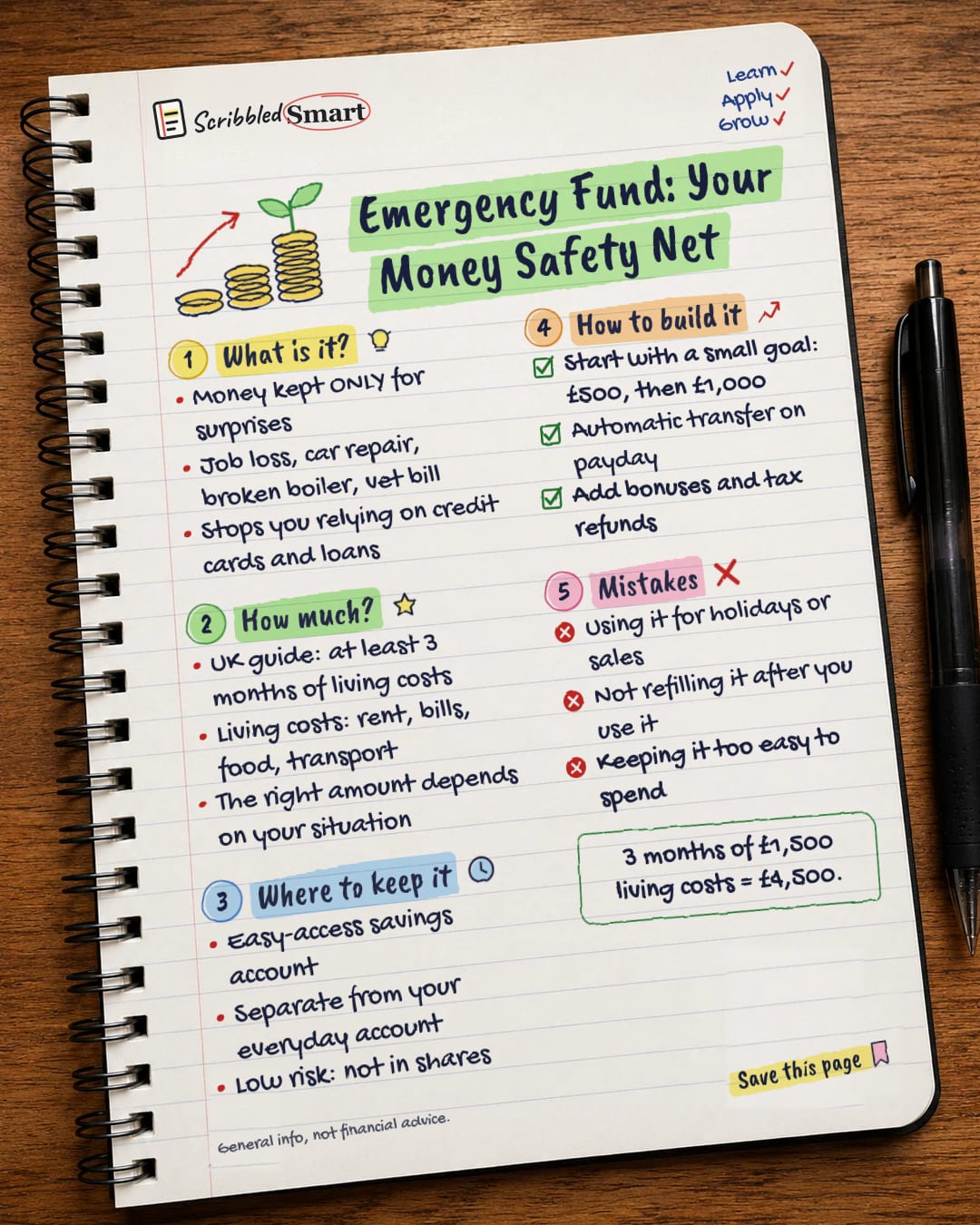
An emergency fund is money you keep only for surprises, like losing your job, a car repair, a broken boiler or a vet bill. UK debt charity StepChange suggests aiming for at least three months of living expenses, kept in an instant-access savings account. It's the most boring money tip there is, but it stops one bad week from turning into months of credit card debt. Here's how much to aim for, where to keep it, and how to build it from nothing.
What is an emergency fund for?
An emergency fund covers costs you can't plan for, such as:
- Job loss
- Car repair
- A broken boiler
- A vet bill
Without one, those costs usually go on a credit card or a loan. The US Consumer Financial Protection Bureau (CFPB) points out that savings help you avoid relying on high-interest credit. Debt that compounds is exactly what an emergency fund protects you from. See our guide to how compound interest works on debt.
How much should your emergency fund be?
🇬🇧 In the UK, StepChange says: "Aim for your fund to cover at least three months of living expenses." That's a minimum, with no upper figure. A working group for HM Treasury and the FCA quotes the rule of thumb as "three months' salary", and adds that "for some people, three months would not be an achievable target". In its focus groups, people felt "1 month's income might be possible".
The working group also says: "The amount needed could be higher or lower, depending on circumstances." So treat three months as a starting point, and adjust it to your situation.
What counts as living costs?
Count what it costs you to get by each month:
- Rent or mortgage
- Bills and utilities
- Food
- Transport
Example: if your living costs are £1,500 a month, 3 months is £1,500 × 3 = £4,500.
Where should you keep an emergency fund?
An easy-access savings account
Your emergency fund needs to be liquid (you can get it quickly) and low risk. StepChange's advice: "Make sure you use an 'instant access' savings account." Chase notes that long-term accounts may not fit, and One Pay recommends liquid, low-risk accounts. That rules out shares. If the market falls just as you need the money, you could get back less than you put in. Investing is for money you can leave alone for years. See our guide to index funds for that.
Separate from your everyday account
StepChange says to "keep your emergency fund separate from other accounts", and warns that "it can be tempting to dip into your savings as they grow". Amplify's advice is similar: accessible, but not so easy to reach that you dip into it. A separate savings account, away from your everyday spending, puts a little distance between you and the money.
Rates on easy-access accounts change often, so we don't quote one. Compare current rates before you choose.
🇬🇧 Is my emergency fund protected? (UK)
In the UK, savings with authorised banks, building societies and credit unions are protected by the Financial Services Compensation Scheme (FSCS). Since 1 December 2025, the FSCS can compensate you up to £120,000 per eligible person, per authorised firm. One catch: brands that share one banking licence count as one firm, so the limit applies to your total across them.
How to build an emergency fund from £0
- ✅ Start with a small goal. For example £500, then £1,000. Experian suggests starting smaller if the full target feels overwhelming, and StepChange says "something is better than nothing".
- ✅ Automate a transfer on payday. Money that moves before you see it is easier to save. The HM Treasury/FCA working group's advice is to "save on your pay day rather than at the end of the month".
- ✅ Add bonuses and pay rises. The same working group suggests you "save some of your pay rise/bonus". Windfalls can fill the fund much faster.
In the 50/30/20 budget, the emergency fund is the first job for your 20% savings pot. Once it's built, you can move on to extra debt payments or investing.
Emergency fund mistakes to avoid
- ❌ Using it for holidays or sales. Those are wants, not emergencies. StepChange: "Only use the money in a true emergency." Calling it a "rainy day fund" may help: the working group says the label "may discourage withdrawals for frivolous expenditures".
- ❌ Not refilling it after you use it. Rebuild it before going back to other goals.
- ❌ Keeping it too easy to spend. Money sitting in your everyday account is easy to dip into without noticing.
Having no emergency fund is the first mistake in our guide to money mistakes in your 20s.
FAQ
How much should I have in my emergency fund?
In the UK, StepChange suggests at least three months of living expenses: rent, bills, food and transport. The HM Treasury/FCA working group adds that the right amount "could be higher or lower, depending on circumstances". If that feels huge, start with £500, then £1,000.
Where is the best place to keep an emergency fund?
In an easy-access, low-risk savings account, kept separate from your everyday spending account. It should be quick to reach in a real emergency, but not so easy that you spend it by accident. Don't keep it in shares, because their value can fall just when you need the money.
Should I save an emergency fund or pay off debt first?
Build the emergency fund first, then move on to extra debt payments or investing. Without a safety net, a surprise bill tends to go straight onto a credit card, which undoes your progress. Keep paying the minimum on every debt while you save.
Is my emergency fund protected if my bank fails?
🇬🇧 In the UK, yes, up to a limit. The FSCS protects up to £120,000 per eligible person, per authorised firm. This limit has applied since 1 December 2025. Brands that share one banking licence count as a single firm, so check before splitting money between them.
What counts as an emergency?
Real, unplanned costs you can't avoid, such as losing your job, an urgent car or boiler repair, or a vet bill. Holidays, sales and planned purchases don't count. Save for those separately.
Related reading
- The 50/30/20 budget rule: where your savings pot comes from.
- Paying off debt: avalanche vs snowball: what to do once the fund is in place.
- 6 money mistakes in your 20s: starting with having no safety net.
- Index funds explained: for long-term money, not emergencies.
Sources
- StepChange: How can I save money for an emergency or rainy day?
- CFPB: Explore saving (teens and young adults)
- Citi: How much should you save for an emergency fund?
- Chase: Guide to emergency funds
- Ally: How much do you need in your emergency fund?
- Experian: How much should you have in an emergency fund?
- One Pay: How much should you have in emergency savings?
- Amplify: Saving an emergency fund
- FCA: Rules of thumb and nudges
- FSCS: Deposit protection limit
- Further reading: MoneyHelper: Building an emergency savings fund
How we checked this
Every fact in this article comes from the 11 sources listed above, checked against official or peer-reviewed sources where possible. AI tools help with drafting; a person checks every fact against the sources. How we research
- Published and checked
- Next check
- yearly (FSCS deposit limit)
General info, not financial advice.
Spotted a mistake? Tell us and we'll fix it and log it on the corrections page.


