
On this page
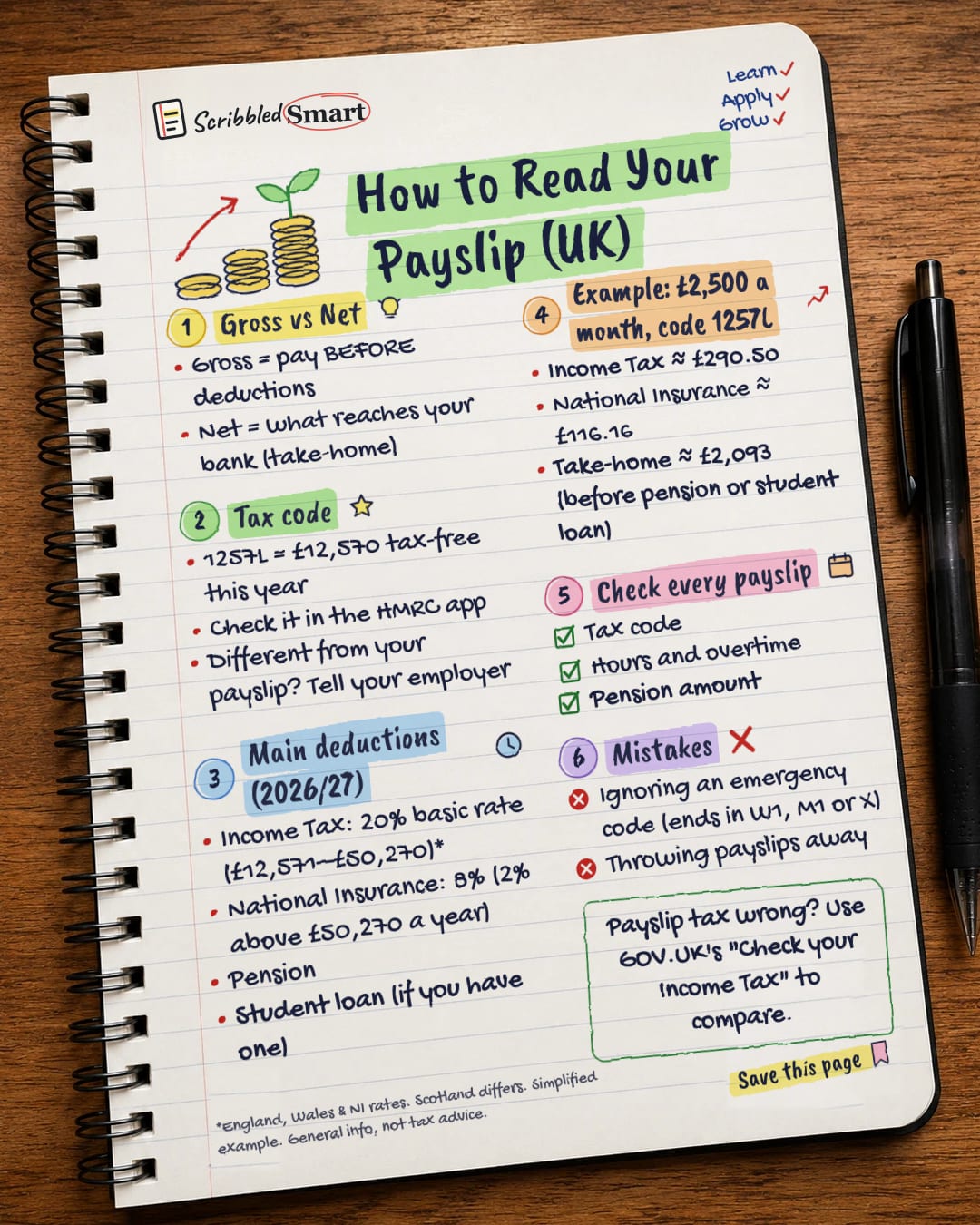
To read your payslip, start with two numbers: gross pay (what you earn before anything is taken off) and net pay (what actually reaches your bank). Everything in between is a deduction: Income Tax, National Insurance, pension and, if you have one, student loan. This guide explains each line, your tax code, and a worked example using 🇬🇧 2026/27 rates for England, Wales and Northern Ireland.
What's the difference between gross and net pay?
- Gross pay is your pay before any deductions.
- Net pay is what's left after them: your take-home pay.
MoneyHelper and the government's Tax Confident campaign both explain payslips this way. When you budget, always use net pay. Our 50/30/20 budget guide is built on take-home pay for that reason.
What your employer must show
By law, your payslip must show your gross pay, deductions and net pay. If your pay varies with the time you work, it must also show your hours (GOV.UK, "Payslips: employee rights").
What does your tax code mean?
What does 1257L mean?
Your tax code tells your employer how much tax-free pay you get. A common code is 1257L:
- 1257 = your tax-free Personal Allowance divided by 10. So 1257 means £12,570, the Personal Allowance for 2026/27.
- L = you get the standard Personal Allowance.
Other letters, such as BR, D0 or K, mean something specific. GOV.UK has a "what your tax code means" tool to look yours up.
Check your tax code
You can check your tax code in the HMRC app. If it's different from the code on your payslip, tell your employer (GOV.UK).
Emergency tax codes
An emergency tax code ends in W1, M1 or X (or NONCUM, depending on your employer's payroll software), according to GOV.UK. You might get one when you start a new job. Don't ignore it. If you overpay tax on an emergency code, you can get a refund, and HMRC often fixes it automatically.
The main deductions (2026/27)
Income Tax
🇬🇧 In England, Wales and Northern Ireland for 2026/27 (GOV.UK):
| Band | Taxable income | Rate |
|---|---|---|
| Personal Allowance | Up to £12,570 | 0% |
| Basic rate | £12,571 to £50,270 | 20% |
Scotland has its own Income Tax rates, so Scottish payslips will look different.
For high earners, the Personal Allowance shrinks by £1 for every £2 earned over £100,000. It's gone completely at £125,140.
National Insurance
Employee National Insurance for 2026/27 (GOV.UK):
- 8% on earnings between £1,048 and £4,189 a month
- 2% on earnings above that (above about £50,270 a year)
Pension
If you're in a workplace pension, your contribution appears as a deduction. Some schemes take it before tax (a "net pay arrangement"). Others take it after tax and claim tax relief for you ("relief at source"). The method changes how your tax line looks. Our ISA vs pension guide explains how workplace pensions work.
Student loan
If you have a student loan, repayments are taken through your payslip too (MoneyHelper).
Worked example: £2,500 a month, code 1257L
Here's a simplified example with no pension or student loan:
| Line | Calculation | Amount |
|---|---|---|
| Gross pay | £2,500.00 | |
| Tax-free pay | £12,570 ÷ 12 | £1,047.50 |
| Income Tax | (£2,500 − £1,047.50) × 20% | £290.50 |
| National Insurance | (£2,500 − £1,048) × 8% | £116.16 |
| Net pay | £2,500 − £290.50 − £116.16 | ≈ £2,093.34 |
Real payslips can differ by a few pence. PAYE uses cumulative year-to-date figures and exact tax tables, not this simple monthly sum.
How to read your payslip every month: 3 checks
- ✅ Tax code: does it match the one in your HMRC app?
- ✅ Hours and overtime: are they all there?
- ✅ Pension amount: is the percentage right?
If the tax looks wrong, use GOV.UK's "Check if the tax on your payslip is correct" guidance and estimate tool to compare.
Payslip mistakes to avoid
- ❌ Ignoring an emergency code (ending in W1, M1 or X, or NONCUM). You may be paying too much tax.
- ❌ Throwing payslips away. You'll need them for mortgages, rentals and tax refund claims.
Starting a new job? Our guide to spotting a job scam shows the warning signs before you hand over any personal details.
Related reading
- ISA vs pension (UK): what your pension deduction is building.
- The 50/30/20 budget rule: budget with your net pay.
- How to negotiate your salary: grow the top line.
- How to spot a job scam: protect your details.
Sources
- MoneyHelper: Understanding your payslip
- GOV.UK: Check if the tax on your payslip is correct
- GOV.UK: Income Tax rates and Personal Allowances
- GOV.UK: National Insurance, how much you pay
- GOV.UK: Emergency tax codes
- GOV.UK: What your tax code means
- GOV.UK: Payslips, employee rights
- Tax Confident (GOV.UK campaign): How tax works in your first job
How we checked this
Every fact in this article comes from the 8 sources listed above, checked against official or peer-reviewed sources where possible. AI tools help with drafting; a person checks every fact against the sources. How we research
- Published and checked
- Next check
- every April (new tax year); update before 6 April 2027
🇬🇧 England, Wales & Northern Ireland rates for 2026/27. Scotland differs. Simplified example. General info, not financial or tax advice.
Spotted a mistake? Tell us and we'll fix it and log it on the corrections page.


