
On this page
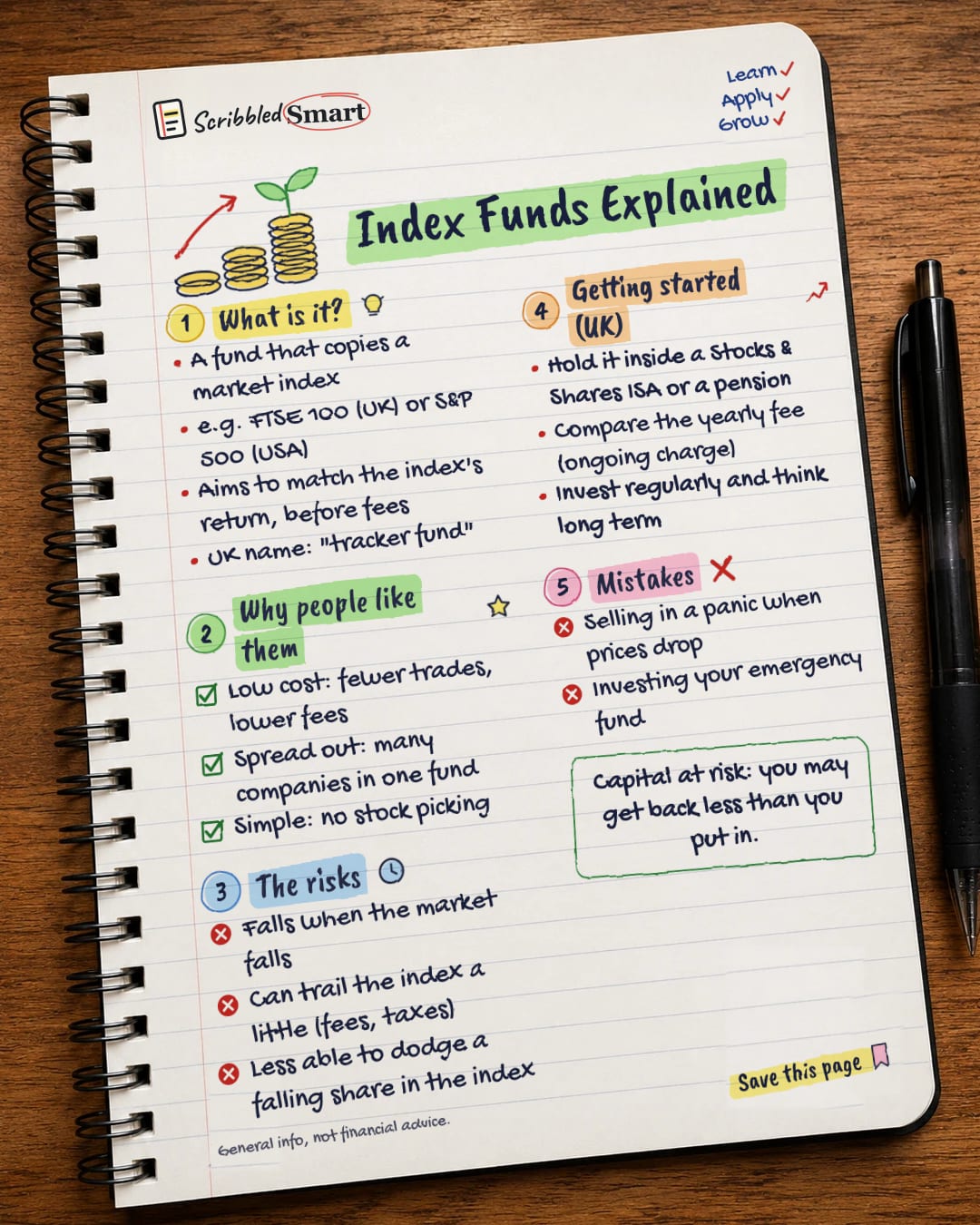
Index funds are funds that copy a market index, such as the FTSE 100 in the UK or the S&P 500 in the USA. Instead of trying to pick winning shares, an index fund buys the shares in that index and aims to match its return, before fees. Here's how they work, why so many people use them, the risks, and how to get started.
What is an index fund?
An index is a list of companies that represents part of a market. The FTSE 100 (UK) and the S&P 500 (USA) are two well-known examples.
According to Investor.gov (run by the US Securities and Exchange Commission), an index fund aims to match the return of an index, before fees, by buying the securities in that index. It doesn't try to beat the market. It tries to be the market.
Vanguard UK puts it simply: "The aim of an index fund is to track the performance of a given index."
Index funds vs ETFs
An ETF (exchange-traded fund) can follow an index too. The idea is the same, but ETFs trade on a stock exchange during the day, like shares. Traditional index funds are mutual funds, called OEICs in the UK.
Global index funds
Some index funds track indices like MSCI World or FTSE All-World. These spread your money across companies in many countries, not just one.
Why do people like index funds?
Low cost
Index funds make fewer trades than funds where a manager picks shares, so their fees tend to be lower (Investor.gov). Vanguard UK says the same. Vanguard sells index funds, so we only use its claims where Investor.gov agrees.
Fees matter because they come out of your returns every year. Over decades, the difference adds up through compounding. Our compound interest guide shows how small differences grow.
Spread out (diversification)
One fund can hold hundreds of companies. Investor.gov notes that funds often make diversification cheaper than buying lots of individual shares yourself.
Simple
There's no stock picking and no need to follow every company. You choose an index and leave the fund to follow it.
What are the risks of index funds?
Index funds are not risk-free. Investor.gov lists some key downsides:
- ❌ They fall when the market falls. If the index drops, so does your fund.
- ❌ They can trail the index a little. Fees and taxes mean the return can be slightly below the index's.
- ❌ Less able to dodge a falling share. A fund that copies an index has less flexibility to react when one of the companies in it declines.
That's why UK investment products carry the warning "capital at risk": you may get back less than you put in.
How to start investing in index funds (UK)
1. Choose a tax wrapper
🇬🇧 In the UK, many people hold index funds inside:
- A Stocks & Shares ISA: one of the ISA types listed by GOV.UK.
- A pension: for money you won't need until later life.
Our guide to ISAs vs pensions explains the difference and the current limits.
2. Compare the yearly fee
Look for the fund's ongoing charge, the yearly fee. You can find a fund's charges and risk score in its Key Information Document (KID).
Vanguard's own 2024 research says fee differences between index funds are now "nearly immaterial". That's about choosing between index funds, not about index funds versus actively managed ones.
3. Invest regularly and think long term
Investing a fixed amount on a regular schedule is called pound-cost averaging. It means you don't have to guess the "right" day to invest.
Mistakes to avoid
- ❌ Selling in a panic when prices drop. Falls are part of investing in the market.
- ❌ Investing your emergency fund. Money you might need soon belongs in easy-access savings. See our emergency fund guide.
Panic-selling is also a classic example of how our brains can trip us up. Our guide to thinking traps (cognitive biases) covers more.
FAQ
What is an index fund in simple terms?
An index fund is a fund that copies a market index, like the FTSE 100 or S&P 500. It buys the companies in that index so its returns roughly match the index, before fees. It's a way to invest in many companies at once without picking shares.
Are index funds safe?
No investment is completely safe. Index funds spread your money across many companies, which reduces the risk of one company failing. But when the whole market falls, the fund falls too. UK investments carry the warning "capital at risk", meaning you could get back less than you put in.
What is the difference between an index fund and an ETF?
Both can track an index. ETFs (exchange-traded funds) trade on a stock exchange during the day, like shares. Traditional index funds are mutual funds, called OEICs in the UK, and don't trade on an exchange during the day. The underlying idea, copying an index, is the same for both.
Can I put index funds in an ISA?
🇬🇧 Yes. A Stocks & Shares ISA, one of the ISA types listed on GOV.UK, can hold index funds. You don't pay tax on income or gains from investments in an ISA. Index funds can also be held inside a pension.
Why do index funds have lower fees?
They follow an index rather than paying a manager to pick shares, so they make fewer trades. Investor.gov notes this usually means lower costs than actively managed funds. Always check the fund's ongoing charge in its Key Information Document before you invest.
Related reading
- ISA vs pension (UK): where to hold your index funds.
- Compound interest explained: why low fees and time matter.
- What is inflation?: why long-term money needs to grow.
- Emergency fund: build this before you invest.
Sources
- Investor.gov: Mutual Funds
- Investor.gov: Exchange-Traded Funds
- Investor.gov: Mutual Funds and ETFs guide (PDF)
- Vanguard UK: An introduction to index-fund investing
- Vanguard UK: Exploring the benefits of index-fund investing
- Vanguard UK Investor: Index funds
- GOV.UK: Individual Savings Accounts
How we checked this
Every fact in this article comes from the 7 sources listed above, checked against official or peer-reviewed sources where possible. AI tools help with drafting; a person checks every fact against the sources. How we research
- Published and checked
- Next check
- yearly
Capital at risk: you may get back less than you put in. General info, not financial advice.
Spotted a mistake? Tell us and we'll fix it and log it on the corrections page.


