
On this page
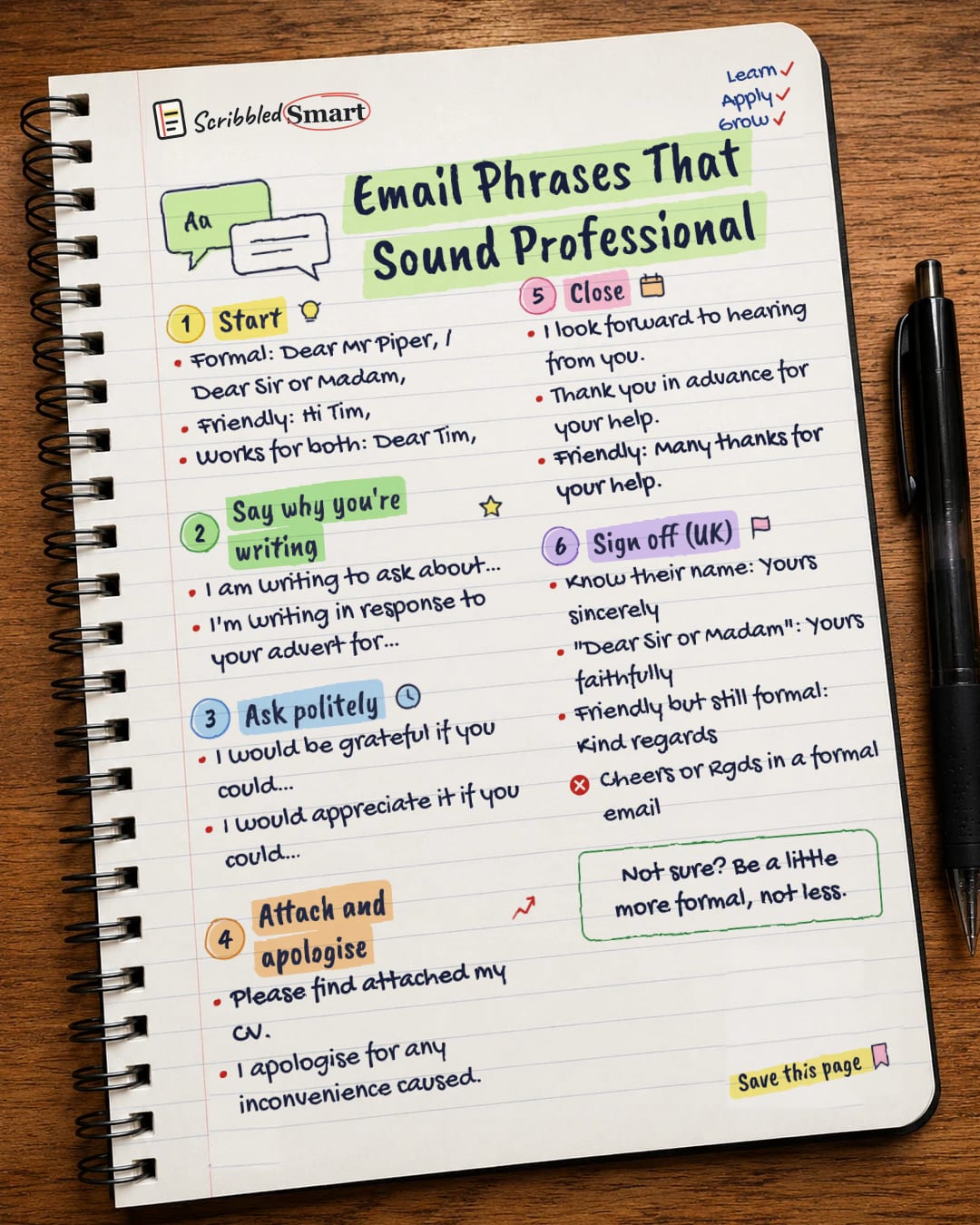
The professional email phrases you need fall into six steps: a greeting, a reason for writing, a polite request, any attachments or apologies, a closing line and a sign-off. Each step has a few standard phrases you can reuse. This guide gives example phrases for each step, taken from the British Council's LearnEnglish lessons on business and formal emails.
1. How do you start a professional email?
Your greeting depends on how well you know the reader. The British Council's lesson on starting and finishing emails sorts greetings into three groups:
| Style | Greeting |
|---|---|
| Formal | Dear Mr Piper, / Dear Sir or Madam, |
| Friendly (informal) | Hi Tim, |
| Works for both | Dear Tim, |
Use "Dear Sir or Madam" when you don't know the person's name. If you do know it, the British Council's covering email tips suggest addressing your email to a named person.
2. Say why you're writing
Tell the reader your reason for writing in the first line. These openings come from British Council model emails:
- I am writing to ask about… (formal)
- I am writing to thank you for all your help. (formal)
- I'm writing in response to your advertisement for… (for a job application)
- Many thanks for your help. (friendly)
The Longman Dictionary lists "advert" as an informal British English word for "advertisement".
3. Ask politely
Two phrases work well for polite requests. The British Council's advice on formal requests is: "To make polite requests use the phrase I would be grateful if you could …". A tutor on the same site also suggests "I would appreciate it if you could…".
- I would be grateful if you could send me the timetable.
- I would appreciate it if you could confirm the date.
"Please send me…" is not wrong. But a British Council tutor says it can sound too direct in a formal email, so the phrases above are a softer choice. For more on choosing your tone, see our guide to formal vs informal English.
A simple structure for a request email
The British Council's C1 lesson on email requests suggests this order:
- Your reason for writing
- The problem
- The outcome you would like
- An apology, if needed
4. Attach and apologise
Here is one short phrase for each. These come from British Council model emails.
- Attaching a file: Please find attached my CV.
- Apologising: I apologise for any inconvenience caused.
The British Council's full version of the apology is "I apologise for the short notice and for any inconvenience caused." You can shorten it or keep it as it is.
5. How do you end a formal email?
End with a short closing line before your sign-off. These closing lines come from British Council models:
- I look forward to hearing from you.
- Thank you in advance for your help.
The British Council also shows how the same idea changes with tone:
- Formal: I look forward to seeing you next week.
- Informal: See you next week.
Notice the "-ing" after "look forward to". Our guide to phrasal verbs explains why it is "seeing", not "see".
6. Sign off: Yours sincerely, Yours faithfully or Kind regards?
The sign-off depends on whether you know the reader's name. The British Council says: "Sign off Yours sincerely, if you know the person's name and Yours faithfully, if you don't."
| Situation | Sign-off |
|---|---|
| You know their name (Dear Mr Piper) | Yours sincerely |
| You don't know their name (Dear Sir or Madam) | Yours faithfully |
| Friendly but still formal | Kind regards |
| Informal emails only | Cheers, See you soon, Bye for now |
Kind regards
The Longman Dictionary says "kind regards" or "best regards" is used to end a letter in a friendly but rather formal way. A British Council model email describes "Regards" or "Kind regards" as more friendly-sounding than "Yours sincerely", but still formal.
What to avoid
The British Council lists "Cheers", "Rgds", "Bye for now" and "See you soon" as informal sign-offs. They are fine with friends, but don't use them in a formal email.
A note for US readers
The "Yours sincerely / Yours faithfully" rule is mainly a British convention. We have not checked US practice against a US source, so we can't give a rule for American emails here.
Tips for using professional email phrases
These habits come from the British Council lessons.
- ✓ When unsure, go a little more formal. A British Council tutor gives this advice, though norms can vary by country.
- ✓ For a job email, follow a clear order. The British Council's covering email tips: say who you are and which role you want, describe your current work, explain why you suit the role, and end by suggesting further contact.
- ✓ Match your greeting and sign-off. "Dear Sir or Madam" goes with "Yours faithfully"; "Dear Mr Piper" goes with "Yours sincerely".
- ✗ Don't use "Cheers" or "Rgds" in a formal email. Save them for friends.
Related reading
- How to write a cover letter: the job email or letter where these phrases matter most.
- Formal vs informal English: how to set the right tone for any reader.
- Check email less, stress less: a calmer way to manage your inbox once your emails are sent.
- Phrasal verbs in one page: why it's "look forward to hearing", not "look forward to hear".
Sources
- British Council LearnEnglish: Unit 4 Starting and finishing emails
- British Council LearnEnglish: An email request (C1)
- British Council LearnEnglish: A covering email (B2)
- British Council LearnEnglish: An email to your professor (B2)
- Longman Dictionary of Contemporary English: regards
- Longman Dictionary of Contemporary English: advert
How we checked this
Every fact in this article comes from the 6 sources listed above, checked against official or peer-reviewed sources where possible. AI tools help with drafting; a person checks every fact against the sources. How we research
- Published and checked
Spotted a mistake? Tell us and we'll fix it and log it on the corrections page.


