
On this page
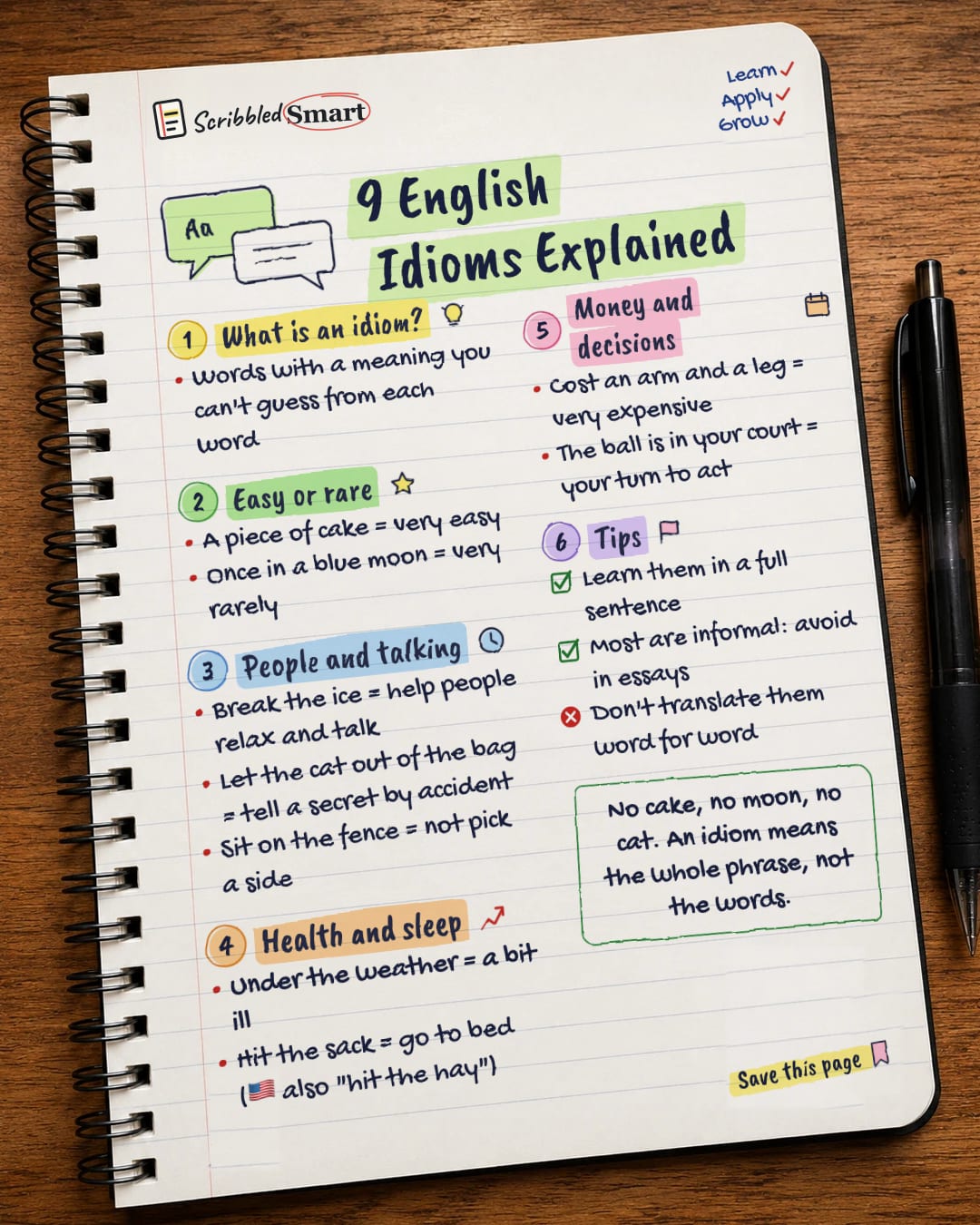
English idioms are groups of words with a special meaning that you can't guess from the ordinary meaning of each word. "A piece of cake" has nothing to do with cake; it means something is very easy. Below are nine common English idioms, each with its meaning from the Longman Dictionary of Contemporary English, a sample sentence, and tips for using them naturally.
What is an idiom?
An idiom is a phrase whose meaning is different from the meaning of its words. The Longman Dictionary defines it as "a group of words that has a special meaning that is different from the ordinary meaning of each separate word".
So when someone says "the ball is in your court", there is no ball and no court. You have to know the phrase as a whole.
That is also why idioms work best as fixed chunks. If you change a word, for example saying "a slice of cake" instead of "a piece of cake", the idiom usually stops working.
Idioms for easy and rare
A piece of cake
Meaning: very easy (to do). The dictionary labels it spoken and informal.
- The test was a piece of cake.
Once in a blue moon
Meaning: very rarely. It is labelled informal.
- We only eat out once in a blue moon.
Idioms about people and talking
Break the ice
Meaning: to make people feel more friendly and willing to talk to each other. Put another way, help people relax and start talking. It is labelled informal.
- She told a funny story to break the ice.
Let the cat out of the bag
Meaning: to tell someone a secret, especially without intending to. In everyday terms: give away a secret by accident.
- The party was meant to be a surprise, but Sam let the cat out of the bag.
Sit on the fence
Meaning: to avoid saying which side of an argument you support, or what your opinion is. In other words, not picking a side.
- You can't sit on the fence forever. Which plan do you prefer?
Idioms for health and sleep
Under the weather
Meaning: slightly ill. It is labelled informal.
- I'm feeling a bit under the weather today, so I'll stay home.
Hit the sack
Meaning: to go to bed. It is labelled informal. In American English, people also say hit the hay.
- I'm exhausted. I'm going to hit the sack.
The dictionary lists a second, old-fashioned sense too. This guide sticks to the main sense, "to go to bed".
Idioms about money and decisions
Cost an arm and a leg
Meaning: to have a price that is much too high. So it simply means very expensive.
- That new phone cost an arm and a leg.
The ball is in your court
Meaning: it is your turn to take action or to reply.
- I've sent them my offer. Now the ball is in their court.
All nine English idioms at a glance
Here is the full list in one table, so you can review the meanings quickly.
| Idiom | Meaning | Dictionary label |
|---|---|---|
| a piece of cake | very easy | spoken, informal |
| once in a blue moon | very rarely | informal |
| break the ice | help people feel friendly and talk | informal |
| let the cat out of the bag | tell a secret, especially by accident | not checked |
| sit on the fence | avoid choosing a side | none |
| under the weather | slightly ill | informal |
| hit the sack | go to bed (US also: hit the hay) | informal |
| cost an arm and a leg | have a price that is much too high | none |
| the ball is in your court | it's your turn to act or reply | none |
Where do these idioms come from?
We have left out origin stories on purpose. Popular stories about where idioms like "let the cat out of the bag" or "hit the sack" came from are often untraceable or disputed. We did not check any of them, so none appear here. The meaning is what you need to use an idiom well.
How do you learn and use English idioms?
Learning idioms well takes three habits.
- ✓ Learn them in a full sentence. The British Council advises learning phrasal verbs in context and writing your own example sentence. We apply the same habit to idioms. "I'm under the weather" is easier to remember than "under the weather = slightly ill".
- ✓ Keep them out of essays. The Longman Dictionary labels most of these idioms informal. Purdue OWL, a university writing guide, says to avoid slang or idiomatic expressions in general academic writing. For more on choosing the right style, see our guide to formal vs informal English.
- ✗ Don't translate them word for word. Because an idiom's meaning differs from the meaning of its words, a word-for-word translation into or out of English will usually make no sense.
Related reading
- Phrasal verbs in one page: another group of phrases where the meaning isn't obvious from the words.
- Useful everyday English phrases: short spoken phrases for greetings, politeness and small talk.
- Formal vs informal English: when idioms fit and when to leave them out.
- Spaced repetition: a study method that helps new vocabulary stick.
Sources
- Longman Dictionary of Contemporary English: idiom
- Longman Dictionary of Contemporary English: be a piece of cake
- Longman Dictionary of Contemporary English: once in a blue moon
- Longman Dictionary of Contemporary English: break the ice
- Longman Dictionary of Contemporary English: let the cat out of the bag
- Longman Dictionary of Contemporary English: sit on the fence
- Longman Dictionary of Contemporary English: under the weather
- Longman Dictionary of Contemporary English: hit the sack
- Longman Dictionary of Contemporary English: cost
- Longman Dictionary of Contemporary English: the ball is in somebody's court
- Purdue OWL: Using appropriate language
- British Council LearnEnglish: Phrasal verbs, why they're good to know
How we checked this
Every fact in this article comes from the 12 sources listed above, checked against official or peer-reviewed sources where possible. AI tools help with drafting; a person checks every fact against the sources. How we research
- Published and checked
Spotted a mistake? Tell us and we'll fix it and log it on the corrections page.


