
On this page
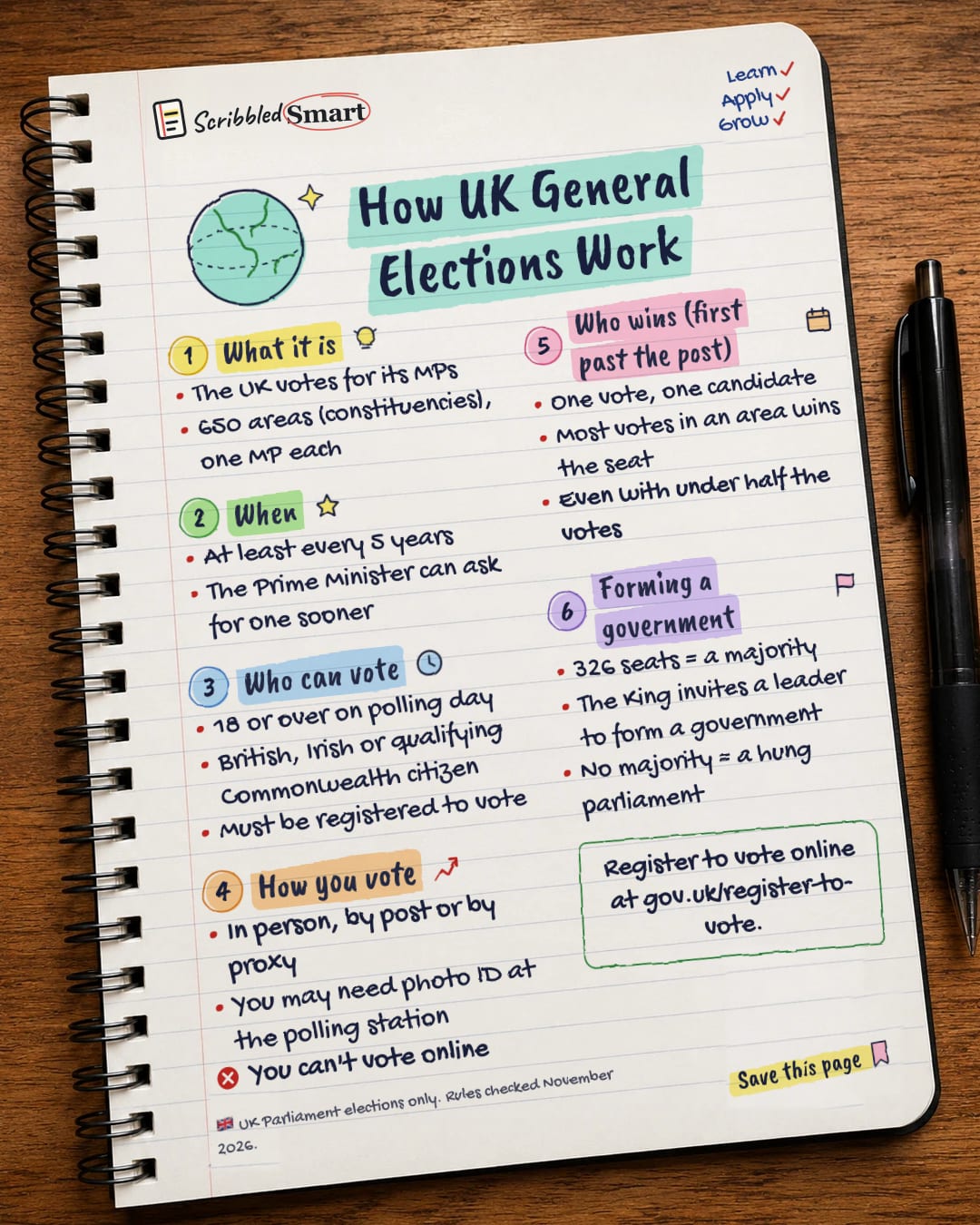
In UK general elections, voters in 650 local areas each choose one Member of Parliament (MP), and the party that can command a majority of those MPs usually forms the government. It sounds simple, and mostly it is. This guide covers when elections happen, who can vote, how you vote, how the winner is decided and what happens when no party wins outright.
🇬🇧 UK only: this page is about elections to the UK Parliament. Rules checked November 2026.
What UK general elections decide
UK general elections choose the MPs who sit in the House of Commons. GOV.UK confirms there are 650 MPs in total.
The UK is split into 650 areas called constituencies. Each one elects a single MP. When you vote, you are not voting directly for a Prime Minister. You get one vote for a candidate standing in your own constituency.
The number of seats is set by law. The Parliamentary Constituencies Act 2020 fixes it at 650. Boundary reviews redraw the map of constituencies from time to time; the latest changes were put in place by the Parliamentary Constituencies Order 2023.
How often are UK general elections held?
A general election must happen at least every 5 years. Under the Dissolution and Calling of Parliament Act 2022, a Parliament is dissolved automatically on the fifth anniversary of the day it first met.
An election can also come sooner. The Institute for Government (IfG) explains that the Prime Minister can ask for Parliament to be dissolved early.
We have not put the date of the next election here, because it depends on whether the current Parliament runs its full term.
Who can vote in a UK general election?
You can vote if you are registered and are, on polling day:
- 18 or over, and
- a British, Irish or qualifying Commonwealth citizen.
You must be on the electoral register. You can sign up online at gov.uk/register-to-vote. Overseas voters can also register if they have lived in the UK or been registered to vote here before.
What about votes at 16?
The voting age may change, but as of 16 November 2026 it had not. The Representation of the People Bill, introduced on 12 February 2026, would extend the voting age to 16 for all UK elections and let people register from 14, according to the GOV.UK policy summary (last updated 28 October 2026).
On 16 November 2026 it was still a Bill, not law. It had passed the House of Commons and was at committee stage in the House of Lords. So the rule for now remains 18 or over. The same Bill may also change photo ID rules. We will update this page once the Bill's final status is known.
How you vote
There are three ways to vote, says GOV.UK:
| Method | How it works |
|---|---|
| In person | At your polling station on election day |
| By post | A postal vote |
| By proxy | Someone else casts your vote on your behalf |
If you vote in person, you may need to show photo ID. If you have no accepted photo ID, GOV.UK says you can get a Voter Authority Certificate. Northern Ireland has its own long-standing ID rules, including an Electoral Identity Card.
One thing you cannot do: GOV.UK states that you cannot vote online in any elections.
First past the post: how is the winner decided?
The UK uses a system called first past the post. Each voter picks one candidate, and the candidate with the most votes in that constituency wins the seat.
A winner does not need more than half of the votes. They only need more votes than anyone else. The UCL Constitution Unit points out that this means a seat can be won with under half the votes cast.
Forming a government after UK general elections
Once the results are in, the party that can command the House of Commons forms the government. With 650 seats, a party needs 326 for a simple majority (650 ÷ 2 + 1 = 326).
The King then appoints the Prime Minister. The IfG explains that the monarch invites the leader who can command the confidence of the Commons. After a clear result, that is normally the leader of the largest party.
What is a hung parliament?
A hung parliament is when no single party has a majority. Possible outcomes then include a minority government, a coalition, or a "confidence and supply" arrangement between parties.
In practice, the number of seats needed to win key votes can be a little lower than 326. This is because the Speaker and deputies don't usually vote, and Sinn Féin MPs don't take their seats. The exact figure changes, so we don't give one.
Tips before polling day
- Check you are registered well before the election, using the official GOV.UK service. If a text or email about voter registration looks odd, our guide on how to spot a scam message can help.
- Check your ID if you plan to vote in person.
- Choose your method early if you want to vote by post or proxy.
Related reading
- Your basic rights at work in the UK: another plain-English guide to rules that apply to you in the UK.
- Moving house: who to tell in the UK: a checklist for when you change address.
- World War II timeline: key dates from a time that shaped modern Britain.
Sources
- GOV.UK: General elections
- GOV.UK: Voting in the UK
- legislation.gov.uk: Dissolution and Calling of Parliament Act 2022
- Institute for Government: Elections (calling a general election)
- Institute for Government: Hung parliaments
- UCL Constitution Unit: What is First Past the Post?
- GOV.UK: Representation of the People Bill policy summaries, Votes at 16
- UK Parliament: Representation of the People Bill, stages
How we checked this
Every fact in this article comes from the 8 sources listed above, checked against official or peer-reviewed sources where possible. AI tools help with drafting; a person checks every fact against the sources. How we research
- Published and checked
- Next check
- Before posting (votes-at-16 Bill in progress), then yearly, and if voting age, ID rules or the number of seats change.
🇬🇧 UK Parliament elections only. Rules checked November 2026.
Spotted a mistake? Tell us and we'll fix it and log it on the corrections page.


