
On this page
Why we procrastinate comes down to a simple pattern: we put off tasks that feel unpleasant, and psychologists see this as a problem with self-control rather than laziness. A big 2007 review pulled together hundreds of findings on what predicts it. Below you'll see what that review found, what didn't seem to matter much, and the small changes that make starting easier.
Why we procrastinate: it's not laziness
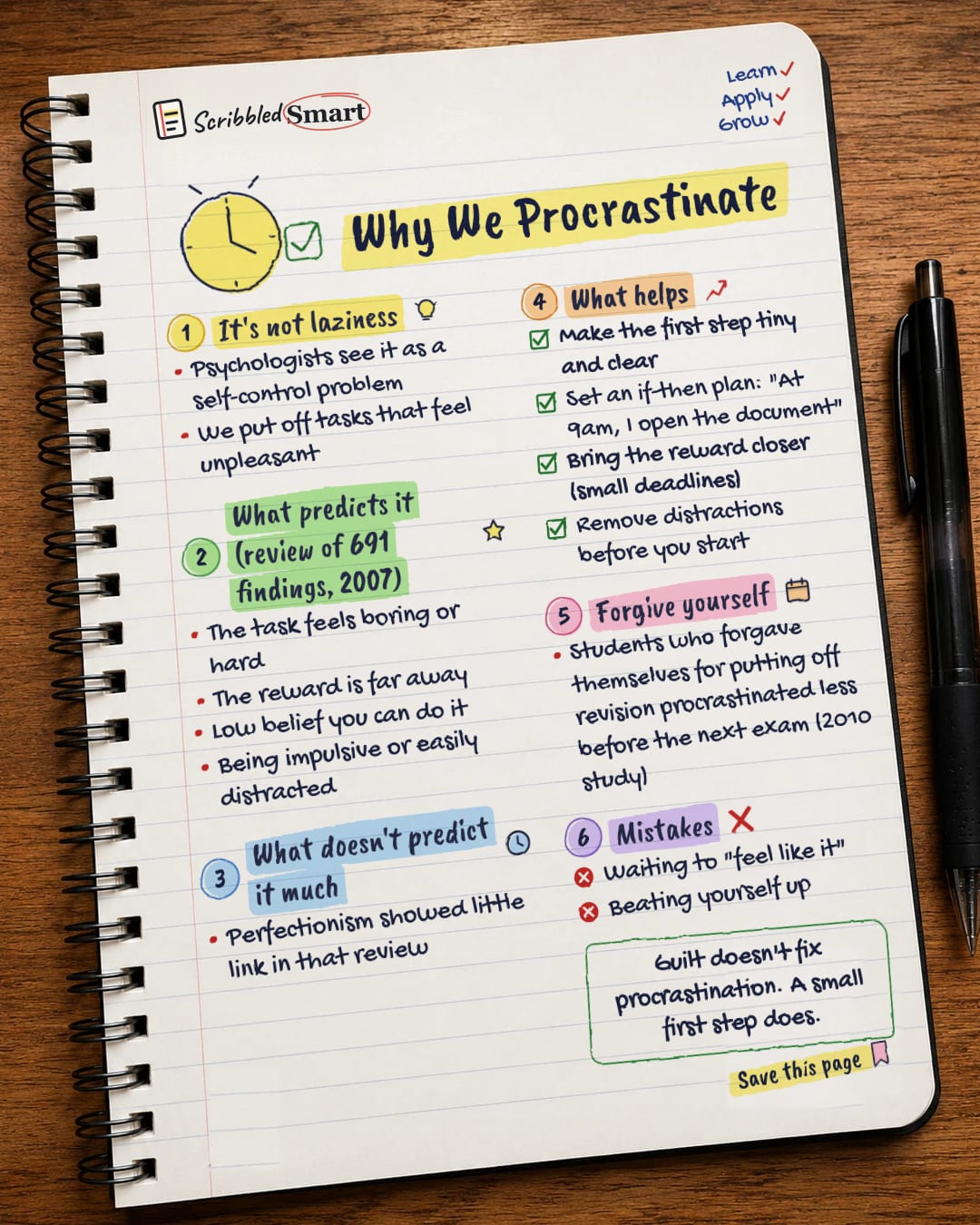
Procrastination is a self-control problem. In a 2007 review published in Psychological Bulletin, researcher Steel described it as a classic case of "self-regulatory failure". That means knowing what you should do, and still not managing to make yourself do it.
We tend to put off tasks that feel unpleasant. That's why the dull report waits while you tidy your desk.
What predicts procrastination?
Steel's review gathered 691 correlations from earlier research. A correlation shows two things tend to go together. It doesn't prove one causes the other.
The strongest links were:
| Predictor | What it looks like |
|---|---|
| The task feels unpleasant | It's boring, hard or both |
| The reward is far away | The payoff comes weeks or months later |
| Low belief you can do it | "I'll probably mess this up anyway" |
| Impulsiveness | Acting on whatever feels good right now |
| Low conscientiousness | Weaker self-control, easily distracted, less organised |
How the predictors fit together
Steel wrote that these results fit temporal motivation theory, which combines two older ideas: how much you expect to succeed, and how rewards feel less motivating the further away they are.
Put together, you feel more motivated when you expect to succeed and the reward matters to you. You feel less motivated when you're easily tempted and the reward is a long way off.
Is procrastination caused by perfectionism?
Perfectionism showed little or no link to procrastination in Steel's review. That may surprise you if you assume perfectionists put things off because they fear doing a poor job.
There is a caveat. Another procrastination researcher, Pychyl, disputed ruling out anxiety and perfectionism. So the fair way to say it is: perfectionism showed little link in that review, and the wider evidence is mixed. Don't assume your procrastination is "caused by" anxiety or perfectionism.
How to stop procrastinating: what helps
These fixes aim straight at the predictors above. Each one makes the task feel smaller, closer or easier to begin.
- Make the first step tiny and clear. "Open the document and write one heading" feels far less unpleasant than "write the essay".
- Set an if-then plan. For example: "At 9am, I open the document." Plans like this are known as implementation intentions, studied by Gollwitzer and Sheeran (2006).
- Bring the reward closer. Split a far-off deadline into small deadlines, so a payoff arrives sooner.
- Remove distractions before you start. If you're easily distracted, make distraction harder: phone away, tabs closed.
If-then plans are also a big part of how habits form, so the same trick can help you build a routine.
Does forgiving yourself help you start?
Being kind to yourself after putting something off may help next time. A 2010 study by Wohl, Pychyl and Bennett, titled "I forgive myself, now I can study", looked at students preparing for exams.
Students who forgave themselves for putting off revision for one exam procrastinated less before the next exam.
Keep the limits in mind. It was a small study with students. It relied on what students reported about themselves. It showed a link, not proof that forgiveness causes less procrastination. And the effect was mainly seen in heavy procrastinators.
Even so, guilt doesn't seem to be the answer. A small first step is more useful than beating yourself up.
Procrastination mistakes to avoid
- Waiting to "feel like it". If the task feels unpleasant, that feeling may not come. Start small instead.
- Beating yourself up. The 2010 study suggests self-forgiveness goes with less procrastination next time.
- Keeping deadlines far away. A distant reward is one of the strongest predictors of delay.
FAQ
What is the main cause of procrastination?
There isn't one single cause. Steel's 2007 review of 691 findings linked procrastination most strongly to tasks that feel unpleasant, rewards that are far away, low belief in your ability, impulsiveness and being easily distracted. Psychologists describe the overall pattern as a failure of self-control, not laziness.
Is procrastination just laziness?
No. Psychologists see procrastination as a self-regulation problem: you intend to do something but struggle to make yourself start. People tend to delay tasks that feel boring or hard, or where the reward is a long way off. That's different from not caring about the task.
Does forgiving yourself help you procrastinate less?
It may. In a 2010 study, students who forgave themselves for putting off revision procrastinated less before their next exam. The study was small, used self-reports and showed a link rather than cause and effect, with the effect mainly in heavy procrastinators.
Related reading
- The Pomodoro Technique: "just 25 minutes" is a tiny first step in timer form.
- How motivation works: more on why we feel driven, or not.
- Why writing a plan calms your mind: a specific plan can quieten thoughts about unfinished tasks.
Sources
- PubMed: Steel (2007), The nature of procrastination (University of Calgary record, not loading securely on 16 November 2026: https://prism.ucalgary.ca/handle/1880/47914)
- ScienceDaily (2007): Steel's procrastination review
- BPS Research Digest: Cure procrastination, forgive yourself
- Psychology Today (Pychyl): Forgive yourself, stop procrastinating
How we checked this
Every fact in this article comes from the 4 sources listed above, checked against official or peer-reviewed sources where possible. AI tools help with drafting; a person checks every fact against the sources. How we research
- Published and checked
Spotted a mistake? Tell us and we'll fix it and log it on the corrections page.


