
On this page
Deep work is focused work on a demanding task with no distractions at all, the kind that stretches your thinking to its limit. The idea comes from Cal Newport's 2016 book Deep Work. This guide covers what counts as deep and shallow work, why switching tasks drags your attention down, and how to build deep work into your week.
What is deep work?
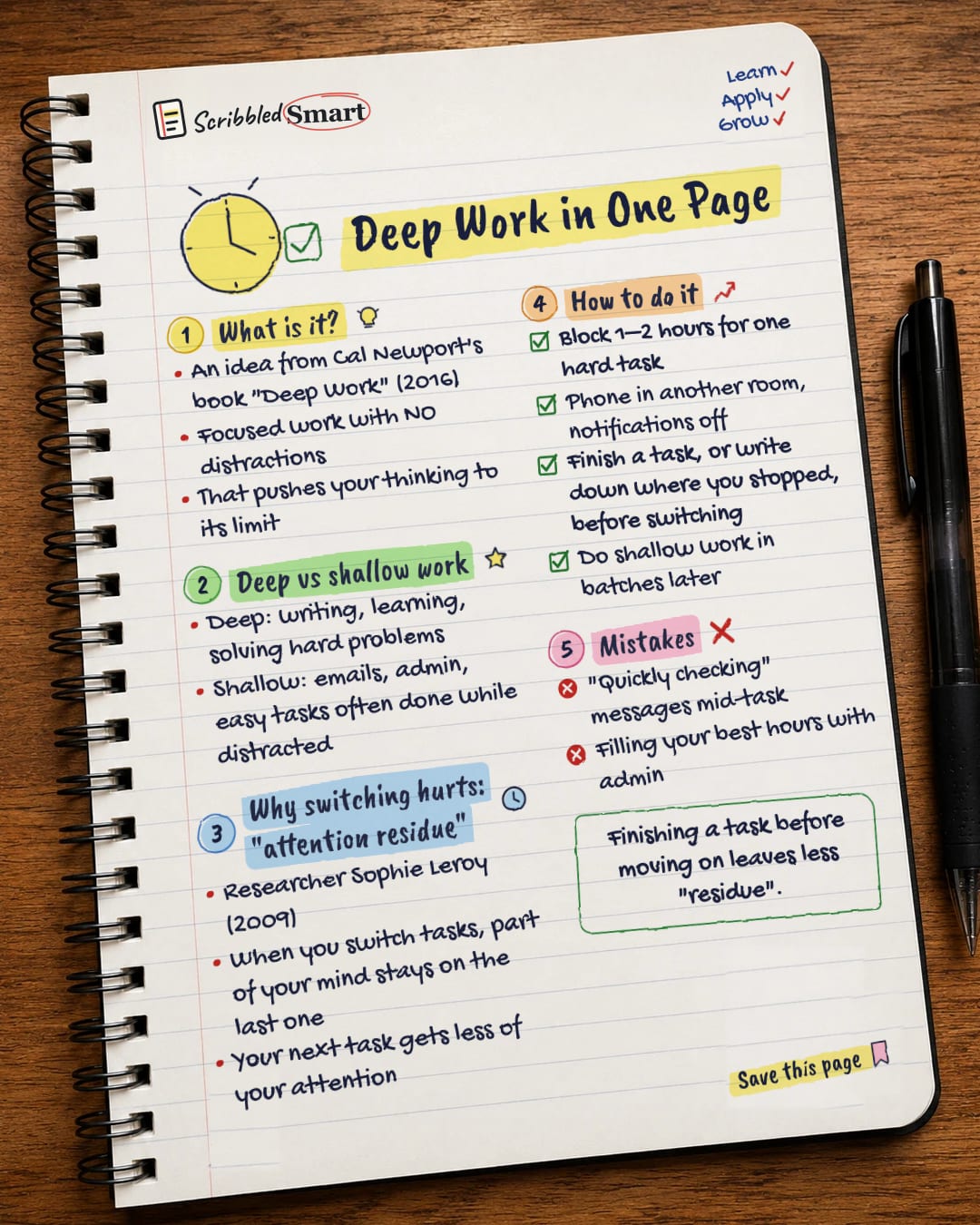
Deep work is a term from Cal Newport's book Deep Work: Rules for Focused Success in a Distracted World (2016). He defines it as professional activities done in a state of distraction-free concentration that push your cognitive capabilities to their limit.
That definition has two parts:
- No distractions. No messages, no notifications, no "quick checks".
- Real effort. The task stretches you. It's not something you could do half-asleep.
What's the difference between deep work and shallow work?
The difference is how much thinking a task needs. Newport contrasts deep work with shallow work: tasks that aren't mentally demanding and are often done while distracted.
| Deep work | Shallow work |
|---|---|
| Writing | Emails |
| Learning something new | Admin |
| Solving hard problems | Easy, routine tasks |
| Needs full attention | Often done while distracted |
Shallow work isn't bad. Most jobs need some. The problem comes when shallow tasks fill the hours you could use for your hardest, most valuable work.
What is attention residue, and why does switching hurt?
Switching tasks leaves part of your mind behind. Researcher Sophie Leroy named this "attention residue" in a 2009 paper titled Why is it so hard to do my work? The challenge of attention residue when switching between work tasks, published in Organizational Behavior and Human Decision Processes.
What attention residue means
When you move from one task to another, part of your attention stays on the first task. That leaves less attention for the next one, so you perform worse on it.
You may know the feeling. You leave a tricky email half-written to join a meeting, and your mind keeps drifting back to it. Our article on the multitasking myth and switching costs shows how much time those switches can eat up.
Finishing a task helps
Leroy's research also found something hopeful. People who finished the first task under a tight deadline showed less attention residue when they moved on. So getting to the end of a task, rather than leaving it hanging, seems to let your mind move on more cleanly.
A figure to avoid
You may see claims like "it takes 23 minutes to refocus" or "each switch costs 15 to 25 minutes". These figures don't come from Leroy's paper and are often wrongly linked to it. We leave them out.
How to do deep work
Plan for it, protect it, and keep shallow tasks for later. These steps follow Newport's recommended practices of scheduling deep work and batching shallow work.
- Block 1–2 hours for one hard task. Put it in your calendar so it doesn't get squeezed out.
- Put your phone in another room and turn notifications off. Remove the temptation, don't just resist it.
- Finish a task, or write down where you stopped, before switching. In a later set of four studies, Leroy and Glomb (2018) found that briefly planning how you'll return to an interrupted task, a "ready-to-resume" plan, reduced attention residue, and performance on the interrupting task didn't suffer.
- Do shallow work in batches later. Answer emails and handle admin in one block, not all day.
Choose your best hours
If you have a time of day when you think most clearly, use it for deep work. Save admin for when your energy is lower.
Common deep work mistakes
- "Quickly checking" messages mid-task. Even a short look can leave your attention split.
- Filling your best hours with admin. Your sharpest time is your most valuable time.
- Leaving a task half-done with no plan. In Leroy's research, finishing the first task, or making a quick ready-to-resume plan, left less residue.
FAQ
What is deep work according to Cal Newport?
Cal Newport describes deep work as professional activities done in a state of distraction-free concentration that push your cognitive capabilities to their limit. That means focused effort on a hard task with no interruptions. He set out the idea in his 2016 book Deep Work: Rules for Focused Success in a Distracted World.
What is attention residue?
Attention residue is the part of your attention that stays stuck on a previous task after you switch. Sophie Leroy described it in a 2009 paper. Because some of your mind is still on the old task, you have less attention for the new one, and your performance on it drops.
How long should a deep work session be?
A practical starting point is a block of 1–2 hours for one hard task, with your phone away and notifications off. Newport recommends scheduling deep work in your calendar, so it gets a protected slot rather than whatever time is left over once everything else is done.
Related reading
- The Pomodoro Technique: short focused rounds if 1–2 hours feels too long to start.
- Check email less: how checking your inbox less often lowered stress in one study.
- Active recall for studying: a demanding way to learn that suits deep work blocks.
Sources
- EconPapers: Leroy (2009), Why is it so hard to do my work?
- strategy+business: Attention residue
- BPS Research Digest: The surprising benefits of time pressure at work
- Graham Mann: Deep Work book notes
- Shortform: Deep Work summary
- INFORMS (Organization Science): Leroy & Glomb (2018), Tasks interrupted
How we checked this
Every fact in this article comes from the 6 sources listed above, checked against official or peer-reviewed sources where possible. AI tools help with drafting; a person checks every fact against the sources. How we research
- Published and checked
Spotted a mistake? Tell us and we'll fix it and log it on the corrections page.


