
On this page
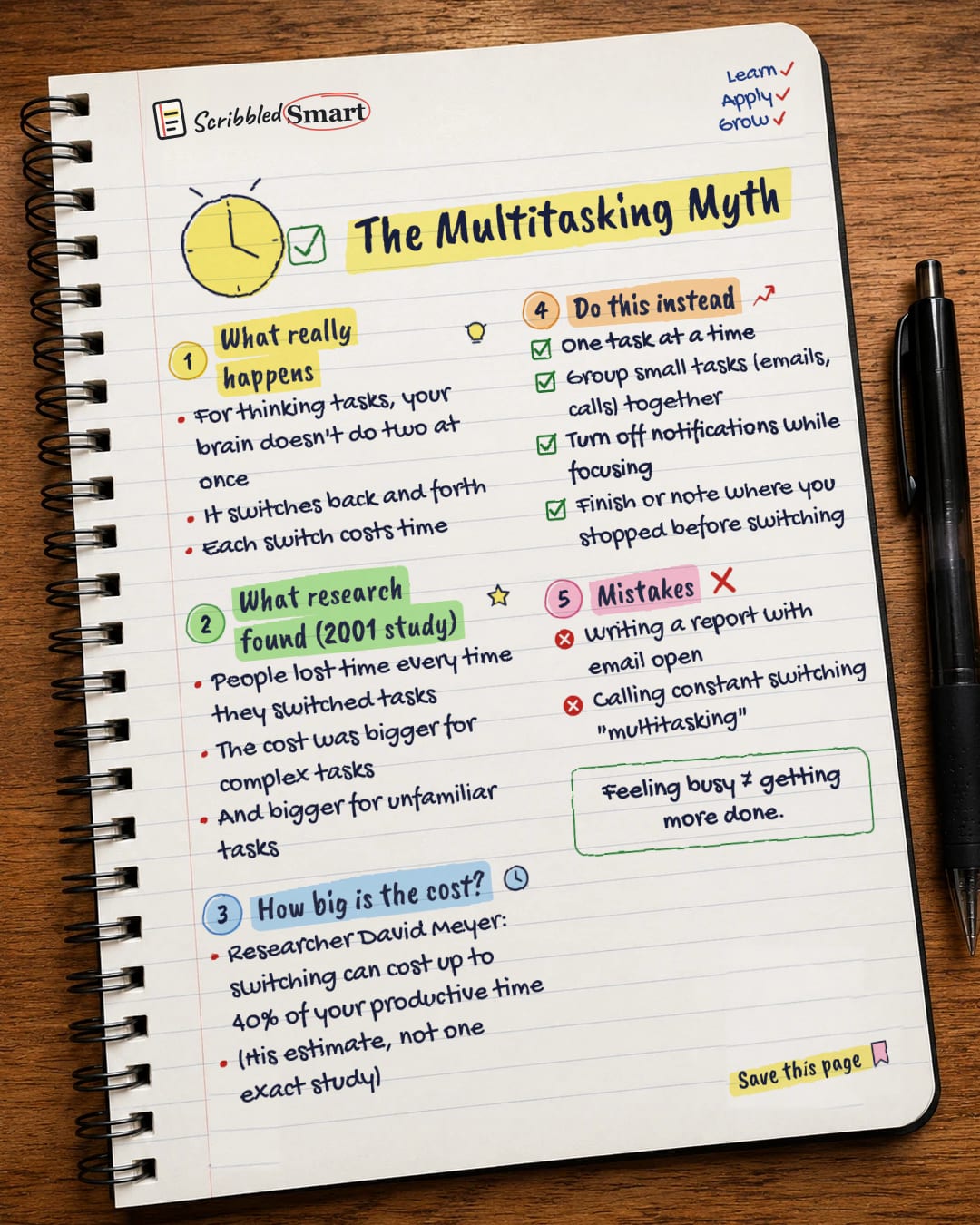
The multitasking myth is the belief that you can do two thinking tasks at the same time. For tasks that need your attention, your brain doesn't really run them side by side. It switches back and forth, and each switch costs time. Here's what the research found, how big the cost might be, and what to do instead.
Can your brain really multitask?
When you try to do two tasks that both need thought, you're switching, not multitasking. The American Psychological Association (APA) describes this as moving attention from one task to another, rather than doing both at once.
Think of writing an email while listening to a colleague explain a problem. It feels like both are happening together. In reality, your attention keeps jumping between them.
What about simple tasks?
Not every pair of tasks clashes. Some simple, automatic activities, like walking and talking, can be combined. The multitasking myth is about tasks that need your attention, which is why this article talks about "thinking tasks".
What the 2001 switching study found
The 2001 study showed that every switch between tasks has a time cost. It was carried out by Rubinstein, Meyer and Evans and published in the Journal of Experimental Psychology: Human Perception and Performance.
The researchers ran four experiments. They measured how much time people lost when they switched between different tasks.
Three findings stand out:
| Finding | What it means for you |
|---|---|
| People lost time every time they switched | Each jump between tasks has a cost |
| The cost was bigger for complex tasks | Hard work suffers most from switching |
| The cost was bigger for unfamiliar tasks | New tasks are especially easy to disrupt |
So the tasks you most want to do well, the hard and new ones, are the ones that switching hurts the most.
How big is the cost of switching?
Nobody has one exact number, but one researcher's estimate is large. David Meyer has said that the brief mental blocks caused by shifting between tasks can cost as much as 40% of someone's productive time.
It's important to read that figure carefully. It's Meyer's estimate, not a result measured in one exact study. The real cost will depend on the person, the tasks and how often they switch.
Even so, the direction is clear. Small switches add up. A day full of tiny jumps between tasks can lose a lot of time you never notice.
How to beat the multitasking myth: do this instead
The fix is simple: cut the number of switches you make. These habits follow directly from the switching cost research.
- Do one task at a time. Give your full attention to one thinking task before moving on.
- Group small tasks together. Answer emails in one go, and make calls in one block, rather than spreading them through the day.
- Turn off notifications while you focus. Every ping is an invitation to switch.
- Finish, or note where you stopped, before switching. A quick note of your next step gives you a clear place to restart.
That last tip also links to an idea called attention residue, which is covered in our guide to deep work and focused attention.
A simple focus routine
- Choose the one task that matters most right now.
- Close email and silence your phone.
- Work on that task until you finish it or reach a natural stopping point.
- Write down where you stopped.
- Then deal with messages in one batch.
Common multitasking mistakes
- Writing a report with email open. Each new message is an invitation to switch, and every switch has a cost.
- Calling constant switching "multitasking". The word makes it sound efficient. It's really a string of interruptions.
- Thinking busy means productive. Feeling busy is not the same as getting more done.
FAQ
Is multitasking a myth?
For tasks that need your attention, yes. According to the APA, people switch between such tasks rather than doing them at the same time. Each switch costs time, and a 2001 study found the cost was bigger for complex and unfamiliar tasks. Simple automatic activities, like walking while talking, are different.
Why is task switching worse for hard tasks?
The 2001 study by Rubinstein, Meyer and Evans found the time lost on each switch grew as tasks became more complex. It was also bigger for tasks people were less familiar with. So the more thinking a task needs, the more a switch interrupts it.
How can I stop multitasking at work?
Do one thinking task at a time, and group small jobs like emails and calls into set blocks. Turn off notifications while you focus. Before you switch, finish the task or jot down where you stopped, so getting back into it takes less effort.
Related reading
- Check email less: a study that limited inbox checks to three a day.
- Time blocking: give each task its own slot so you switch less.
- The Eisenhower Matrix: decide which single task deserves your attention first.
Sources
- APA: Multitasking, switching costs
- APA Monitor (Oct 2001): Is multitasking more efficient?
- Newswise (APA press release): Is multitasking more efficient?
How we checked this
Every fact in this article comes from the 3 sources listed above, checked against official or peer-reviewed sources where possible. AI tools help with drafting; a person checks every fact against the sources. How we research
- Published and checked
Spotted a mistake? Tell us and we'll fix it and log it on the corrections page.


