
On this page
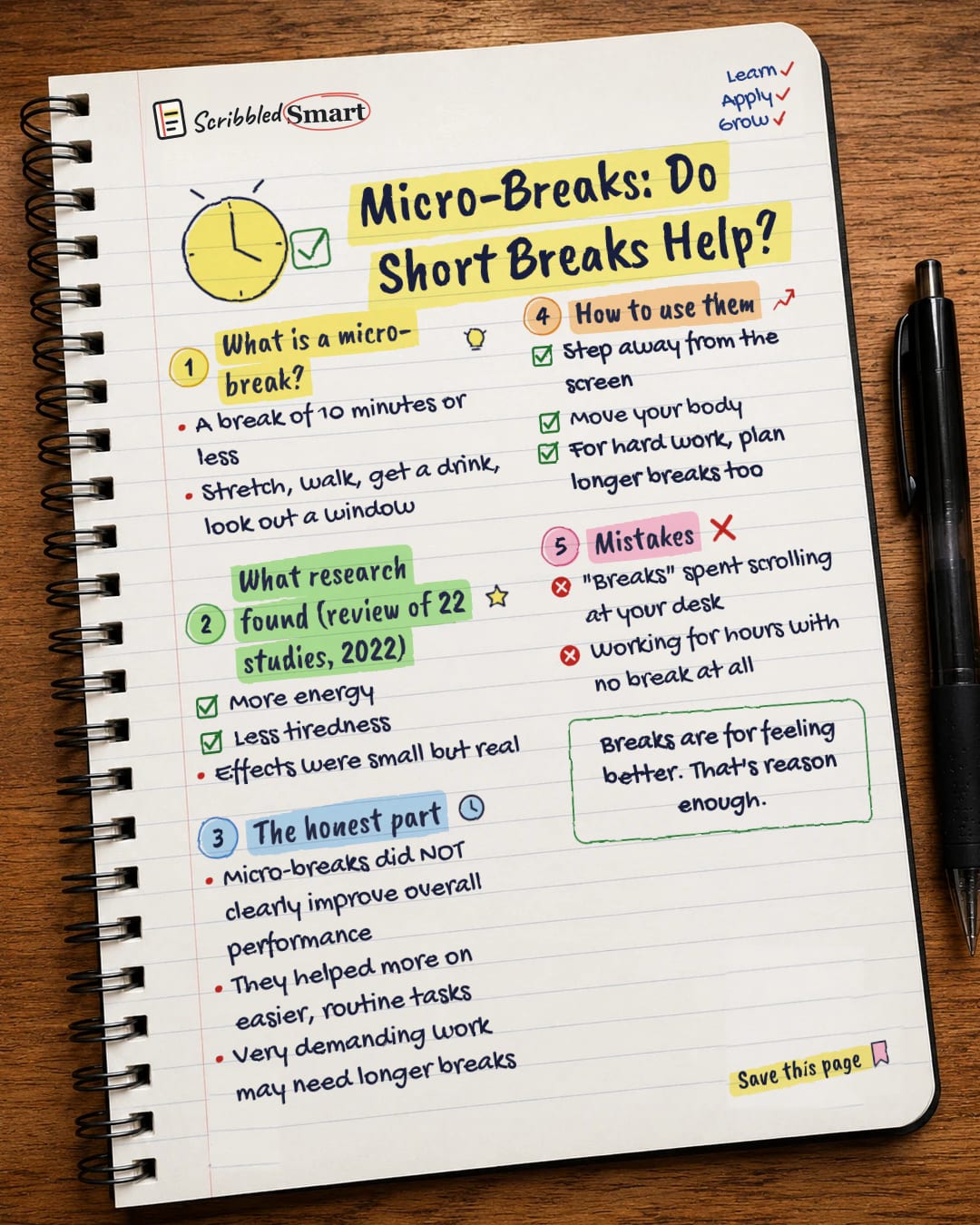
Micro-breaks, short pauses of 10 minutes or less, do seem to help you feel better: a 2022 review found they gave people more energy and less tiredness. What they didn't clearly do was improve overall performance. Here's what the research found, where short breaks help most, and how to use them well.
What is a micro-break?
A micro-break is any break of 10 minutes or less. That's the definition used in a 2022 review of the research.
It can be simple:
- Stretch.
- Walk around.
- Get a drink.
- Look out of a window.
The point is to step away from the task, briefly, and then come back.
Do micro-breaks really help? What the research says
The main evidence comes from a 2022 systematic review and meta-analysis by Albulescu and colleagues, published in PLOS ONE. Its title was "'Give me a break!' A systematic review and meta-analysis on the efficacy of micro-breaks for increasing well-being and performance".
A meta-analysis combines the results of many studies to find the overall picture. This one pulled together 19 records covering 22 samples, with 2,335 people in total.
Micro-breaks and energy
Micro-breaks helped people feel better. The review found:
| Outcome | Effect size (d) | What it means |
|---|---|---|
| Vigour (energy) | 0.36 | Small but significant increase |
| Fatigue (tiredness) | 0.35 | Small but significant decrease |
| Overall performance | 0.16 | Not statistically significant (p = .116) |
Effect sizes like these are a way of measuring how big a difference is. Here, both well-being results were small but real.
Do short breaks improve productivity?
Micro-breaks did not clearly improve overall performance. That's the surprising part of the review.
The performance effect was small and not statistically significant. So the researchers couldn't be confident that short breaks made people do their work better overall.
Where short breaks helped performance
There was one exception. Micro-breaks did help performance on less mentally demanding tasks, the easier and more routine kind of work.
Why demanding work may need longer breaks
The review also found that longer breaks went with a bigger performance boost. The authors suggested that very demanding tasks may need breaks longer than 10 minutes.
What the review can't tell you
The review pooled 22 different samples, and they used different kinds of breaks. So it doesn't point to one best break length. We don't recommend a specific number of minutes, because the evidence doesn't support one.
How to use micro-breaks well
Step away, move, and plan longer breaks for hard work. These tips fit what the review found.
- Step away from the screen. A break is a change of scene, not more of the same.
- Move your body. A stretch or a short walk counts.
- For hard work, plan longer breaks too. The review suggests demanding tasks may need more than 10 minutes.
If you want a set rhythm of work and rest, the Pomodoro Technique's planned breaks are one simple system to try.
Remember the main point. Breaks are for feeling better, and that's reason enough to take them.
Micro-break mistakes to avoid
- "Breaks" spent scrolling at your desk. You haven't really stepped away from the screen.
- Working for hours with no break at all. Even short breaks raised energy and reduced tiredness in the review.
- Expecting a quick break to rescue a very hard task. Demanding work may need a longer pause.
FAQ
How long is a micro-break?
A micro-break lasts 10 minutes or less. That's how the 2022 review by Albulescu and colleagues defined it. It can be as simple as stretching, walking around, getting a drink or looking out of a window. The review didn't find one best length, because the studies it combined used different breaks.
Are micro-breaks good for you?
The 2022 review found micro-breaks gave a small but significant boost to energy and a small but significant drop in tiredness. It combined 22 samples with 2,335 people in total. So short breaks do seem to help you feel better, even if their effect on work output is less certain.
How long should a break be for demanding work?
The review found that longer breaks went with a bigger performance boost, and the authors suggested very demanding tasks may need breaks of more than 10 minutes. It didn't name an exact length. So for hard work, plan some longer breaks alongside quick ones.
Related reading
- Desk posture: set up your workstation for the time between breaks.
- Screens and your eyes: the 20-20-20 rule for screen breaks.
- Deep work: how to plan long, focused blocks that need proper rest.
Sources
- DOAJ: Albulescu et al. (2022), Give me a break! (PLOS ONE record)
- EconPapers: Albulescu et al. (2022) record
- ScienceDaily (2022): Micro-breaks study
- EurekAlert: Micro-breaks news release
How we checked this
Every fact in this article comes from the 4 sources listed above, checked against official or peer-reviewed sources where possible. AI tools help with drafting; a person checks every fact against the sources. How we research
- Published and checked
Spotted a mistake? Tell us and we'll fix it and log it on the corrections page.


