
On this page
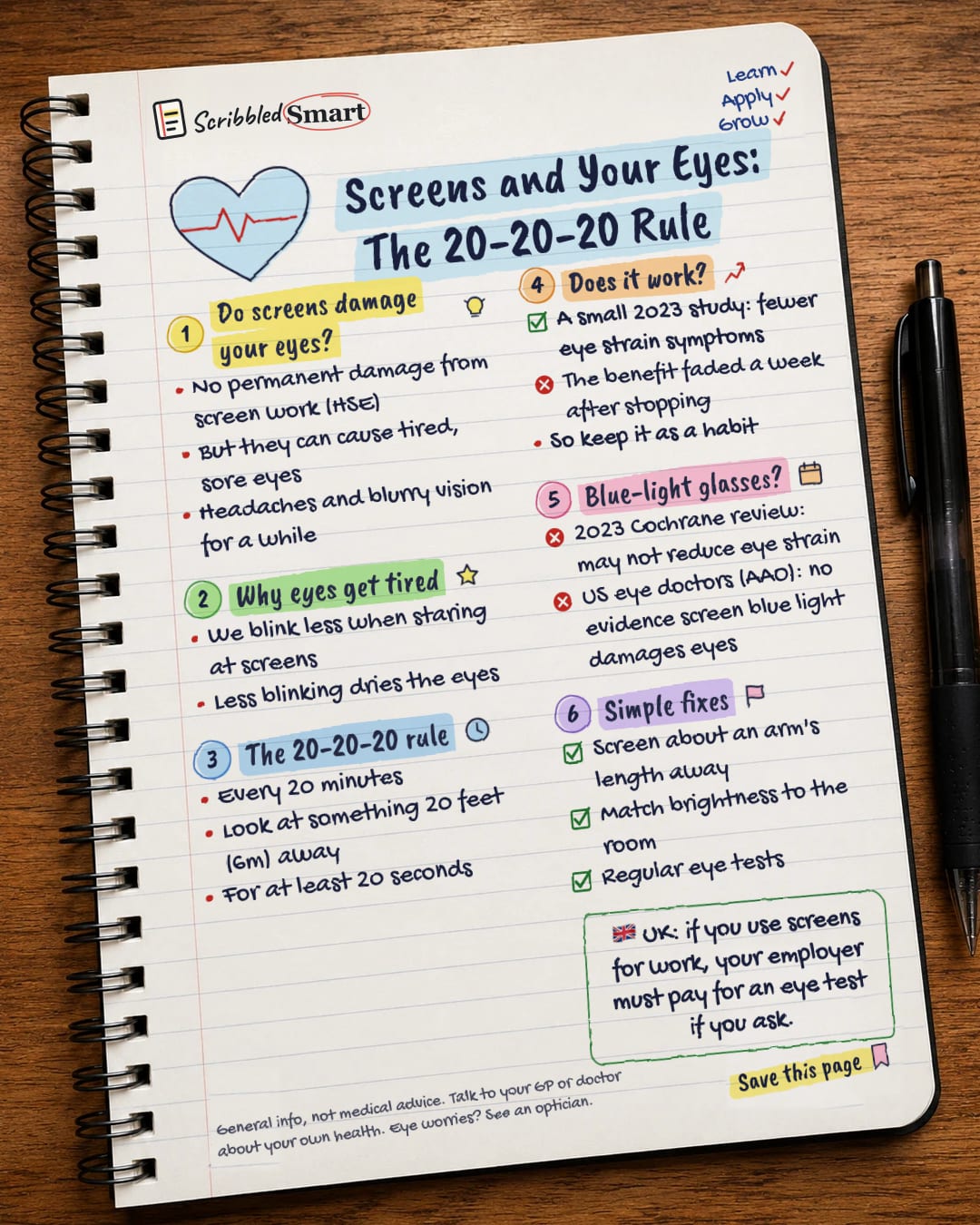
The 20-20-20 rule is simple: every 20 minutes, look at something at least 20 feet (about 6 metres) away for at least 20 seconds. It's a way to rest your eyes during screen time. Screen work doesn't cause permanent damage to your eyes. Below, we cover why your eyes get tired, what the evidence says about the rule, and whether blue-light glasses are worth it.
Do screens damage your eyes?
No. The HSE, the UK's Health and Safety Executive, says screen work does not cause permanent damage to eyes. The American Academy of Ophthalmology (AAO), the US body for eye doctors, agrees that the belief screens permanently damage your eyes is false.
That doesn't mean screens never bother your eyes. The HSE says screen work can cause:
- tired eyes
- discomfort
- headaches
- temporary short-sightedness, which means distant things can look blurry for a while
The AAO adds that eye strain doesn't cause lasting damage.
Why your eyes get tired at a screen
One reason is blinking. The AAO says people blink less when they look at screens, and less blinking dries the eyes, which can cause temporary eye strain symptoms.
How the 20-20-20 rule works
The 20-20-20 rule gives your eyes a regular, short break from staring at your screen. The AAO recommends it like this:
- Every 20 minutes,
- look at something at least 20 feet away (about 6 metres),
- for at least 20 seconds.
How we worked out the metric figure: 20 feet × 0.3048 = 6.1 metres, so about 6m.
Does the 20-20-20 rule work?
It may help, but the evidence is small. In 2023, Talens-Estarelles and colleagues tested the rule with 29 computer users who already had symptoms. For 2 weeks, they got reminders to follow 20-20-20.
The result: their digital eye strain and dry eye symptoms went down. But there was no change in measurements of the eye's surface. And the improvement was not maintained one week after they stopped.
So the practical lesson is to keep it as a habit, not a one-off fix.
Keep this in context. It was one small, short study. A 2026 review in the journal Cureus described the evidence for habits like 20-20-20 as low-certainty. The rule is widely recommended, but it isn't a proven cure.
Do blue-light glasses help?
Probably not for eye strain. A 2023 Cochrane review by Singh and colleagues found that blue-light filtering lenses may not reduce eye strain from computer use, at least in the short term.
The review couldn't assess whether these lenses protect the back of the eye (the macula), and its results on sleep were mixed.
The AAO says there is no scientific evidence that blue light from digital devices damages the eye. It doesn't recommend any special eyewear for computer use.
Simple fixes for screen eye strain
Alongside the 20-20-20 rule, these small changes can help:
- Keep your screen about an arm's length away. Both the HSE and the AAO give this advice. The AAO puts it at about 25 inches.
- Match your screen brightness to the room. This comes from the AAO.
- Cut glare. The AAO says a matte screen filter can reduce glare.
- Use artificial tears if your eyes feel dry. Another AAO tip.
- Have regular eye tests. See below for who can get one free.
For the rest of your setup, see our guide to good desk posture and workstation setup.
Eye tests: work and NHS
Your employer and eye tests (UK)
🇬🇧 In Great Britain, if you are a "DSE user" (someone who uses display screen equipment, like a computer, for work), your employer must provide and pay for an eyesight test if you ask. The HSE also says DSE users should have further tests at regular intervals.
Your employer only has to pay for glasses if you need special glasses for the distance you view your screen at.
Who gets a free NHS eye test?
🇬🇧 The NHS offers free sight tests to many groups in the UK, including people who are:
- under 16
- 16 to 18 and in full-time education
- 60 or over
- living with diabetes or glaucoma
- 40 or over with a close relative who has glaucoma
- registered partially sighted or blind
- getting certain benefits
Related reading
- Sleep better: NHS advice on screens before bed, and what the blue-light research means for sleep.
- Micro-breaks: do short breaks from work really help?
Sources
- HSE: Eyes and eyesight testing
- HSE: Good posture
- American Academy of Ophthalmology: Should you be worried about blue light?
- American Academy of Ophthalmology: Computers, digital devices and eye strain
- Talens-Estarelles C et al. (2023), The effects of breaks on digital eye strain, dry eye and binocular vision: Testing the 20-20-20 rule, Contact Lens & Anterior Eye (PubMed)
- Singh S et al. (2023), Blue-light filtering spectacle lenses, Cochrane Database of Systematic Reviews (PubMed)
- NHS: Free NHS eye tests and optical vouchers
- PubMed: Cureus (2026) narrative review
How we checked this
Every fact in this article comes from the 8 sources listed above, checked against official or peer-reviewed sources where possible. AI tools help with drafting; a person checks every fact against the sources. How we research
- Published and checked
- Next check
- yearly
General info, not medical advice. Talk to your GP or doctor about your own health. Eye worries? See an optician.
Spotted a mistake? Tell us and we'll fix it and log it on the corrections page.


