
On this page
You don't need exactly 10,000 steps a day: the number came from a marketing campaign in Japan, not from science. Large studies do link more daily steps with better health, but the benefits level off below 10,000 for many people. Here's where the number came from, what the research found, and how to use it.
Where did 10,000 steps a day come from?
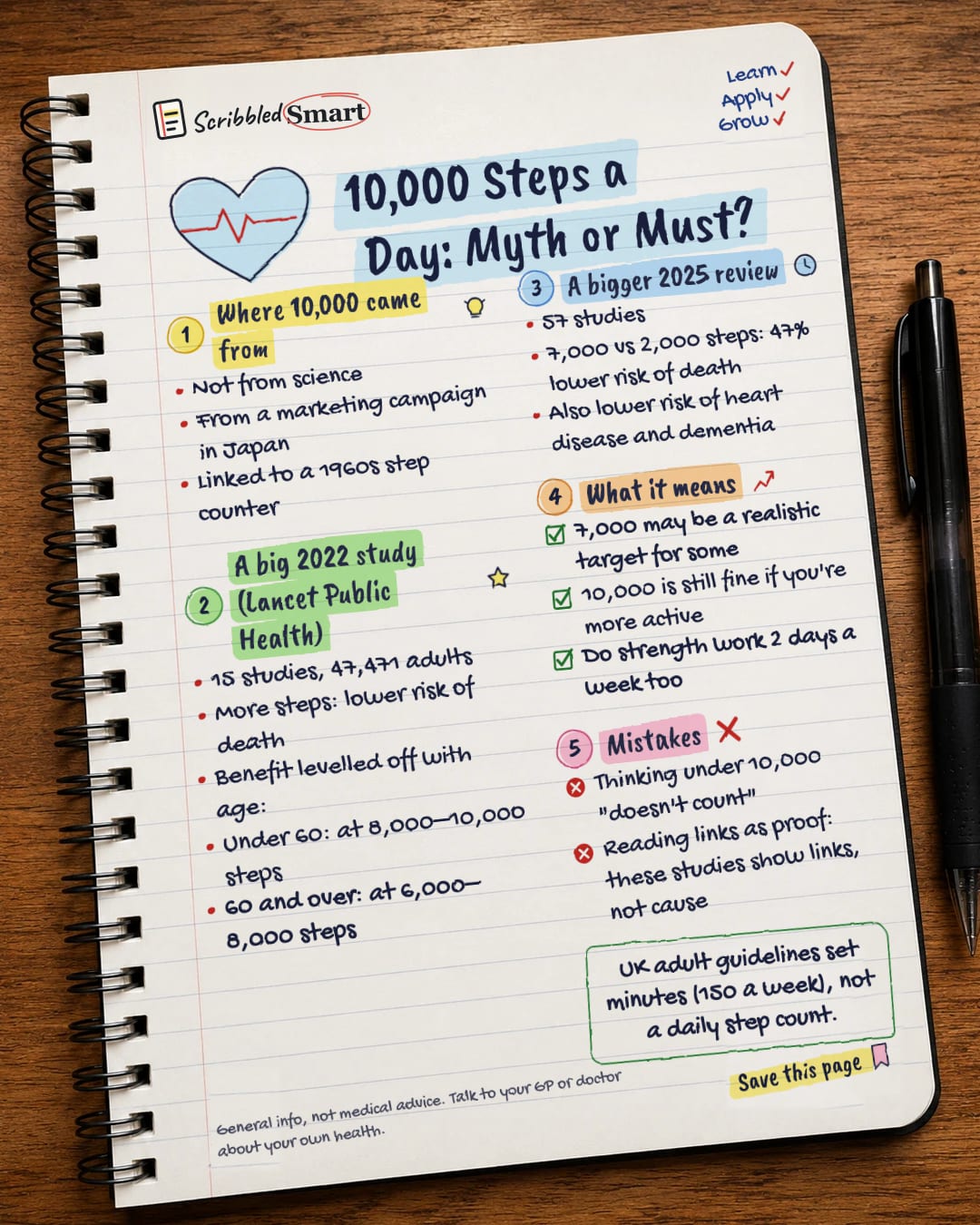
The 10,000 target came from marketing, not research. A 2022 study in Lancet Public Health by Paluch and colleagues says plainly that it is not based on evidence, but originates from a marketing campaign in Japan.
The campaign is widely linked to a 1960s Japanese pedometer, the Yamasa "manpo-kei", which means "10,000-step meter". Popular Science, quoting Harvard's Professor I-Min Lee, is one of several outlets to report this. Sources disagree on the exact year, so we only say the 1960s.
What the 2022 study found
More steps were linked to a lower risk of death, up to a point that depended on age. Paluch et al. (2022) combined data from 15 studies covering 47,471 adults.
They found that the risk of dying from any cause got lower as daily steps went up. But the benefit levelled off:
| Age | Benefit levelled off at about |
|---|---|
| Under 60 | 8,000–10,000 steps a day |
| 60 and over | 6,000–8,000 steps a day |
The four step groups
The study split people into four groups by steps. The middle (median) step counts were 3,553, 5,801, 7,842 and 10,901 a day. Compared with the lowest group, the risk of death was lower in each higher group. The hazard ratios (a measure of relative risk) were 0.60, 0.55 and 0.47.
Is 7,000 steps a day enough?
A bigger 2025 review suggests around 7,000 steps may be a realistic target for some people. Ding et al. (2025), also in Lancet Public Health, included 57 studies.
Compared with 2,000 steps a day, 7,000 steps a day was linked to:
- a 47% lower risk of death from any cause
- a 25% lower risk of getting heart and circulation disease
- a 38% lower risk of dementia
The researchers rated the evidence for these three results as "moderate certainty". They also found the benefits started to slow at around 5,000 to 7,000 steps for death, heart disease, dementia and falls.
Other results, with weaker evidence
The review reported other links too: lower rates of death from heart disease, death from cancer, type 2 diabetes and depressive symptoms, and fewer falls. But the evidence for some of these was rated low or very low certainty. For example, death from heart disease was low certainty and falls were very low. There was no clear link with getting cancer.
What "47% lower" actually means
This is relative risk, not absolute risk. It compares people walking 7,000 steps with people walking very little (2,000 steps). It doesn't mean nearly half of people avoid death. It means that, in these studies, the more active group had a much lower risk than the least active group.
Do more steps cause better health?
Both studies are observational. They looked at what people already did, rather than asking them to change. Paluch's team say causal inferences cannot be made from their data, and Ding's team note that other factors may still affect the results.
There is also a risk of reverse causation. People who are already ill tend to walk less, which can make low step counts look more harmful than they are.
How many steps a day should you aim for?
Use step counts as a guide, not a pass-or-fail test.
- 7,000 steps may be a realistic target for some people, according to the 2025 review.
- 10,000 steps is still fine if you're more active. The same review says it remains a viable goal.
- Don't forget strength work. The UK Chief Medical Officers recommend muscle-strengthening activities on at least 2 days a week.
The UK adult guidelines (ages 19 to 64) don't set a step target at all. They set minutes: at least 150 minutes of moderate activity a week, or 75 minutes of vigorous activity. Our beginner workout plan shows how to turn that into a simple week.
Common mistakes
- Thinking under 10,000 "doesn't count". Both big studies found benefits below 10,000 steps.
- Reading links as proof. These studies show links, not cause and effect.
- Counting steps but skipping strength work. The UK guidelines ask for both activity and strength.
Related reading
- Why habits stick (or don't): how to build a daily walking habit.
- Desk posture and breaks: getting up and moving during the working day.
- How the heart works: a plain guide to the heart, as the 2025 review linked more steps with lower heart disease risk.
Sources
- Paluch AE et al. (2022), Daily steps and all-cause mortality: a meta-analysis of 15 international cohorts, Lancet Public Health (open-access PDF)
- Ding D et al. (2025), Daily steps and health outcomes in adults: a systematic review and dose-response meta-analysis, Lancet Public Health (PubMed)
- Popular Science: No, you don't need 10,000 steps a day
- GOV.UK: UK Chief Medical Officers' physical activity guidelines
How we checked this
Every fact in this article comes from the 4 sources listed above, checked against official or peer-reviewed sources where possible. AI tools help with drafting; a person checks every fact against the sources. How we research
- Published and checked
- Next check
- yearly (new step studies appear often)
General info, not medical advice. Talk to your GP or doctor about your own health.
Spotted a mistake? Tell us and we'll fix it and log it on the corrections page.


