
On this page
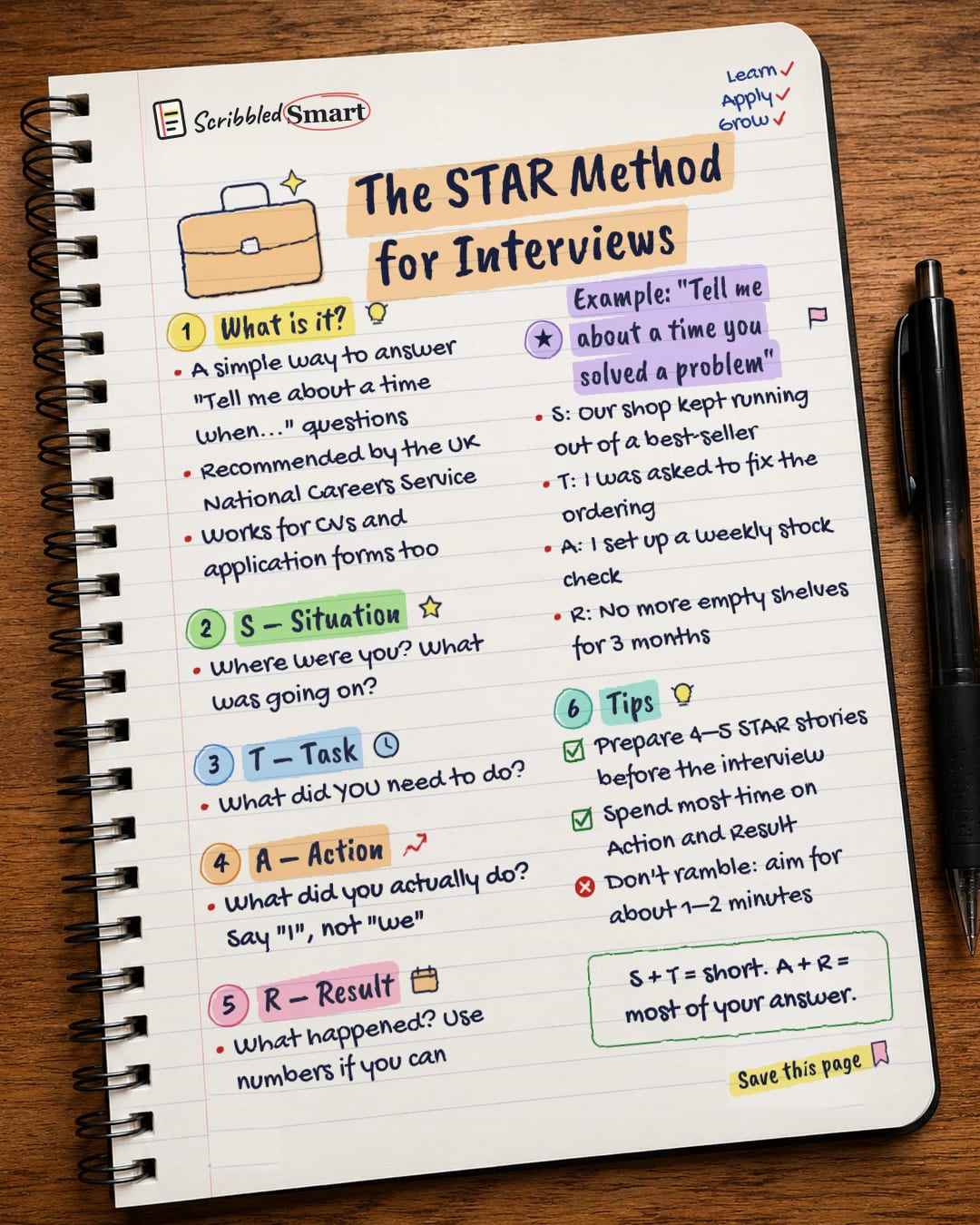
The STAR method is a simple way to answer interview questions that start with "Tell me about a time when…": you describe the Situation, the Task, the Action you took and the Result. The UK's National Careers Service recommends it, and it works for CVs and application forms too. This guide explains each step, gives a worked example and shows how to prepare your own STAR stories as part of getting ready for a job interview.
What is the STAR method?
Some interview questions ask you to prove a skill with a real example from your past. They often begin "Tell me about a time when…" or "Give an example of…". Without a plan, it's easy to freeze, or to ramble without ever getting to the point.
STAR gives you a ready-made shape for your answer. The National Careers Service says it "helps you to answer interview questions fully", and its CV guide suggests using STAR to structure your answers in a CV, an application or an interview.
The four steps of STAR
The National Careers Service defines each part like this.
S: Situation
The situation you had to deal with. Set the scene: where were you, and what was going on? One or two sentences is plenty.
T: Task
The task you were given to do. What did you need to achieve? This tells the interviewer what was at stake.
A: Action
The action you took. This is the heart of your answer. Explain the steps you took, in order.
Say "I", not "we". It's natural to talk about your team, but the interviewer is assessing your own actions. The National Careers Service's own sample answers use "I" throughout.
R: Result
What happened as a result of your action, and what you learned from the experience. Use numbers if you can. If something didn't go perfectly, the "what you learned" part lets you show you can grow from it.
A STAR answer example
Question: "Tell me about a time you solved a problem."
- Situation: "Our shop kept running out of a best-selling product."
- Task: "I was asked to fix the ordering."
- Action: "I set up a weekly stock check, so we could see what was running low before it ran out."
- Result: "We had no more empty shelves for 3 months."
This is an illustration, not a script. Notice how short the Situation and Task are. Most of the words go on what the person did and what changed.
How long should a STAR answer be?
The National Careers Service advises keeping examples short and to the point. A good rule of thumb is about 1–2 minutes per answer.
A simple way to balance it:
| Part | How much time |
|---|---|
| Situation + Task | Short: just enough context |
| Action + Result | Most of your answer |
If you spend two minutes on the background, the interviewer may lose track before you reach the part that matters.
How do you prepare STAR stories before an interview?
The National Careers Service advises preparing examples from your past experience before the interview. A simple way to do it:
- Read the job description and list the skills it asks for, such as teamwork, solving problems or dealing with customers.
- Find one real example for each skill. It can come from work, study, volunteering or everyday life.
- Write each one out as S, T, A and R in a few bullet points.
- Aim for 4–5 stories. One story may fit more than one question.
- Practise saying them out loud, but don't learn them word for word.
That last point matters. The National Careers Service suggests getting your points across in a conversational way, so you don't sound too rehearsed. Know your bullet points, not a script.
Tips and common mistakes
Tips
- ✓ Prepare 4–5 STAR stories before the interview.
- ✓ Spend most of your time on the Action and the Result.
- ✓ Use numbers in your Result where you honestly can.
- ✓ Use STAR on your CV and application forms too, not just in interviews.
Mistakes to avoid
- ✗ Rambling. Aim for about 1–2 minutes.
- ✗ Saying "we" all the way through. The interviewer can't tell what you did.
- ✗ A long Situation and no Result. Get to the outcome.
- ✗ Reciting a memorised script. Stay conversational.
Related reading
- How to prepare for a job interview: the full prep checklist, including common questions.
- How to write a CV: use STAR thinking to show results in your work history.
- Imposter syndrome explained: for when you doubt your own examples are good enough.
Sources
- National Careers Service: Interview advice
- National Careers Service: How to write a CV
- National Careers Service: The STAR method
How we checked this
Every fact in this article comes from the 3 sources listed above, checked against official or peer-reviewed sources where possible. AI tools help with drafting; a person checks every fact against the sources. How we research
- Published and checked
Spotted a mistake? Tell us and we'll fix it and log it on the corrections page.


