
On this page
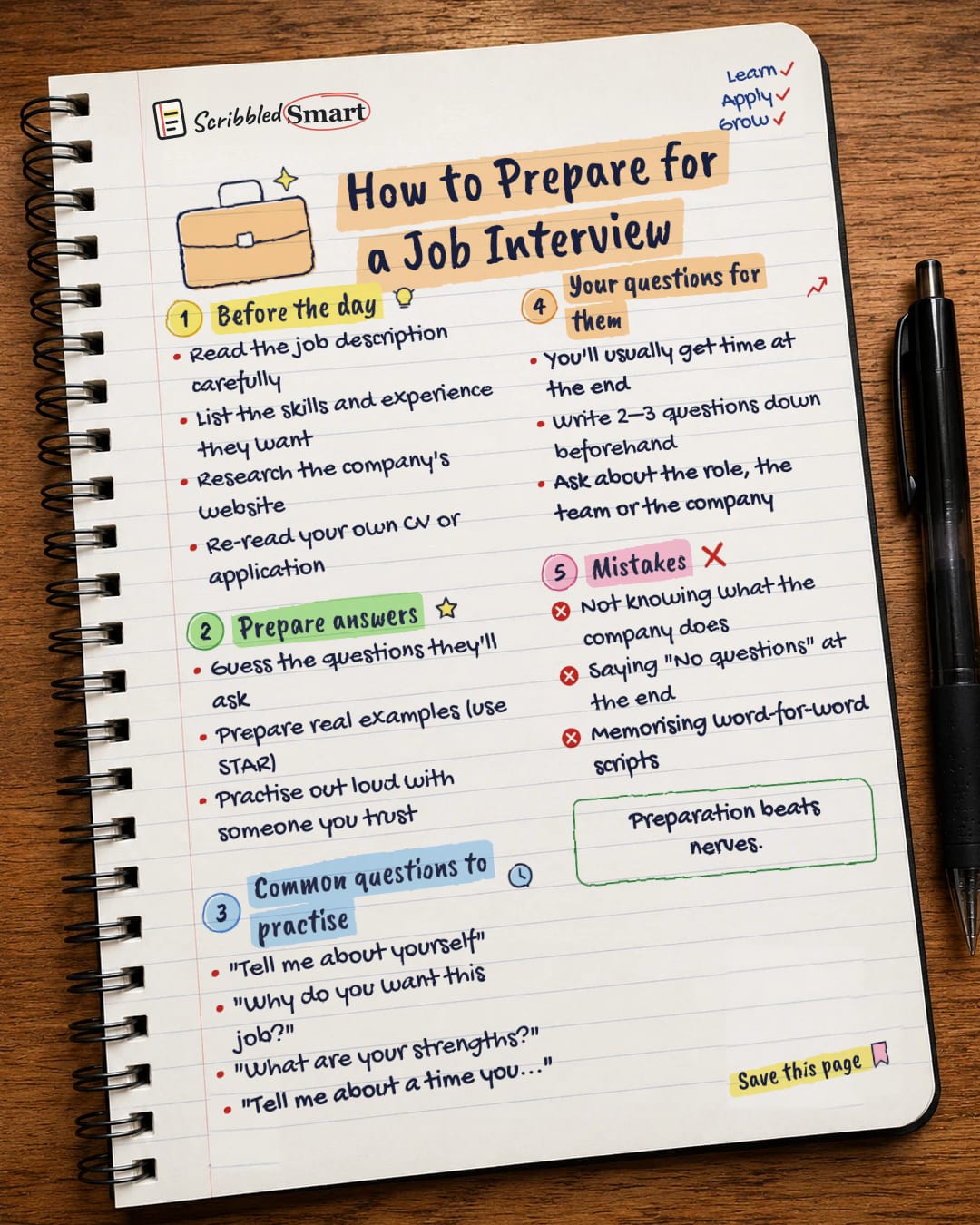
Here's how to prepare for a job interview: read the job description carefully, research the company's website, re-read your own CV or application, prepare real examples from your past, practise out loud, and write down a few questions to ask at the end. That's the core advice from the UK's National Careers Service. Much of the work happens before you walk in. This guide turns that advice into a step-by-step checklist.
Step 1: How to prepare for a job interview before the day
Read the job description carefully
The National Careers Service advises you to read the job description carefully and understand what skills and experience the employer is looking for. Make a simple list. This list becomes the backbone of your preparation, because many questions are likely to test whether you have those things.
Research the company
The National Careers Service also suggests doing some research on the company's website. Look for what they do, who their customers are and anything they say about their values. Its common questions page points to the "about us" pages as a good place to start.
Why it matters: interviewers often ask questions like "What do you know about our company?" or "Why do you want to work for us?". You can't answer those well without doing your homework.
Re-read your own CV or application
It sounds obvious, but it's easy to forget what you wrote weeks ago. The interviewer may have your CV or application in front of them and ask about anything on it. Read it again so your answers match.
Step 2: Prepare your answers
Guess the questions they'll ask
The National Careers Service suggests thinking ahead about the questions you're likely to be asked. Go back to your list of skills from the job description. For each one, ask yourself: "How would they test this?"
Prepare real examples (use STAR)
Prepare examples from your past experience. The STAR method gives each example a clear shape:
- Situation: what was going on
- Task: what you needed to do
- Action: what you did
- Result: what happened, and what you learned
Your examples can come from work, study, volunteering or life outside work. The National Careers Service's common questions page says examples from volunteering or outside work are fine if you need them.
Practise out loud
The National Careers Service advises practising with someone you trust. Saying an answer out loud is very different from thinking it. You'll notice where you ramble, where you go blank and which examples work best.
Step 3: What are the most common interview questions?
Prepare for the main types of question rather than every possible wording. The National Careers Service has a page of commonly asked questions, grouped like this:
| Type of question | Examples from the NCS page | How to prepare |
|---|---|---|
| About the employer | "What do you know about our company?", "Why do you want to work for us?" | Use your research from the company's website. |
| About you | "What are your hobbies and interests?" | Pick activities that show qualities or skills relevant to the job. |
| Work history | "When have you faced a challenging situation?" | Answer with a STAR example. |
| Strengths | "What are your main strengths?", "Why should we hire you?" | Plan 2 or 3 relevant strengths, each with an example. |
| Weaknesses | "Do you have any weaknesses?" | Be honest. Pick a real weakness and explain what you're doing to improve. |
| Why you left your last job | (No set wording) | Stay positive. Explain any long gap and what you did during it. |
You don't need a perfect answer for every possible question. If you've prepared a handful of strong examples, you can adapt them to many questions on the day.
Step 4: What questions should you ask at the end?
You'll usually get time at the end to ask your own questions. The National Careers Service advises writing them down beforehand. Ask about the role, the team or the company.
Its common questions page suggests examples such as:
- "What does a typical day involve?"
- "Will there be any training opportunities after I start?"
Asking questions shows you're interested in the company and the role. Aim for 2–3, in case some get answered during the interview.
Common interview mistakes
- ✗ Not knowing what the company does. A few minutes on their website fixes this.
- ✗ Saying "No questions" at the end. It can look like you're not interested. Have 2–3 ready.
- ✗ Memorising word-for-word scripts. Learn your key points instead. Scripts can sound stiff and fall apart if the question is worded differently.
- ✗ Only preparing in your head. Practise out loud, ideally with someone you trust.
Preparation beats nerves. The more you've practised, the less there is to worry about on the day.
Related reading
- The STAR method: how to structure the examples you prepare.
- How to negotiate your salary: what to do once the offer comes in.
- Body language myths: what's true and what isn't about how you come across.
- Why we overthink: for when interview nerves keep you up at night.
Sources
- National Careers Service: Interview advice
- National Careers Service: Common interview questions and answers
How we checked this
Every fact in this article comes from the 2 sources listed above, checked against official or peer-reviewed sources where possible. AI tools help with drafting; a person checks every fact against the sources. How we research
- Published and checked
Spotted a mistake? Tell us and we'll fix it and log it on the corrections page.


