
On this page
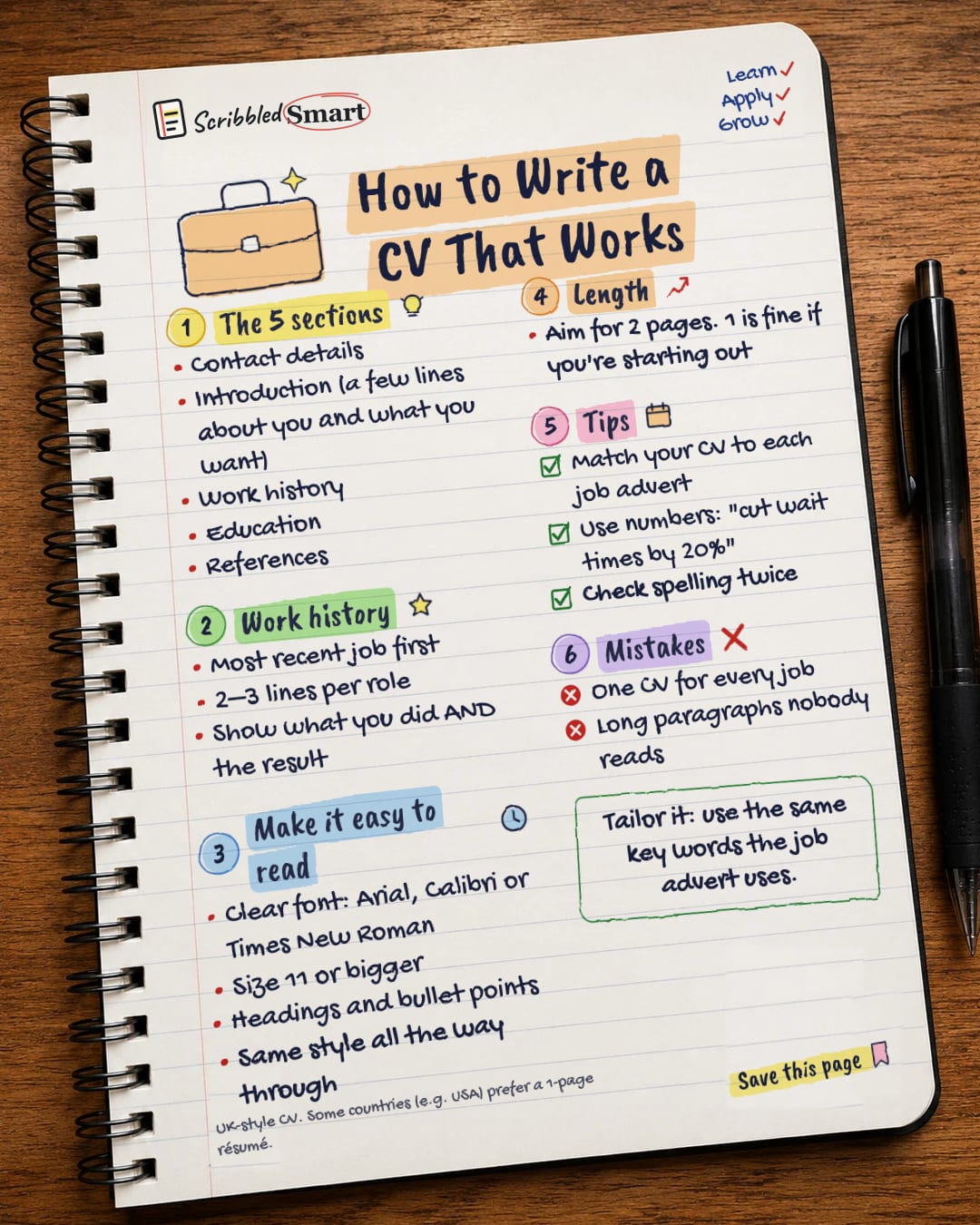
Here's how to write a CV that works: use five clear sections (contact details, a short introduction, work history, education and references), list your most recent job first, keep it easy to read, and change it for every job you apply for. That's the core of the advice from the UK's National Careers Service. Your CV has one job: to get you an interview. This guide walks through each part, step by step.
How to write a CV: start with the 5 sections
A UK CV is built from five standard sections. The National Careers Service (the UK government's careers advice service) lists them as:
- Contact details: how the employer can reach you.
- Introduction: a few short lines summing up who you are and what you hope to do.
- Work history: the jobs you've done.
- Education: your studies and qualifications.
- References: people who can vouch for you.
Think of the introduction as your opening line. It isn't a life story. A few lines are enough to tell the reader who you are and what kind of work you want next.
What order should your work history go in?
List your jobs newest first, keep each one to a few lines, and show results rather than duties.
Most recent job first
List your jobs in reverse order, starting with your current or latest role. This puts your latest experience at the top, where the reader sees it first.
Keep each role short
The National Careers Service suggests usually 2–3 lines per role. That's enough to say what the job was and what you achieved, without burying the important bits.
Show what you did and the result
Don't just list your duties. Say what you did and what happened because of it. The National Careers Service suggests using the STAR method (Situation, Task, Action, Result) to structure this. The "Result" part is where numbers help. For example, "cut wait times by 20%" says far more than "helped with customer service". (That figure is just an illustration. Use your own real results.)
If you don't have exact figures, describe the outcome in plain words: what changed, what improved, or what you were trusted to do.
Make your CV easy to read
Pick a clear font at size 11 or above and keep one style throughout. The National Careers Service recommends:
- A clear font, such as Arial, Times New Roman or Calibri.
- Size 11 or bigger.
- Headings and bullet points to break up the text.
- The same style all the way through: the same font, the same heading style and the same layout for every job.
Consistency matters because it makes your CV look tidy and lets the reader find things quickly. If one job uses bullets and the next uses a paragraph, it looks rushed.
How long should a CV be?
Aim for 2 pages. If you're starting out and don't have much work history yet, 1 page is fine.
It's worth knowing where this comes from. The National Careers Service doesn't give a length rule. The 2-page guide comes from UK local council careers pages: Southwark Council advises sticking to 2 pages, and Warwickshire Skills Hub says 2 pages is good and 1 is even better. So treat 2 pages as a sensible limit, not a strict law.
UK CV vs US résumé
🇬🇧 This guide is for a UK-style CV. Other countries have their own conventions, and a US-style résumé can follow different length rules. If you're applying abroad, check what's normal there.
Should you change your CV for every job?
Yes. Change your CV for each job, using the key words from that advert. UK careers advice says to write a new cover letter for every job and to read each job description carefully. The same idea applies to your CV.
Four steps to tailor it:
- Read the job advert slowly and underline the skills and experience it asks for.
- Note the exact words it uses.
- Make sure those same key words appear in your introduction and work history, wherever they're true for you.
- Move your most relevant experience higher up.
This isn't about copying the advert or stretching the truth. It's about making it obvious that you have what they're looking for.
Tips and common mistakes
Tips
- ✓ Match your CV to each job advert.
- ✓ Use numbers to show results, for example "cut wait times by 20%".
- ✓ Check your spelling and grammar twice. UK careers guidance stresses this for cover letters, and the same goes for your CV.
Mistakes to avoid
- ✗ One CV for every job. A generic CV doesn't show the employer why you fit their role.
- ✗ Long paragraphs nobody reads. Use short lines and bullet points instead.
- ✗ Mixed styles. Changing fonts or layouts halfway through makes your CV look careless.
Related reading
- How to write a cover letter: the letter that goes with your CV, paragraph by paragraph.
- The STAR method: the structure the National Careers Service suggests for your work history.
- LinkedIn profile checklist: make your online profile match your CV.
- Common English mistakes: fix the errors to look for when you check your spelling.
Sources
- National Careers Service: How to write a CV
- National Careers Service: How to write a cover letter
- Southwark Local Offer: How to write a good CV
- Warwickshire Skills Hub: CV writing hints and tips
- NI Direct: CVs and cover letters
How we checked this
Every fact in this article comes from the 5 sources listed above, checked against official or peer-reviewed sources where possible. AI tools help with drafting; a person checks every fact against the sources. How we research
- Published and checked
- Next check
- Yearly
Spotted a mistake? Tell us and we'll fix it and log it on the corrections page.


