
On this page
AI hallucinations happen when a chatbot gives an answer that sounds right but is false, and research from OpenAI in 2025 points to two causes: how models learn and how they are scored. Models are trained to predict text, and they are tested in a way that rewards a confident guess over an honest "I don't know". Here is what that means, and how to protect yourself.
What are AI hallucinations?
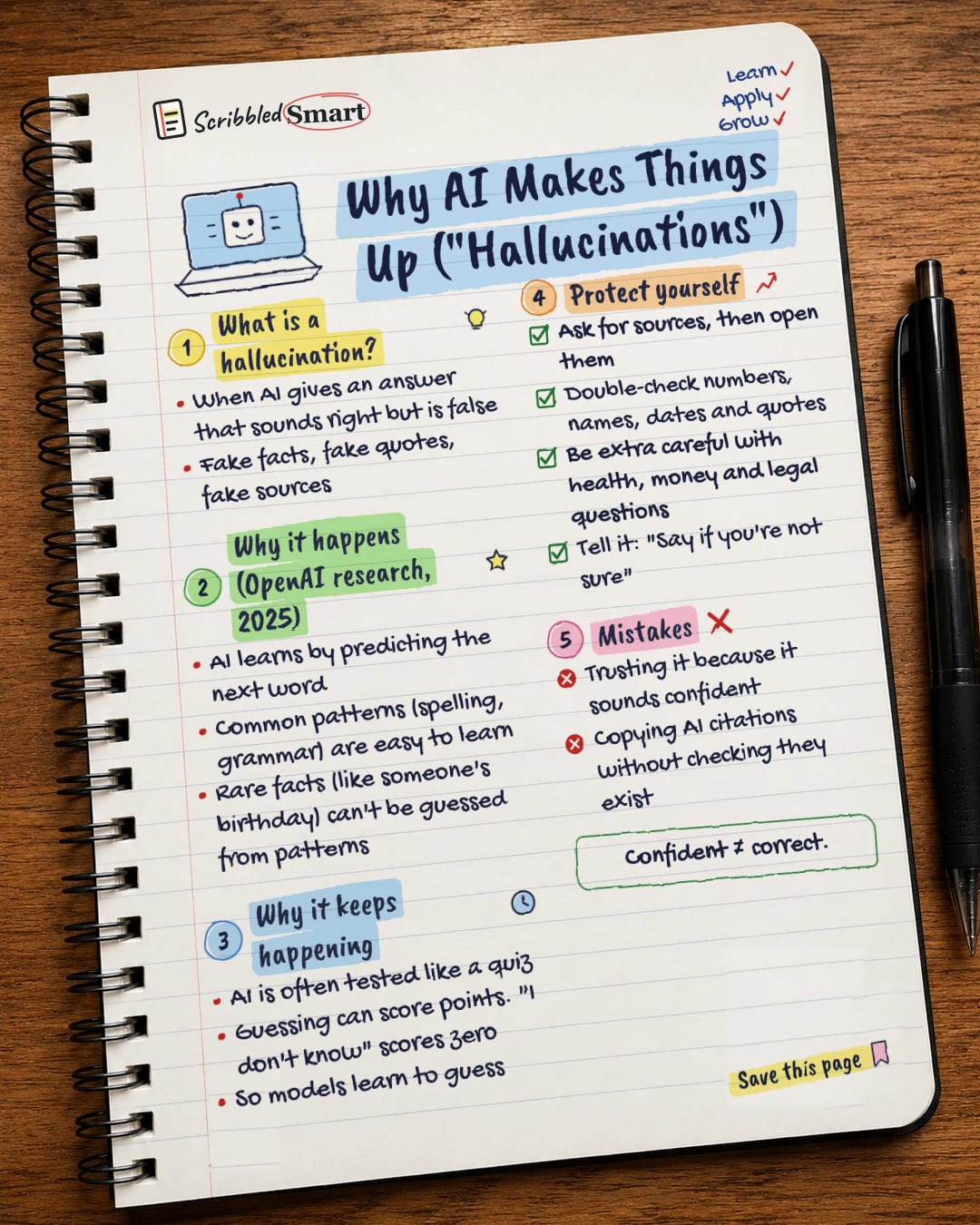
An AI hallucination is an answer that is plausible but wrong. It reads smoothly and confidently, so it is easy to believe.
It can take a few forms:
- Fake facts: a wrong date, number or name stated as if it were certain.
- Fake quotes: words put in someone's mouth that they never said.
- Fake sources: references, articles or links that look real but don't exist. In a June 2025 judgment, the High Court of England and Wales warned that AI tools can give plausible answers that are entirely wrong, "may cite sources that do not exist" and may quote passages that don't appear in a real source.
The word "hallucination" makes it sound rare or strange. It isn't. It is a normal side effect of how these tools are built.
Where the research comes from
The explanation below comes from a paper called "Why Language Models Hallucinate" by Kalai, Nachum, Vempala and Zhang, published in 2025 (arXiv 2509.04664). It is a joint piece of work from OpenAI and Georgia Tech, and OpenAI summarised it in a blog post on 5 September 2025.
Keep in mind that OpenAI builds chatbots, so this is a company explaining its own technology. That is why we say "OpenAI research" rather than presenting it as settled fact.
Why AI hallucinations happen: learning by prediction
Hallucinations start in training, because a chatbot learns by predicting the next word in huge amounts of text rather than by learning which statements are true. This stage is called pretraining. (Our guide to how AI chatbots work explains it step by step.)
Patterns are easy, rare facts are not
Some things follow clear patterns. Spelling and grammar are like this, and so is matching brackets correctly. With enough examples, the model gets these right, and these kinds of errors fade as models get bigger.
Other facts follow no pattern at all. OpenAI's example is a pet's birthday. Nothing in the rest of language tells you which day of the year it falls on. If a fact like that appears rarely in the training text, the model has no reliable pattern to predict it from. So it produces something that sounds like a birthday instead.
Why does AI keep making things up? It's tested like a quiz
Hallucinations persist because of how models are measured: many tests score them like a multiple-choice quiz, where a guess can earn points and a blank earns nothing.
OpenAI's blog uses the birthday example again. If a model guesses someone's birthday, it has a 1-in-365 chance of being right and scoring a point. If it says "I don't know", it is guaranteed zero. Over thousands of test questions, the guesser looks better on the scoreboard.
The authors argue that this teaches models to guess rather than admit uncertainty. The result is a tool that is rewarded for sounding sure.
What the numbers showed
OpenAI's blog compares two of its own models on a test called SimpleQA:
| Model | Said "I don't know" | Wrong answers |
|---|---|---|
| o4-mini | 1% | 75% |
| gpt-5-thinking-mini | 52% | 26% |
The model that held back far more often gave far fewer wrong answers. That is the trade-off in action: honesty about uncertainty means fewer confident mistakes.
The proposed fix
The paper suggests changing how models are scored. Confident errors should be penalised more than uncertainty, and "I don't know" should get partial credit. The authors also say accuracy will never reach 100%, because some questions simply can't be answered.
Does web search fix it?
Not completely. Letting a chatbot search the web or pull from documents (sometimes called retrieval, or RAG) reduces hallucinations, but it doesn't remove them.
How can you protect yourself from AI hallucinations?
The safest approach is to treat AI answers as a first draft and check the parts that matter. These habits follow from the research:
- ✓ Ask for sources, then open them. A link that doesn't work, or says something different, is a red flag.
- ✓ Double-check the specifics. Numbers, names, dates and quotes are where made-up details hide.
- ✓ Take extra care with health, money and legal questions. A wrong answer costs more here.
- ✓ Tell it to flag doubt. Add something like "Say if you're not sure" to your prompt. Expressing uncertainty is the fix the researchers propose.
Common mistakes
- ✗ Trusting it because it sounds confident. Confident does not mean correct. The tone of an answer tells you nothing about whether it is true.
- ✗ Copying AI citations without checking they exist. If you paste a reference into your work, open it first.
Related reading
- How to write a good AI prompt: prompts that ask for sources and flag uncertainty get more useful answers.
- The Dunning–Kruger effect: what research really says about confidence and skill in people.
- How to spot a scam message: another place where a confident tone is used to make you stop checking.
Sources
- OpenAI: Why language models hallucinate
- arXiv 2509.04664: Why Language Models Hallucinate (Kalai, Nachum, Vempala and Zhang, 2025)
- Judiciary of England and Wales: Ayinde v London Borough of Haringey, and Al-Haroun v Qatar National Bank (High Court, 6 June 2025)
How we checked this
Every fact in this article comes from the 3 sources listed above, checked against official or peer-reviewed sources where possible. AI tools help with drafting; a person checks every fact against the sources. How we research
- Published and checked
- Next check
- Yearly
General info. For health, money or legal questions, check with an official source or a qualified professional.
Spotted a mistake? Tell us and we'll fix it and log it on the corrections page.


