
On this page
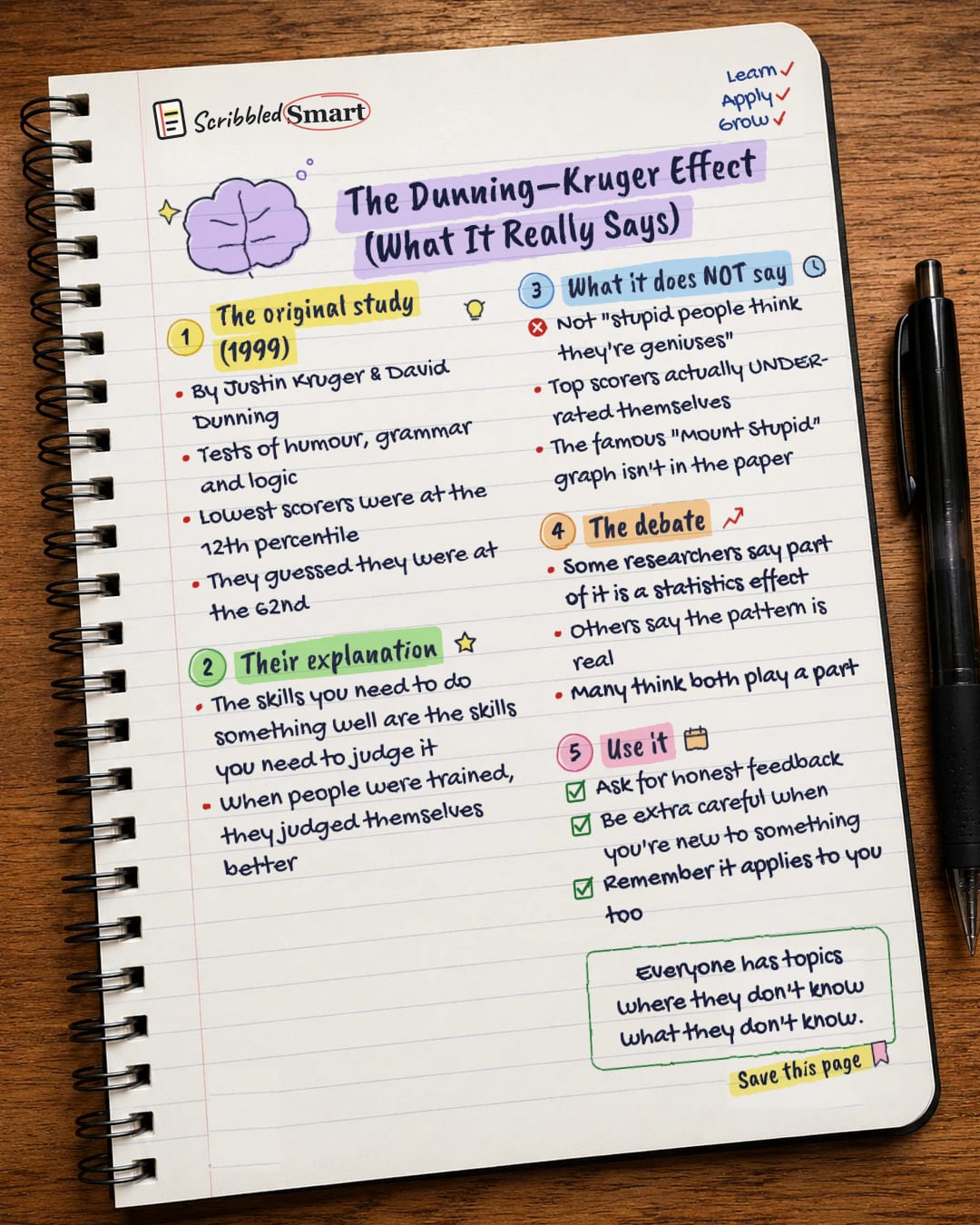
The Dunning-Kruger effect is the finding that people with the lowest skill at a task often rate their own performance far higher than it really is. In the original 1999 study, the lowest scorers were at the 12th percentile but guessed they were at the 62nd. It's widely quoted, and often misquoted. Here's what the study found, what it doesn't say, and why researchers still debate it.
The original Dunning-Kruger study (1999)
The effect comes from one paper: Justin Kruger and David Dunning's "Unskilled and unaware of it", published in 1999 in the Journal of Personality and Social Psychology (volume 77, issue 6, pages 1121–1134).
What they tested
Across four studies, people took tests of humour, grammar and logic. Then they estimated how well they had done compared with everyone else.
The headline result
People in the bottom quarter had scores that put them, on average, at the 12th percentile. But they estimated themselves to be at the 62nd. In other words, they thought they had done better than most people, when they had actually done worse than most.
A percentile shows where you rank out of 100. Being at the 12th percentile means you scored higher than about 12% of people.
Why does the Dunning-Kruger effect happen?
The authors' explanation is that the skills you need to do something well are the same skills you need to judge how well you did it. Psychologists call this kind of self-judging skill "metacognition".
If you don't know the rules of grammar, you also can't spot your own grammar mistakes. So you can't see how poorly you're doing.
Training helped
The paper also found that when people were trained and their skills improved, they got better at recognising their own limitations. This supports the idea that skill and self-judgement go together.
What the Dunning-Kruger effect does not say
It's not "stupid people think they're geniuses"
The study is often summed up as "stupid people think they're geniuses". That isn't what it found. The lowest scorers overrated themselves, but they didn't think they were the best. And the study measured specific skills (humour, grammar and logic), not general intelligence.
Top scorers underrated themselves
The paper gave equal weight to the other end. The highest scorers tended to underestimate how well they had done compared with others. This half of the finding gets far less attention.
The "Mount Stupid" graph isn't in the paper
You've probably seen a curve of confidence against experience with an early peak labelled "Mount Stupid". That graph isn't in the paper. The study reports average scores for four groups (quartiles), not a curve of confidence against experience.
Is it real, or just a statistics effect?
Researchers still disagree about how much of the effect is real and how much comes from the way the data is analysed. The fair answer is that it's neither fully proven nor fully debunked.
The statistics critique
Some researchers argue that part of the pattern is a statistical artefact, meaning it comes partly from how the numbers behave rather than from people's minds. The two ideas they point to most are regression to the mean and the better-than-average effect.
The first major statistical critique was by Krueger and Mueller in 2002, titled "Unskilled, unaware, or both?". Others, including Nuhfer and colleagues, have made similar points.
The case that the pattern is real
Other researchers say the pattern is genuine. Dunning himself returned to the topic in a 2011 chapter, "The Dunning-Kruger effect: On being ignorant of one's own ignorance".
Where that leaves us
Many researchers now think both explanations play a part: some of the pattern is statistics, and some is real. That's a less exciting story than the memes, but it's the honest one.
How to use the Dunning-Kruger effect
Everyone has topics where they don't know what they don't know. These habits help.
Ask for honest feedback
Because it's hard to judge your own skill, other people's feedback fills the gap.
Be extra careful when you're new to something
When you're new to something, you may not yet have the skills to judge your own work. That's the moment to check, ask and slow down. Study methods like active recall, where you test yourself, show you what you really know.
Remember it applies to you too
It's easy to spot in other people. The point is that it can apply to anyone, including you.
Common mistakes
- Using it as an insult. The study was about specific tasks, not about calling people stupid.
- Sharing the "Mount Stupid" graph. It isn't from the research.
- Forgetting the top scorers. In the study, the highest scorers tended to underrate themselves.
- Treating it as settled. There's a real debate about the statistics.
Related reading
- Cognitive biases: 7 thinking traps: Dunning-Kruger alongside six other well-known traps.
- Imposter syndrome explained: feeling like a fraud even when you're doing well.
- Why AI makes things up: confident answers aren't always correct ones.
Sources
- Kruger & Dunning (1999): Unskilled and unaware of it (PDF)
- Altmetric record: Kruger & Dunning (1999)
- University of Michigan: Dunning-Kruger, for researchers
- BPS The Psychologist: The Dunning-Kruger effect and its discontents
- RIOT IQ: What the research actually shows
- Wikipedia: Dunning-Kruger effect
An earlier source we could not re-check on 16 November 2026, so this article no longer relies on it: CASRAI: The Dunning-Kruger effect study metric critique (original page, no longer online: https://casrai.org/news/the-dunning-kruger-effect-study-metric-critique). The point it supported, that the "Mount Stupid" curve isn't in the paper, is also covered by Wikipedia above.
How we checked this
Every fact in this article comes from the 6 sources listed above, checked against official or peer-reviewed sources where possible. AI tools help with drafting; a person checks every fact against the sources. How we research
- Published and checked
General info, not professional advice.
Spotted a mistake? Tell us and we'll fix it and log it on the corrections page.


