
On this page
- Which everyday words are different?
- A word to watch: pavement
- How is British spelling different from American spelling?
- Grammar differences
- Is it "my team is" or "my team are"?
- The biggest British vs American English difference: pronunciation
- Tips for choosing between British and American English
- Related reading
- Sources
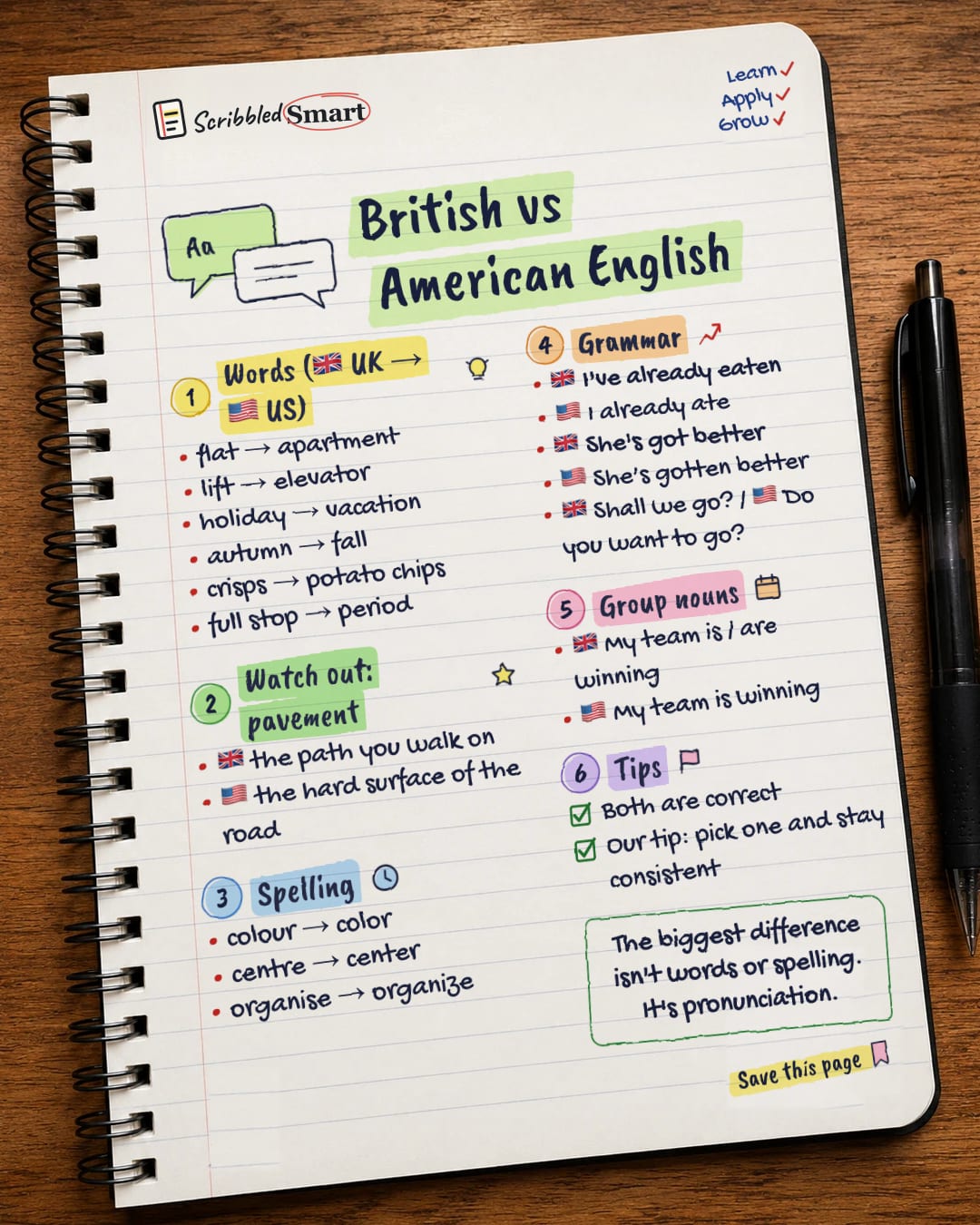
The differences between British vs American English show up in four places: some everyday words (flat vs apartment), some spellings (colour vs color), a few grammar patterns (got vs gotten) and, most of all, pronunciation. Neither version is more correct than the other. This guide sets out the main differences side by side, with notes from the British Council and the Longman Dictionary of Contemporary English.
Which everyday words are different?
Many common words simply change between the two. The Longman Dictionary and the British Council list these pairs.
| 🇬🇧 British English | 🇺🇸 American English |
|---|---|
| flat | apartment |
| lift | elevator |
| holiday | vacation |
| autumn | fall |
| crisps | chips (potato chips) |
| full stop | period |
| film | movie |
| pavement | sidewalk |
A few details from the dictionary:
- Crisps are very thin, flat, round pieces of potato. The American English word is "potato chips".
- Full stop is the British name for the point at the end of a sentence. Americans say "period". See our punctuation guide for how to use it.
- Apartment is labelled "especially American English", so you may hear it in the UK too.
A word to watch: pavement
"Pavement" is a word that means different things on each side of the Atlantic. The Longman Dictionary gives two senses:
- 🇬🇧 British English: a hard, level surface or path at the side of a road for people to walk on. Americans call this a "sidewalk".
- 🇺🇸 American English: the hard surface of a road.
So if a British friend says "walk on the pavement", they mean the path, not the road.
How is British spelling different from American spelling?
Some words are spelled differently in each variety. The Longman Dictionary and the British Council show these patterns.
| Pattern | 🇬🇧 British | 🇺🇸 American |
|---|---|---|
| -our / -or | colour | color |
| -re / -er | centre, theatre | center, theater |
| -ise / -ize | organise or organize | organize |
The -ise and -ize myth
It is easy to assume that "-ize" is American only. It isn't. The Longman Dictionary lists the word as "organize (also organise British English)". In other words, "organize" is correct in British English too; "organise" is simply an extra British option. Both are fine in the UK.
If you want to learn more spelling splits, our guide to affect vs effect covers practice vs practise.
Grammar differences
The grammar differences are small, and some are about what is typical rather than strict rules. These come from the British Council's guide to British and American English.
Present perfect vs past simple
The British Council says American English often uses the past simple with "already", "just" and "yet", where British English uses the present perfect.
- 🇬🇧 I've already eaten.
- 🇺🇸 I already ate.
Note the word "often". Americans do use "I've already eaten" too. This is a typical pattern, not a rule.
Got vs gotten
As the past participle of "get", British English uses "got" and American English uses "gotten".
- 🇬🇧 She's got better.
- 🇺🇸 She's gotten better.
However, "have got" meaning possession is used in both: "I've got two brothers" works in the UK and the US.
Shall vs should
The British Council says British English uses "Shall I…?" and "Shall we…?". American English rarely uses "shall" and prefers "Should I…?", "Can I…?" or "Do you want…?".
- 🇬🇧 Shall we go?
- 🇺🇸 Should we go?
Have a shower or take a shower
British English says both "have a shower" and "take a shower" (and the same for "break"). American English uses "take" only.
- 🇬🇧 I'll have a shower. / I'll take a shower.
- 🇺🇸 I'll take a shower.
Is it "my team is" or "my team are"?
Words for groups behave a little differently. The British Council says that in British English, a group noun like "team" can take a singular or plural verb. American English uses a singular verb.
- 🇬🇧 My team is winning. / My team are winning.
- 🇺🇸 My team is winning.
One exception: "police" always takes a plural verb, in both varieties. "The police are here."
The biggest British vs American English difference: pronunciation
The biggest gap is not in vocabulary or spelling. The British Council says: "The main difference between British English and American English is in pronunciation."
Tips for choosing between British and American English
Both varieties are correct, so your choice is about your reader.
- ✓ Both are correct. The British Council presents each form as typical of one variety. It does not rank them.
- ✓ Pick one and stay consistent. Choose one spelling, such as "colour" or "color", and use it throughout.
- ✓ Know your audience. Writing for UK readers? Use British spelling. Writing for US readers? Use American.
- ✗ Don't assume "-ize" is wrong in the UK. It is correct in British English too.
Related reading
- Punctuation in one page: full stop vs period, and the Oxford comma debate.
- Affect vs effect: includes the UK/US split for practice and practise.
- Useful everyday English phrases: with British-only phrases like "cheers" marked.
- Travel checklist for flying from the UK: handy if you are heading to the US.
Sources
- British Council LearnEnglish: British English and American English
- Longman Dictionary of Contemporary English: flat
- Longman Dictionary of Contemporary English: apartment
- Longman Dictionary of Contemporary English: lift
- Longman Dictionary of Contemporary English: holiday
- Longman Dictionary of Contemporary English: autumn
- Longman Dictionary of Contemporary English: crisp
- Longman Dictionary of Contemporary English: full stop
- Longman Dictionary of Contemporary English: pavement
- Longman Dictionary of Contemporary English: colour
- Longman Dictionary of Contemporary English: centre
- Longman Dictionary of Contemporary English: organize
How we checked this
Every fact in this article comes from the 12 sources listed above, checked against official or peer-reviewed sources where possible. AI tools help with drafting; a person checks every fact against the sources. How we research
- Published and checked
Spotted a mistake? Tell us and we'll fix it and log it on the corrections page.


