
On this page
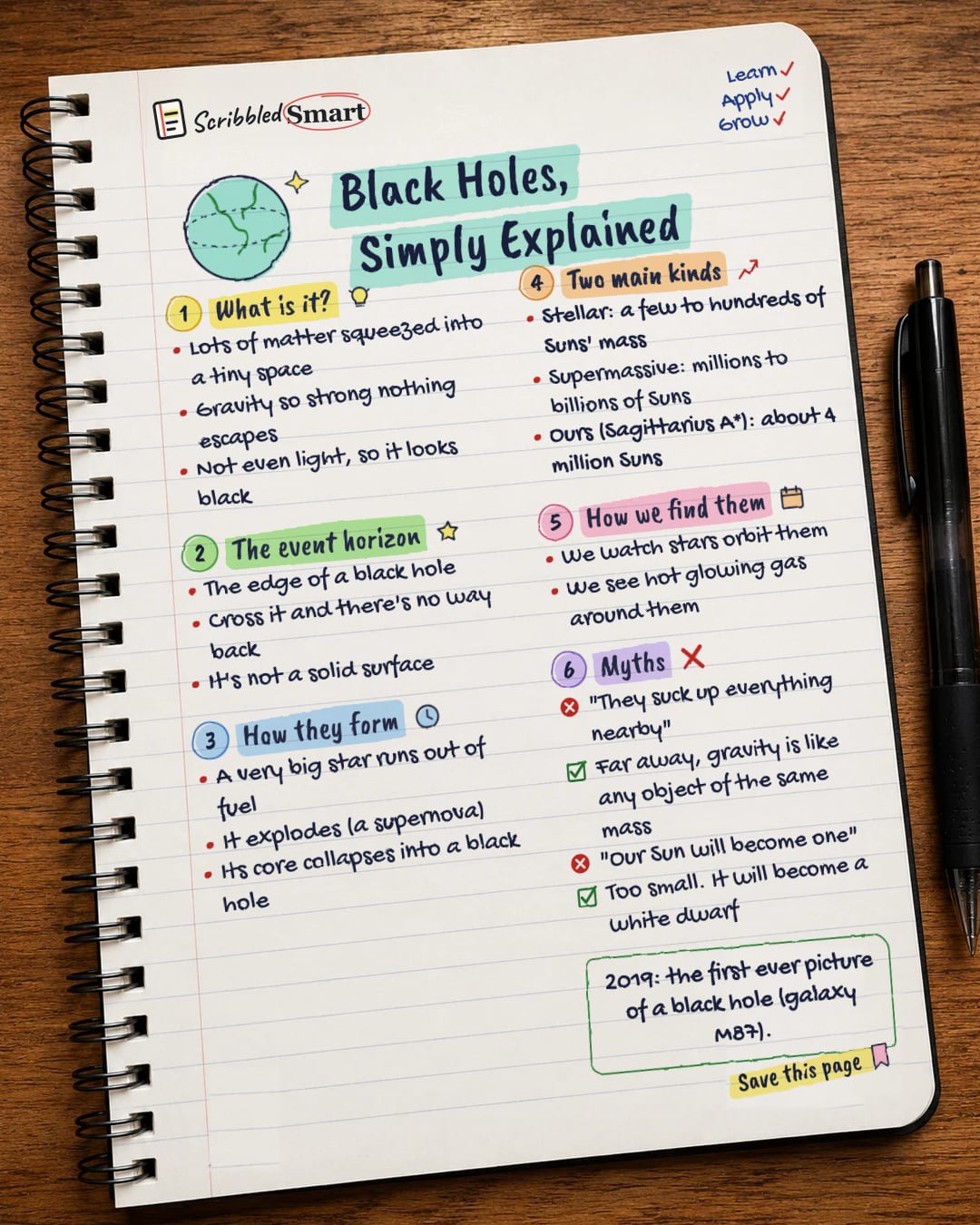
A black hole is a place where a lot of matter is packed into a tiny space, so its gravity is strong enough that nothing can escape, not even light. Because no light gets out, it looks black. That is black holes explained in two lines. Below, we go a little deeper: the event horizon, how black holes form, the two main kinds, how scientists find something that gives off no light, and two popular myths.
Black holes explained: what is a black hole?
A black hole is a huge amount of matter packed into a very small area, according to NASA. That squeezing makes its gravity extremely strong.
It is so strong that nothing can get out, including light. Light is how we see things, so with no light coming out, a black hole looks black.
What is the event horizon of a black hole?
The event horizon is the edge, or boundary, of a black hole, and anything that crosses it cannot come back. NASA is clear that it is not a solid surface. There is nothing there to stand on or crash into.
Inside the event horizon, gravity pulls everything in, even light. To fall into a black hole, an object has to cross this line. Once it has, there is no way back.
How big is the event horizon?
Smaller than you might think. NASA says a black hole with the same mass as our Sun would have an event horizon with a radius of only about 3 km. For comparison, the Sun's radius is about 700,000 km.
What happens close to one?
Objects that get close to a black hole are stretched out. NASA Space Place calls this spaghettification.
How do black holes form?
One type of black hole forms when a very big star dies. It happens in three steps:
- The star runs out of fuel.
- It explodes in a huge blast called a supernova.
- Its core collapses into a black hole.
Not every star can do this. NASA says a star of more than about 8 times the Sun's mass can end in a supernova. If the star had around 20 times the Sun's mass or more, its core collapses into a black hole.
The two main kinds of black hole
The two main kinds are stellar black holes, made from collapsed stars, and supermassive black holes, found at the centres of galaxies.
| Kind | Mass | Example |
|---|---|---|
| Stellar | A few to hundreds of times the Sun's mass | Formed from collapsed stars |
| Supermassive | Millions to billions of times the Sun's mass | Sagittarius A*, at the centre of our galaxy |
A quick note on that "millions" figure. NASA's own range for supermassive black holes starts at hundreds of thousands of Suns, and some scientists set the lower limit even lower. "Millions to billions" is the simple version.
Our galaxy, the Milky Way, has a supermassive black hole at its centre called Sagittarius A*. It is about 4 million times the mass of the Sun.
NASA also mentions other kinds. Intermediate-mass black holes are hard to confirm, and primordial black holes are unproven, so we leave them there.
How we find black holes
Scientists find black holes by watching what they do to the stars and gas around them. The black hole itself gives off no light, so its effects are the clue. NASA lists several clues:
- Orbiting stars: we watch stars moving around something we cannot see.
- Hot, glowing gas: hot gas in a disc around a black hole (an accretion disc) gives off light, including X-rays.
- Gravitational waves and lensing: NASA lists these as further ways scientists spot black holes.
The first pictures
In April 2019, the Event Horizon Telescope collaboration released the first ever picture of a black hole, in the galaxy M87. The image was made by that team of scientists, with NASA telescopes observing in support.
On 12 May 2022, the same collaboration released the first image of Sagittarius A*, the black hole at the centre of our own galaxy. NASA telescopes, including Chandra, watched it at the same time.
Black hole myths
NASA says two popular ideas about black holes are wrong.
Myth: "Black holes suck up everything nearby"
Not true. From far away, a black hole's gravity is no different from any other object of the same mass. It is not a cosmic vacuum cleaner.
NASA offers a thought experiment. If the Sun were swapped for a black hole of the same mass, Earth's orbit would not change. It would, though, get very dark and cold.
Myth: "Our Sun will become a black hole"
Also not true. NASA says the Sun is too small to become a black hole. It will end its life as a white dwarf instead. You can read more about our star in how the Sun and the planets fit together.
Related reading
- Why the Moon changes shape: the eight phases and the shadow myth.
- Why the sky looks blue: what sunlight does when it meets our air.
- The Feynman technique for checking you understand: explain black holes in your own words and see what sticks.
Sources
- NASA Science: Black Holes
- NASA Science: Black Hole Types
- NASA Space Place: What is a black hole?
- NASA: Why the Sun won't become a black hole
- NASA Imagine the Universe: Black Holes (archived)
- NASA JPL: Black Hole Image Makes History
- NASA: Sagittarius A*, NASA telescopes support Event Horizon Telescope in studying Milky Way's black hole
How we checked this
Every fact in this article comes from the 7 sources listed above, checked against official or peer-reviewed sources where possible. AI tools help with drafting; a person checks every fact against the sources. How we research
- Published and checked
- Next check
- Yearly (new discoveries).
Spotted a mistake? Tell us and we'll fix it and log it on the corrections page.


