
On this page
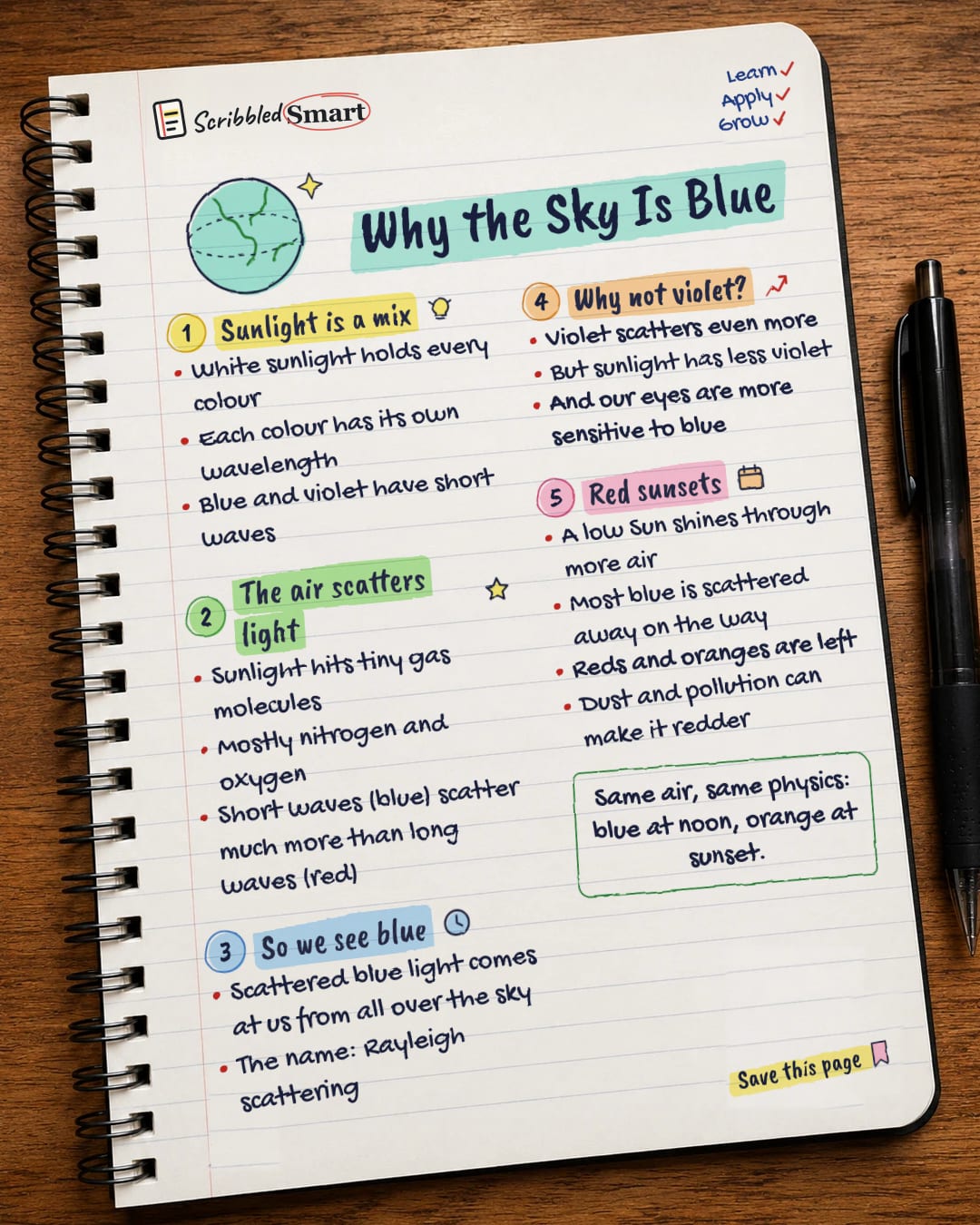
Why the sky is blue comes down to light meeting air: sunlight is a mix of colours, and the gas molecules in our air scatter the blue part far more than the red part, so blue light reaches your eyes from every direction overhead. Scientists call this Rayleigh scattering. The same air, and the same physics, also explain why sunsets glow orange and red. This page takes it step by step, using the Met Office and NASA as sources.
Sunlight is a mix of colours
Sunlight looks white, but it is really a mix of colours. The Met Office explains that each colour has its own wavelength.
Some colours have longer waves and some have shorter ones. Blue light has short waves. Violet has even shorter waves. Red has long waves.
Strictly speaking, sunlight holds the full visible spectrum. "Every colour" is the plain-English way of saying the same thing.
How the air scatters sunlight
On its way to the ground, sunlight runs into the gas molecules that make up our air. According to the Met Office, these are mostly nitrogen and oxygen.
When light hits these tiny molecules, it gets scattered, or bounced off in all directions. Not every colour scatters equally, though. Short waves, like blue, are scattered far more than long waves, like red.
Why the sky is blue: Rayleigh scattering
Because blue light is scattered so much more than the other colours, it ends up spread across the whole sky. NASA Space Place puts it like this: blue light is scattered more than the other colours because it travels as shorter, smaller waves.
So wherever you look in the daytime sky, scattered blue light is heading towards your eyes. The sky looks blue as a result.
This effect has a name: Rayleigh scattering. The Met Office uses this term for the scattering of sunlight by the tiny molecules in our air.
Why isn't the sky violet?
If violet has even shorter waves than blue, it should scatter even more, and it does. So why doesn't the sky look violet? The Met Office gives two simple reasons:
- There is less violet in sunlight to begin with.
- Our eyes are more sensitive to blue than to violet.
There is more to it than that. How our eyes see colour also depends on how the colour receptors in the eye respond. But those two reasons are the simple version.
Why are sunsets red and orange?
At sunrise and sunset, the Sun sits low in the sky. Its light then has to travel through much more of the atmosphere to reach you.
Along that longer path, most of the blue light is scattered away before it gets to your eyes. What is left is mostly the longer waves: reds and oranges. That is why a low Sun often paints the sky in warm colours.
NASA Space Place adds that dust, pollution and other tiny particles in the air (aerosols) can make the sky look even redder.
Same air, same physics
The midday blue and the evening orange are not two different effects. It is the same scattering in the same air. The only difference is how much air the sunlight passes through before it reaches you.
| Time of day | Path through the air | What you see |
|---|---|---|
| Midday | Shorter | Scattered blue from all over the sky |
| Sunset | Much longer | Most blue scattered away; reds and oranges left |
What about the sky on Mars?
Mars shows how much the air matters. NASA Space Place says Mars has a very thin atmosphere, made mostly of carbon dioxide and full of fine dust. Those particles scatter light differently from the gases in Earth's air.
The result is close to the reverse of what we see. By day, the Martian sky looks orange or reddish. As the Sun sets, the sky around the Sun takes on a blue-grey tone.
Common mistakes
- "Blue is the only colour in the sky." All colours are scattered; blue simply scatters much more than red.
- "Violet doesn't scatter." It scatters even more than blue. There is just less of it in sunlight, and our eyes favour blue.
- "Sunsets are a different effect." It is the same scattering, working through more air.
For more everyday science with a simple answer, see our page on why the Moon has phases.
Related reading
- The solar system: more about the Sun and Mars, the planet with a reddish sky.
- How planes fly: another look at what the air around us can do.
- Black holes, simply explained: where gravity is so strong that light can't escape.
Sources
How we checked this
Every fact in this article comes from the 2 sources listed above, checked against official or peer-reviewed sources where possible. AI tools help with drafting; a person checks every fact against the sources. How we research
- Published and checked
Spotted a mistake? Tell us and we'll fix it and log it on the corrections page.


