
On this page
Moon phases happen because, as the Moon travels round the Earth, we see different amounts of the half that the Sun is lighting up. The Moon itself never changes shape. Only our view of its sunlit side does. This page covers the simple version, the eight phases in order, the words that trip people up, and a common mistake about what causes them.
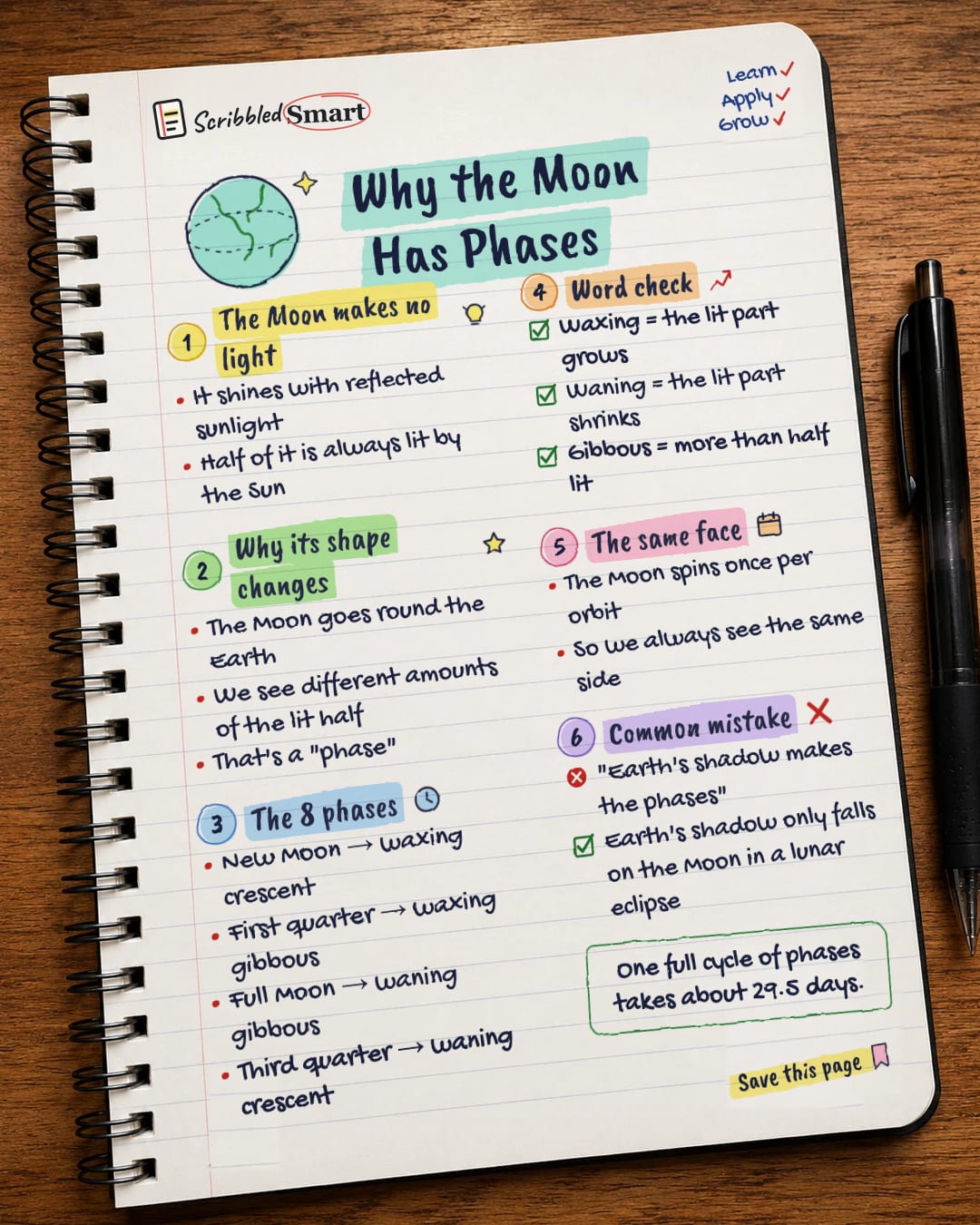
The Moon makes no light of its own
The Moon does not glow by itself. What we see at night is sunlight bouncing off its surface.
NASA puts it simply: the Moon is always half-lit by the Sun. Whatever shape it seems to be from Earth, one half of it is in sunlight.
Why do moon phases happen?
Moon phases come from the Moon's path round the Earth. As it moves along that path, we see a different share of its lit half.
Some nights we see almost none of the sunlit side. Other nights we see all of it. Every step in between is a "phase".
How long does it take?
NASA says one full cycle, from new Moon to new Moon, takes about 29.5 days.
The Moon goes round the Earth once in about 27.3 days. So one trip round the Earth and one full set of phases are not quite the same length. NASA gives both figures.
What are the 8 phases of the Moon in order?
NASA lists eight phases. They always come in the same order:
| Order | Phase | Is the lit part growing or shrinking? |
|---|---|---|
| 1 | New Moon | Start of the cycle |
| 2 | Waxing crescent | Growing |
| 3 | First quarter | Growing |
| 4 | Waxing gibbous | Growing, more than half lit |
| 5 | Full Moon | The turning point |
| 6 | Waning gibbous | Shrinking, more than half lit |
| 7 | Third (last) quarter | Shrinking |
| 8 | Waning crescent | Shrinking |
After the waning crescent, the cycle starts again with a new Moon.
Three words that explain the names
The phase names look tricky, but they are built from three plain words.
- Waxing: the lit part is growing, night by night.
- Waning: the lit part is shrinking.
- Gibbous: more than half of the face we see is lit.
Put them together and the names explain themselves. A "waxing gibbous" Moon is more than half lit and growing. A "waning gibbous" Moon is more than half lit and shrinking.
Why do we always see the same side of the Moon?
We see the same side of the Moon because it spins exactly once for every trip round the Earth. NASA calls this being tidally locked.
This confuses some people into thinking the Moon does not spin at all. It does. It just spins at the same pace as it orbits, so the same face keeps pointing towards us.
A small twist: libration
"Always the same side" is the simple version. NASA notes that, over time, an effect called libration lets us see a little more than half of the Moon's surface.
Is the far side dark?
No. The far side is often called the "dark side", but it gets just as much sunlight as the side we see. At new Moon, when the side facing us looks dark, the far side is fully lit.
The common mistake: Earth's shadow
Earth's shadow does not cause the Moon's phases. This is a common mix-up.
NASA explains phases only by how much of the sunlit half we can see. Earth's shadow only falls on the Moon during a lunar eclipse. That can only happen at full Moon. The rest of the time, the changing shape has nothing to do with Earth's shadow.
If space puzzles like this interest you, our page on how the Sun and planets fit together gives the bigger picture.
Tips for spotting the phases
- Track it for a month. Look at the Moon on a few nights a week and note its shape. You will see the cycle for yourself.
- Learn the three words first. Once you know waxing, waning and gibbous, the eight names are easy to remember.
- Remember the cycle length. New Moon to new Moon is about 29.5 days, so the same phase comes back roughly once a month.
Related reading
- Black holes, simply explained: the strangest objects in space, without the jargon.
- Why the sky looks blue by day and orange at sunset: more everyday sky science.
- The memory palace method: a memory trick for learning lists like the eight phases in order.
Sources
How we checked this
Every fact in this article comes from the 2 sources listed above, checked against official or peer-reviewed sources where possible. AI tools help with drafting; a person checks every fact against the sources. How we research
- Published and checked
Spotted a mistake? Tell us and we'll fix it and log it on the corrections page.


