
On this page
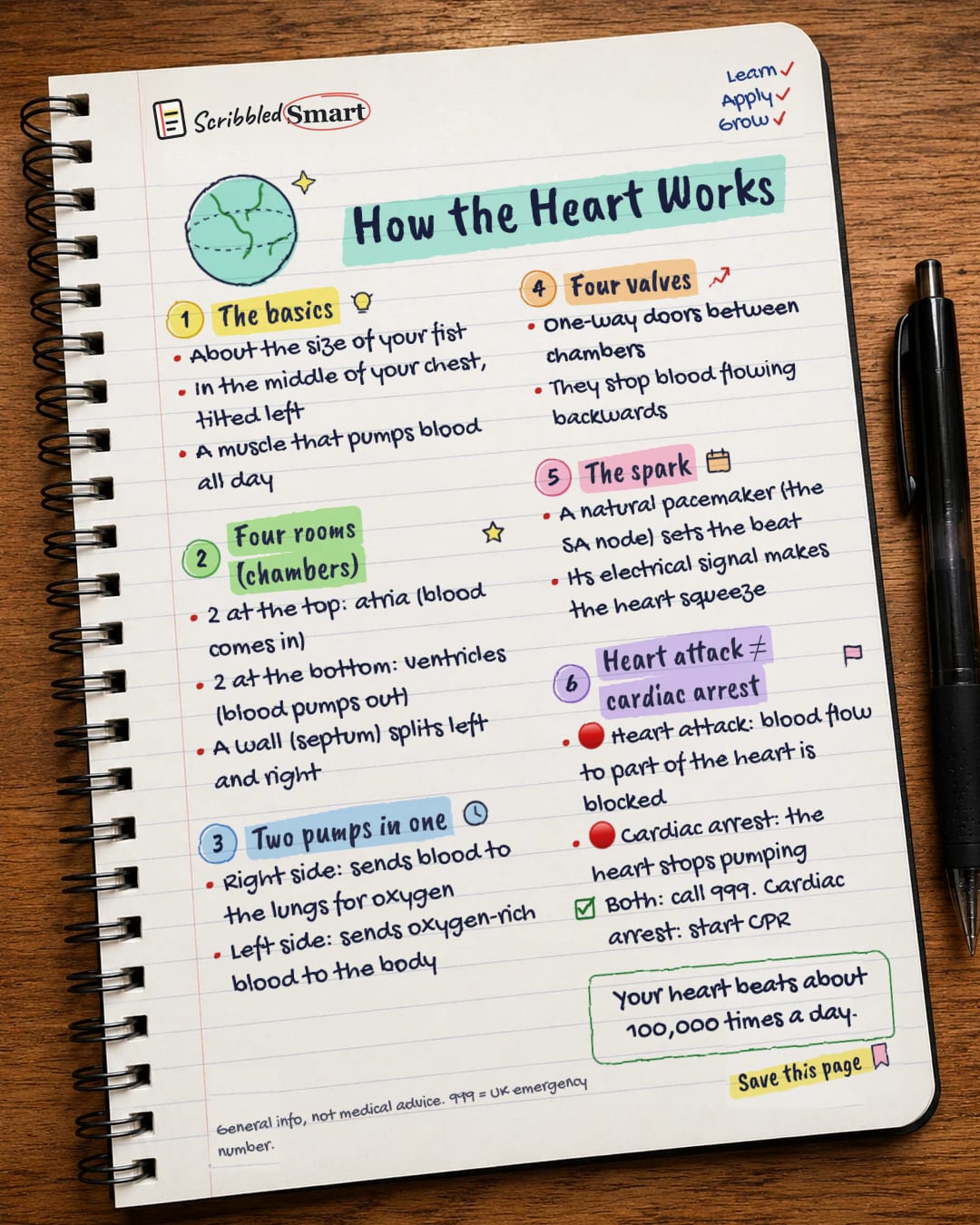
How the heart works fits in one sentence: it is a muscle that squeezes again and again, pushing blood to your lungs to pick up oxygen and then out to the rest of your body. It does this about 100,000 times a day, without you thinking about it. This guide walks through the parts, the two pumps, the valves and the electrical spark that keeps it all in time. It ends with a clear look at the difference between a heart attack and a cardiac arrest.
How big is the heart, and where is it?
Your heart is a fist-sized muscle in the middle of your chest, tilted slightly to the left. That is how the British Heart Foundation (BHF) describes it.
It is a muscle, and its job is to pump blood around your body all day and night. The heart wall has three layers:
- Pericardium: the outer layer.
- Myocardium: the thick muscle layer that does the pumping.
- Endocardium: the inner lining.
Your heart rate is not fixed. The BHF notes it changes with activity and emotion, which is why it speeds up when you run for a bus or feel nervous.
There is no single figure for a normal resting heart rate that every source agrees on. NHS pages give 60 to 100 beats a minute for adults, but one NHS Scotland manual gives 60 to 80, and fit people can be lower. Treat any figure as a rough guide, and speak to a doctor if you are worried about your heart rate.
Four rooms: the heart chambers
The heart has four chambers: two on top that take blood in and two below that pump it out. Think of them as four rooms in a small house.
- Two atria (top): blood comes in here.
- Two ventricles (bottom): blood is pumped out from here.
A wall of muscle called the septum runs down the middle. It splits the heart into a left side and a right side, so the two sides do not mix.
How the heart works as two pumps in one
The heart is really two pumps joined side by side: the right one serves your lungs and the left one serves your body. Picturing it this way makes the rest easy to follow.
The right side: to the lungs
The right side receives low-oxygen blood coming back from the body. It pumps this blood to the lungs, where it picks up oxygen.
The left side: to the body
The left side receives the oxygen-rich blood back from the lungs. It pumps it out to the rest of your body, from your brain to your toes.
The pipes that carry it
Blood travels in three kinds of vessels:
- Arteries carry blood away from the heart.
- Veins bring blood back to the heart.
- Capillaries are the tiny vessels that link the two.
Four valves: one-way doors
Four valves keep blood flowing in one direction through the heart. Think of them as one-way doors that open to let blood through, then close to stop it flowing backwards.
The BHF names the four valves:
- Tricuspid: between the right atrium and the right ventricle.
- Mitral: between the left atrium and the left ventricle.
- Pulmonary
- Aortic
Together they keep blood moving in one direction through the heart.
What makes your heart beat?
Each heartbeat starts with an electrical signal from a small area of the heart called the sinoatrial (SA) node, often called the heart's natural pacemaker.
The BHF explains that the SA node sets the heartbeat. Its electrical signals make the heart muscle contract, or squeeze. That squeeze is what pushes blood out of the chambers and around your body.
What is the difference between a heart attack and a cardiac arrest?
A heart attack is a problem with blood supply to the heart, while a cardiac arrest is the heart suddenly stopping. The two terms are easy to mix up, but the difference matters.
| Heart attack | Cardiac arrest | |
|---|---|---|
| What happens | Blood supply to part of the heart muscle is suddenly blocked, often by a clot | The heart suddenly stops pumping blood around the body |
| What kind of problem | A blood flow problem | An electrical problem |
| What to do | Call 999 | Call 999, start CPR and use a defibrillator if one is available |
The two are linked, though. The BHF notes that a heart attack can lead to a cardiac arrest.
🇬🇧 999 is the UK emergency number. If you live elsewhere, use your local emergency number. For more on what to do while you wait for help, see our guide to first aid in five common emergencies.
Common mistakes
Three mix-ups to avoid.
- Thinking the heart is on the far left. It sits in the middle of the chest, just tilted to the left.
- Mixing up heart attack and cardiac arrest. One is a blocked blood supply; the other is the heart stopping. Both are emergencies.
- Waiting to see if it passes. For either one, the BHF advice is to call 999.
Related reading
- What stress does to your body: the physical side of stress, explained simply.
- A beginner workout plan based on UK guidelines: simple ways to get your heart working.
- How vaccines work: how your immune system learns to protect you.
Sources
- British Heart Foundation: How a healthy heart works
- British Heart Foundation, Heart Matters: Heart attack and cardiac arrest, what's the difference?
- NHS: Supraventricular tachycardia (SVT)
How we checked this
Every fact in this article comes from the 3 sources listed above, checked against official or peer-reviewed sources where possible. AI tools help with drafting; a person checks every fact against the sources. How we research
- Published and checked
General info, not medical advice. 999 = UK emergency number.
Spotted a mistake? Tell us and we'll fix it and log it on the corrections page.


