
On this page
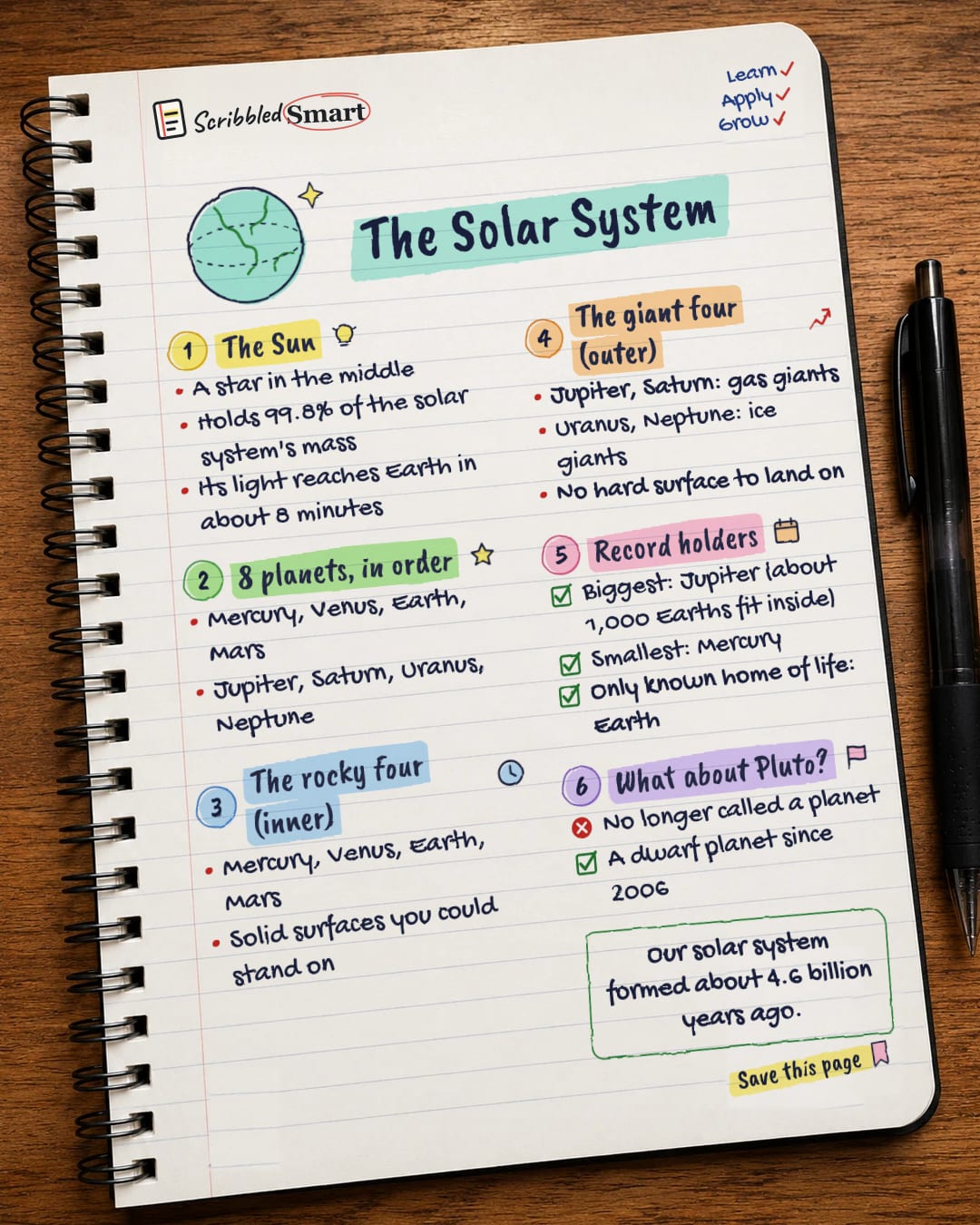
Our solar system has a star at its centre, the Sun, and eight planets: Mercury, Venus, Earth, Mars, Jupiter, Saturn, Uranus and Neptune. The four nearest the Sun are small and rocky. The four further out are giants with no solid ground. Below you will find the planets in order, a few record holders, an easy way to remember them, and the story of why Pluto lost its planet title.
The Sun: the star at the centre of the solar system
The Sun is the star at the centre of the solar system. NASA classes it as a yellow dwarf star (type G2 V).
It is by far the heaviest thing here. NASA says the Sun accounts for 99.8% of all the mass in the solar system. Everything else together adds up to the remaining 0.2%.
How far away is the Sun?
Earth is on average about 150 million km (93 million miles) from the Sun. Astronomers call this distance one astronomical unit.
Sunlight crosses that gap in about 8 minutes. NASA gives the figure as about 8.35 minutes. So the sunlight reaching you now left the Sun about 8 minutes ago.
How old is it?
NASA says the solar system formed about 4.6 billion years ago. One small note: NASA's Sun page gives the Sun's age as 4.5 billion years in one place and about 4.6 billion in another. We use NASA's figure for when the solar system formed.
The 8 planets in order
From nearest the Sun to furthest away, the planets are:
- Mercury
- Venus
- Earth
- Mars
- Jupiter
- Saturn
- Uranus
- Neptune
One memory trick: "My Very Easy Method Just Speeds Up Naming." The first letter of each word matches a planet, in order.
Which planets are rocky?
The four inner planets are rocky, with solid surfaces you could, in theory, stand on. NASA calls them the terrestrial planets.
Earth is one of them, and it holds a special record: NASA says it is the only place we know of with life.
Which planets are gas giants and ice giants?
The four outer planets are giants, and none of them has a hard surface to land on. They come in two types:
| Type | Planets |
|---|---|
| Gas giants | Jupiter, Saturn |
| Ice giants | Uranus, Neptune |
Jupiter is home to the Great Red Spot. NASA describes it as a storm bigger than Earth that people have watched for more than 300 years.
Between Mars and Jupiter lies the asteroid belt. NASA says the largest object in it is Ceres, which also comes up again below.
Record holders in the solar system
Each of these planets holds a main record:
| Record | Planet | Detail |
|---|---|---|
| Biggest | Jupiter | About 1,000 Earths could fit inside it |
| Smallest | Mercury | Also the closest planet to the Sun |
| Only known life | Earth | The only place we know of with life |
A quick note on Jupiter's number. NASA's "1,000 Earths" works if you picture Jupiter as a hollow shell you could fill with Earths. It is a way to show size, not weight.
What happened to Pluto?
Pluto is no longer counted as a planet. In 2006, the International Astronomical Union (IAU) reclassified it as a dwarf planet.
Pluto is not alone. NASA lists five dwarf planets recognised by the IAU: Ceres, Pluto, Haumea, Makemake and Eris. More possible dwarf planets exist, so that count could grow.
Common mistakes
- Calling Pluto the ninth planet. It has been a dwarf planet since 2006.
- Thinking you could land on Jupiter. The giant planets have no hard surface.
- Mixing up gas and ice giants. Jupiter and Saturn are gas giants; Uranus and Neptune are ice giants.
The Sun, by the way, will never collapse into a black hole. Our guide to black holes, simply explained shows why it is too small.
FAQ
What are the 8 planets in order from the Sun?
The eight planets, from nearest the Sun to furthest, are Mercury, Venus, Earth, Mars, Jupiter, Saturn, Uranus and Neptune. The first four are rocky planets with solid surfaces. The last four are giants. A handy way to remember the order is "My Very Easy Method Just Speeds Up Naming".
Is Pluto still a planet?
No. Pluto has been classed as a dwarf planet since 2006, when the International Astronomical Union reclassified it. NASA now lists it as one of five dwarf planets recognised by the IAU, alongside Ceres, Haumea, Makemake and Eris. Other possible dwarf planets exist, so the number may change.
What is the biggest planet in the solar system?
Jupiter is the biggest planet in the solar system. NASA says about 1,000 Earths could fit inside it, if you picture Jupiter as a hollow shell. It is a gas giant with no hard surface, and its Great Red Spot is a storm bigger than Earth that has been watched for more than 300 years.
How long does sunlight take to reach Earth?
Sunlight takes about 8 minutes to reach Earth. NASA gives the more exact figure as about 8.35 minutes. In that time, the light travels around 150 million km, which is Earth's average distance from the Sun and is known as one astronomical unit.
How old is the solar system?
NASA says the solar system formed about 4.6 billion years ago. NASA's Sun page gives the Sun's own age as both 4.5 billion and about 4.6 billion years in different places, so you may see either figure. Here we use NASA's stated date for the formation of the solar system.
Related reading
- Why the Moon has phases: what our nearest neighbour is really doing each month.
- Why the sky is blue: what happens to sunlight once it reaches Earth's air.
- The memory palace method: another way to memorise lists like the planets in order.
Sources
How we checked this
Every fact in this article comes from the 4 sources listed above, checked against official or peer-reviewed sources where possible. AI tools help with drafting; a person checks every fact against the sources. How we research
- Published and checked
- Next check
- If the IAU changes planet definitions.
Spotted a mistake? Tell us and we'll fix it and log it on the corrections page.


