
On this page
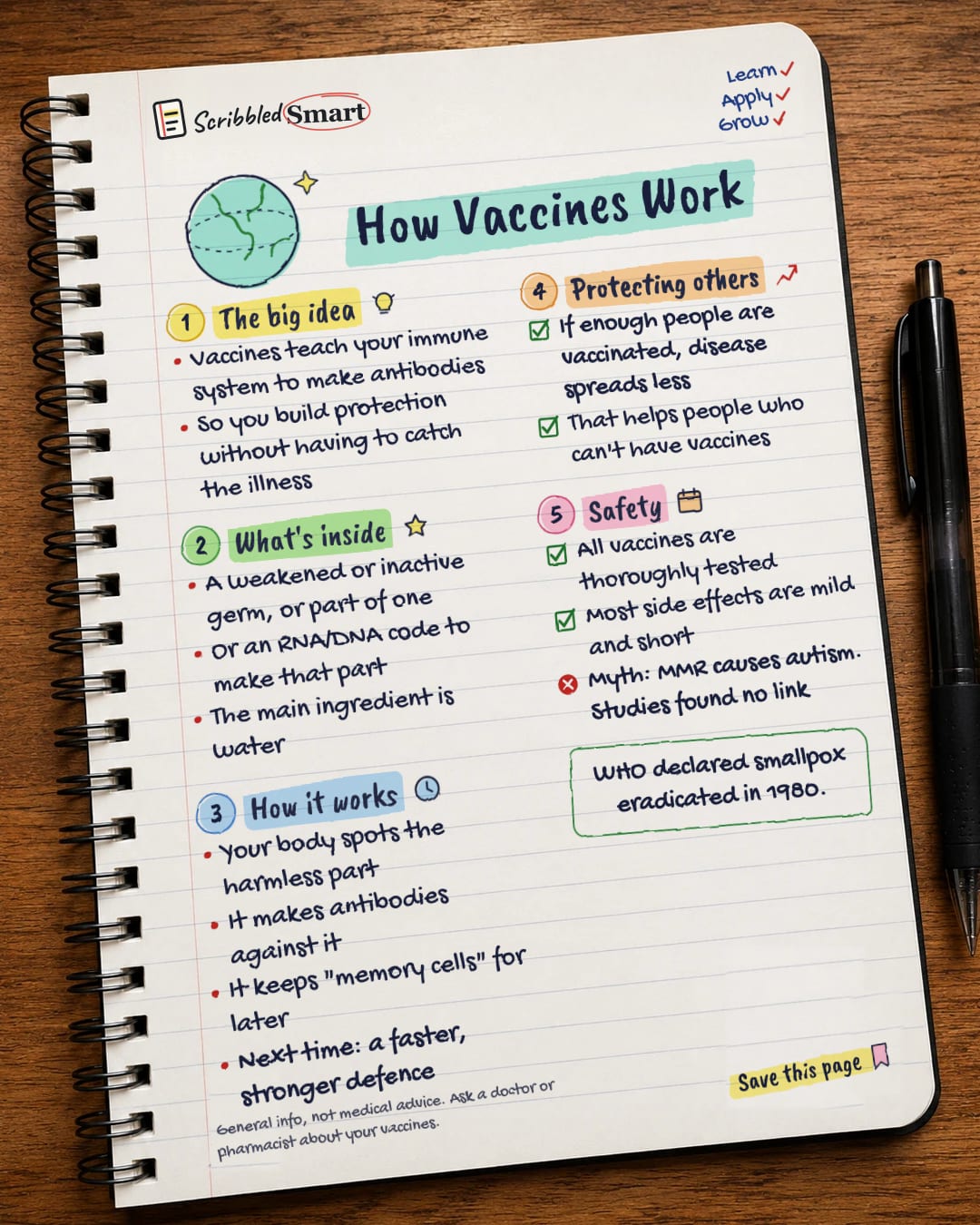
How vaccines work, in one line: they teach your immune system to make antibodies against a disease, so you build protection without having to catch the illness first. Your body then remembers what it learned. This guide explains what is inside a vaccine, what happens in your body after the jab, how vaccines protect other people too, and what the NHS and the World Health Organization (WHO) say about safety.
The big idea behind vaccines
A vaccine gives your immune system a safe practice run. The NHS says vaccines teach your immune system how to create antibodies that protect you from diseases.
Safety is the whole point. You get the protection without the risk of catching the illness itself.
What's inside a vaccine
A vaccine holds something harmless that looks like the germ, so your body learns to spot it. WHO describes a few options:
- A whole germ that has been weakened or made inactive.
- Part of a germ (called an antigen), weakened or inactive.
- A code (RNA or DNA): newer vaccines carry a blueprint that tells your own cells to make the antigen.
It may surprise you that the NHS says the main ingredient in vaccines is water.
Types of vaccine
Vaccines are grouped into types, and you may see these names on health websites or vaccine leaflets:
- Live-attenuated
- Inactivated
- Subunit
- mRNA
- Viral vector
How vaccines work inside your body
Vaccines work in four steps, according to WHO:
- Your body spots the harmless part. This is the antigen from the vaccine.
- It makes antibodies against it. These are what protect you.
- It keeps "memory cells". These remember the germ for later.
- Next time, it reacts faster and harder. If you meet the real germ, your immune system responds faster and more strongly.
Some vaccines need several doses, given weeks or months apart. WHO notes this. Your GP or pharmacist can tell you what applies to you.
How do vaccines protect other people?
Vaccines protect the people around you as well as you. The NHS and WHO both explain that if enough people are vaccinated, it becomes harder for a disease to spread.
That matters for people who cannot have vaccines. Fewer cases around them means less chance of catching the illness. WHO is careful to add that this "herd immunity" does not give them full protection. It helps, but it is not a guarantee.
Are vaccines safe?
The NHS says all vaccines are thoroughly tested, and most side effects are mild and do not last long.
Checking carries on after approval too. 🇬🇧 In the UK, the NHS says the MHRA watches for rare side effects once a vaccine is in use. Serious allergic reactions are rare, and the NHS says the people giving vaccines are trained to treat them.
The MMR myth
One myth you may have heard is that the MMR vaccine causes autism. The NHS is clear that there is no evidence of a link between MMR and autism. When a health claim sounds convincing, check it against a trusted source such as the NHS. Our guide to the thinking traps we all fall into explains why a claim can feel true even when it isn't.
What have vaccines achieved?
Vaccines have changed what illness looks like around the world. WHO says immunisation prevents 3.5 to 5 million deaths a year, and vaccines now exist for more than 30 diseases.
Smallpox is the stand-out case. WHO declared it eradicated (wiped out) in 1980, and says it is the only infectious disease to have been eradicated. WHO credits two things working together: widespread immunisation and surveillance.
🇬🇧 The NHS lists smallpox, polio and tetanus among the diseases that are now rare or gone in the UK since vaccines arrived.
FAQ
How do vaccines work in simple terms?
Vaccines teach your immune system to make antibodies against a disease without you having to catch it. Your body spots a harmless part or version of the germ, makes antibodies against it, and keeps memory cells. If you later meet the real germ, your immune system can respond faster and more strongly than it would have otherwise.
What is actually in a vaccine?
A vaccine contains a weakened or inactive germ, a weakened or inactive part of one (an antigen), or a code made of RNA or DNA that tells your body to make that part. According to the NHS, the main ingredient in vaccines is water.
Are vaccine side effects common?
The NHS says most side effects of vaccination are mild and do not last long. Serious allergic reactions are rare, and staff who give vaccines are trained to treat them. In the UK, the MHRA keeps watching for rare side effects after a vaccine has been approved. If you have concerns, talk to your GP or pharmacist.
Does the MMR vaccine cause autism?
No. The NHS says there is no evidence of a link between the MMR vaccine and autism. The NHS also says all vaccines are thoroughly tested, and safety checks carry on after a vaccine is approved, with the MHRA watching for rare side effects.
What is herd immunity?
Herd immunity is the protection a community gets when enough people are vaccinated that a disease struggles to spread. It helps people who cannot have vaccines, because there are fewer cases around them. WHO says it does not give those people full protection, so it lowers their risk rather than removing it.
Related reading
- How the heart works: another simple guide to what goes on inside your body.
- First aid basics for five emergencies: what to do while you wait for help.
- Why AI chatbots make things up: why it pays to check health claims against a trusted source.
Sources
- NHS: Why vaccination is safe and important
- WHO: How do vaccines work?
- WHO: Vaccines and immunization
- WHO: Smallpox
How we checked this
Every fact in this article comes from the 4 sources listed above, checked against official or peer-reviewed sources where possible. AI tools help with drafting; a person checks every fact against the sources. How we research
- Published and checked
- Next check
- Yearly.
General info, not medical advice. Ask your GP or pharmacist about your vaccines.
Spotted a mistake? Tell us and we'll fix it and log it on the corrections page.


