
On this page
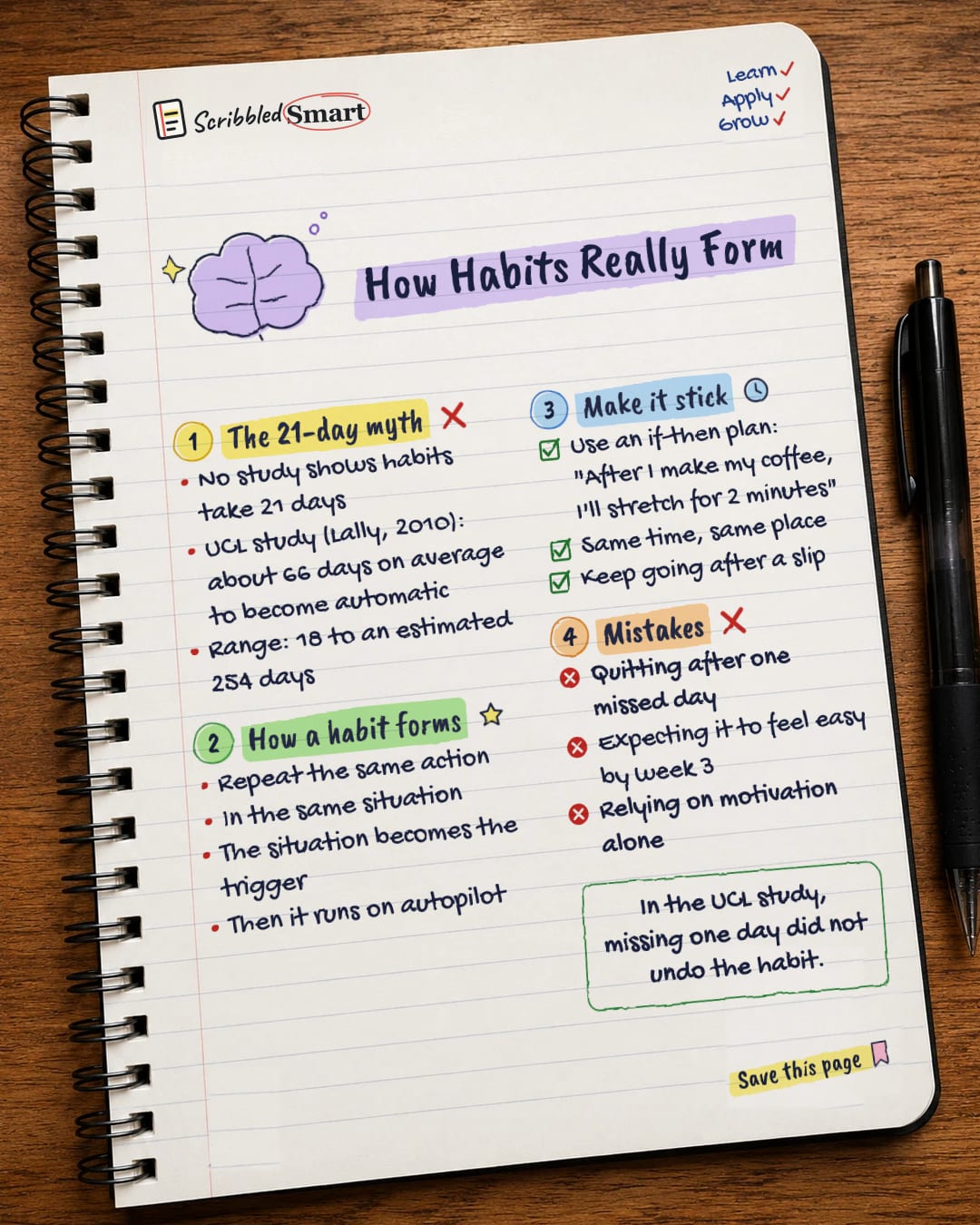
Habits form when you repeat the same action in the same situation until the situation itself starts to trigger it, and then it runs on autopilot. That takes longer than the famous "21 days". In a UCL study, it typically took about 66 days for a new daily action to become automatic, with a huge range between people. This article explains how habits form, where the numbers come from, and how to make a new habit stick.
Does it really take 21 days to form a habit?
The 21-day rule is a myth: no study shows that habits take 21 days. The researchers behind the best-known habit study say there is no evidence for it. The UCL Behavioural Science and Health blog, written by the study's authors, and the British Psychological Society's Research Digest both make the same point.
A longer timeline is normal. If week three still feels like hard work, nothing has gone wrong.
How long does it take to form a habit?
The UCL study found that a new daily behaviour took a median of about 66 days to become automatic, with very wide differences between people. It is Lally and colleagues (2010), "How are habits formed: Modelling habit formation in the real world", published in the European Journal of Social Psychology.
- Who took part: 96 participants.
- What they did: each chose one daily behaviour and tracked it for 84 days.
- What was measured: how automatic the behaviour felt over time.
What "66 days" really means
The headline figure of about 66 days is a median, the middle value. It comes only from the participants whose data fitted the researchers' model, which was a small group of about 39 students. Our page says "on average" to keep it simple.
So treat 66 days as a rough guide, not a rule. Never take it to mean that a habit takes exactly 66 days.
The range is the real lesson
Times ranged from 18 days to an estimated 254 days. The 254-day figure is a statistical projection, because the study itself only lasted 84 days. That is why we say "estimated".
The takeaway is simple: people vary a lot. Some habits click in weeks. Others take many months.
Secondary reports of the study say simple behaviours, like drinking water, became automatic faster than effortful ones, like exercise. We have not yet confirmed this in the paper itself, so take it as a likely pattern rather than a proven one.
How habits form, step by step
Habits form when a repeated action becomes linked to the situation you do it in. The science is summed up well in a review by Wood and Rünger (2016), "Psychology of Habit", in the Annual Review of Psychology. In simple steps:
- Repeat the same action.
- In the same situation. This could be the same time, place or thing you were just doing.
- The situation becomes the trigger. Repeating an action in a stable context links it to cues around you.
- Then it runs on autopilot. The cue starts the behaviour automatically.
Why motivation alone isn't enough
Wood and Rünger also explain that habits are triggered by context, without needing the original goal. Once a habit has formed, you don't have to feel motivated to do it. The situation does the work.
That is why relying on motivation alone is a mistake. Our page on how motivation really works looks at the other side of this. Motivation helps you start. The repeated cue is what keeps you going.
What about the "habit loop"?
You may have seen the "habit loop" of cue, routine and reward. It comes from Duhigg's popular book "The Power of Habit". It is a useful way to think, but it is a popular framing, not the research model described above.
How to make a habit stick
Three things help: a clear cue, a stable routine and not giving up after a slip.
Use an if-then plan
An if-then plan links a new action to a clear cue. Researchers call these "implementation intentions". For example: "After I make my coffee, I'll stretch for 2 minutes."
A meta-analysis by Gollwitzer and Sheeran (2006) found that if-then plans help. A later, larger meta-analysis by Sheeran, Listrom and Gollwitzer found smaller effects once they corrected for bias. So the effect is real, but probably smaller than first thought.
"Habit stacking", where you say "after X, I do Y", is a practical form of an if-then plan.
Same time, same place
Keep the situation stable. The more consistent the cue, the more chance it has to become the trigger.
Keep going after a slip
In the UCL study, missing one day did not significantly affect habit formation. One missed day is not failure. The study's authors did note that very inconsistent people didn't form habits, so the aim is to get back on track quickly.
Common habit mistakes
- Quitting after one missed day. The UCL research suggests one slip doesn't undo your progress.
- Expecting it to feel easy by week 3. The typical time in the study was about 66 days, and some people took much longer.
- Relying on motivation alone. Habits run on cues and repetition, not on motivation.
- Changing the situation every day. Without a stable cue, there is nothing for the habit to attach to.
Related reading
- Spaced repetition: repetition over time, applied to learning.
- Beginner workout plan: a good first habit to try with an if-then plan.
- Why we procrastinate: what gets in the way of starting.
Sources
- BPS Research Digest: How to form a habit
- UCL Behavioural Science & Health blog (2012)
- The Behavioral Scientist: What Lally et al. (2010) actually found
- Wood & Rünger (2016): Psychology of Habit (PDF)
- UCL Discovery: Lally comment (PDF)
- The Behavioral Scientist: Implementation intentions
How we checked this
Every fact in this article comes from the 6 sources listed above, checked against official or peer-reviewed sources where possible. AI tools help with drafting; a person checks every fact against the sources. How we research
- Published and checked
General info, not professional advice.
Spotted a mistake? Tell us and we'll fix it and log it on the corrections page.


